
Copenhagen summit punts on a continent‑wide ‘aerial wall’ as France detains crew of Russia‑linked tanker suspected of guiding raids
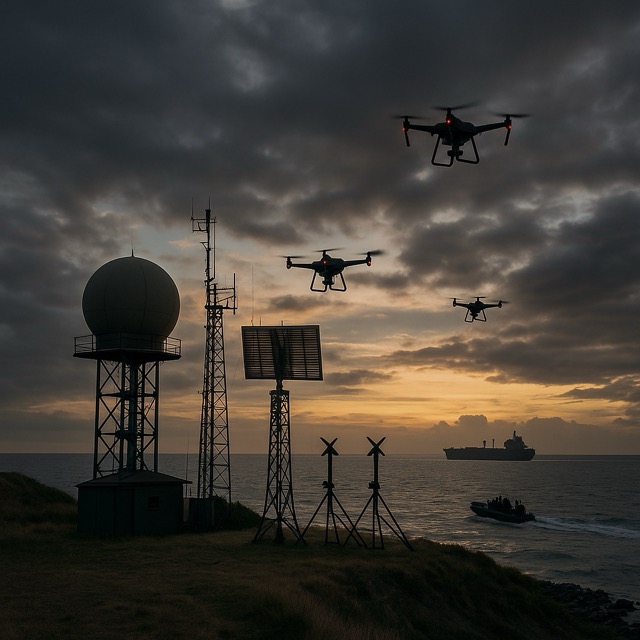
Europe’s political heart spent the week beating in Copenhagen, where leaders wrestled with a problem that keeps hopping borders: small, cheap drones of unclear origin buzzing sensitive sites, closing airports, and probing air‑defense seams. After days of tense consultations, Germany and Denmark signaled a tougher line—saying they are prepared to shoot down hostile drones in European airspace—yet the continent’s grand plan for an integrated ‘aerial wall’ was nudged into further technical work, not finalized policy.
The immediate catalyst was a volley of mysterious drone incursions over Denmark that, according to officials, temporarily shut parts of civilian airspace and spooked military facilities from Jutland to Zealand last week. NATO allies surged surveillance aircraft and counter‑drone teams to help Denmark secure the capital ahead of this week’s European Political Community and EU meetings. Copenhagen’s message hardened: what had looked like nuisance flights now fits a broader pattern of hybrid pressure on Europe that also includes cyberattacks, maritime sabotage and disinformation.
“We are in a hybrid war and we must arm ourselves accordingly,” Danish Prime Minister Mette Frederiksen said as leaders gathered, casting the spate of drone sightings as ‘tests’ of allied reactions. Berlin, under mounting domestic pressure after sightings at ports and defense sites, said it is moving to clarify rules of engagement so security forces can down unauthorized drones that threaten people or critical infrastructure. The intention, German officials stress, is to make legal authorities match the physics of drones: minutes matter, and a police helicopter or a court order often arrives too late.
If rhetoric sounded steely, policy proved slower. A flagship concept—shorthand ‘aerial wall’—to stitch together sensors, jammers and interceptors from the Baltic to the Black Sea drew broad political support but was sent back to defense ministries and the European Commission to nail down financing, governance and technical standards. Officials say they aim to present a concrete, costed roadmap this autumn, but disagreements persist over who pays, who commands, and how to integrate national assets with NATO’s air‑policing architecture.
The drama spilled beyond meeting rooms. Off France’s Atlantic coast, naval commandos boarded a Russia‑linked oil tanker suspected of sailing under a false flag and violating sanctions. French prosecutors opened an investigation into the ship’s nationality irregularities and non‑compliance, while two senior crew members were detained. European security sources say vessels like this—part of a sprawling ‘shadow fleet’ that ferries Russian crude—may also serve as launch pads or relay nodes for drones harassing European airspace. Paris urged caution about leaping to conclusions, but the timing—days after the Danish incidents—was impossible to ignore.
For months, eastern EU states have warned that Europe’s air‑defense posture was optimized for missiles, not slow, low, plastic airframes that cost a few thousand euros but can force runways to close and expose gaps in surveillance. Poland says it has already shot down drones crossing its borders; the Baltics have accelerated procurement of jammers and radar upgrades; and Finland and Sweden, newly aligned in NATO, are weaving their sensors into a Nordic network. Denmark, which initially treated the drone sightings as possible criminal mischief, now frames them as deliberate probes of allied resilience.
That shift set the stage for Germany’s recalibration. Berlin has faced awkward questions at home: can authorities legally neutralize drones over cities? Who bears liability if debris falls? The interior ministry now backs a package to expand police powers, create a national Anti‑Drone Center, and clarify when the Bundeswehr can support domestic forces. Separately, lawmakers are weighing investments in layered defenses—from handheld disruptors for police to counter‑UAS batteries covering industrial corridors—alongside the broader European ‘Sky Shield’ effort to rebuild ground‑based air defense.
Yet politics and practicality keep colliding. Some member states want the EU to pool procurement and maintenance to avoid a patchwork of proprietary systems that don’t talk. Others prefer to move fast with national buys, arguing that jammers and radar are needed now, not after years of standards battles. Industry, sensing a market that could stretch into the tens of billions, is lobbying for open architectures and common interfaces—while selling turnkey kits that close gaps quickly but can lock customers into vendor ecosystems.
The ‘aerial wall’ as currently sketched would merge three layers. First, a distributed mesh of passive and active sensors—radio‑frequency detectors, radar optimized for small cross‑sections, electro‑optical towers—feeding a common track picture. Second, a digital ‘deconfliction’ layer to distinguish bad actors from hobbyists and to coordinate with civil aviation and air‑traffic control. Third, an intervention tier that scales from soft‑kill jamming to kinetically intercepting drones that ignore warnings or threaten life. The concept is sound, say officials; the sticking point is command authority when tracks cross borders at 150 meters altitude and 90 km/h.
France’s seizure of the sanctioned tanker—part of what analysts call Moscow’s ‘ghost fleet’—featured prominently in sideline briefings. The ship, previously operating under shifting names and flags, had transited near Danish waters during last week’s disruptions, according to tracking data cited by investigators. Prosecutors emphasize the legal basis for boarding was maritime, not counter‑terrorism. But within hours of the operation, diplomats from the Baltic states and Poland pressed for a two‑front approach: aerial defenses above, maritime policing below, to catch drones and the ships that may launch or guide them.
The Kremlin denies any involvement in the Danish or German incidents and dismisses the ‘aerial wall’ as propaganda. But European leaders argue that the precise attribution matters less than the pattern: incursions into Poland’s airspace; fighter jets straying into Estonia; sabotage to undersea cables and pipelines; and now drones loitering around airbases and ports. Whether state‑directed or plausibly deniable, the effect is the same—stress the response cycle, sow doubt, and raise costs.
Money is pivotal. The Commission has floated using elements of its Readiness 2030 framework to finance sensors and interceptors, while hawks want to tap windfall profits from frozen Russian assets to fund Ukraine and continental defenses. Berlin signaled openness; Paris and Brussels raised legal questions. Northern states argue that dithering is itself a vulnerability—if Europe cannot protect its own skies in peacetime, deterrence elsewhere rings hollow.
Technicians caution that shooting down drones is no panacea. Many are too small for conventional radar; jammers can bleed into civilian bands; and kinetic shots over cities carry risk. Still, counter‑UAS specialists say the technology curve is bending Europe’s way: multi‑static sensors reduce false positives; AI‑assisted classification improves threat ID; and low‑collateral interceptors—net‑guns, capture drones, and proximity‑fused micro‑munitions—offer options short of missiles. The trick is scaling these tools beyond VIP events or summits to protect ports, power plants and rail hubs every day.
For Denmark, the next weeks are a test of resolve and coordination. Civilian drone bans remain in place around key sites. Allies have left behind liaison teams and mobile counter‑drone kits to harden the capital. If more unmanned aircraft appear over military depots or near airports, officials say the response will be swifter and more public—track, warn, jam, and if necessary, shoot.
And for Germany, the political clock is ticking. Parliament must translate intentions into law while upgrading forces that were pared back in the 2010s. Berlin’s wager—shared increasingly across Europe—is that the clearest way to prevent a dangerous escalation is to close loopholes that invite probing. After Copenhagen, the headline ambition remains the same: build the wall, wire the sensors, and stand ready to take down what does not belong in Europe’s skies.
What began as scattered sightings now feels like strategy. Whether piloted from a beach in the Baltic or a deck in the Atlantic, the message drones carry is blunt: Europe’s seams are showing. This week, leaders promised fewer seams—and, if required, fewer drones.
Reporting based on official statements, allied briefings and open-source records available as of October 2, 2025.



 The Tower Post