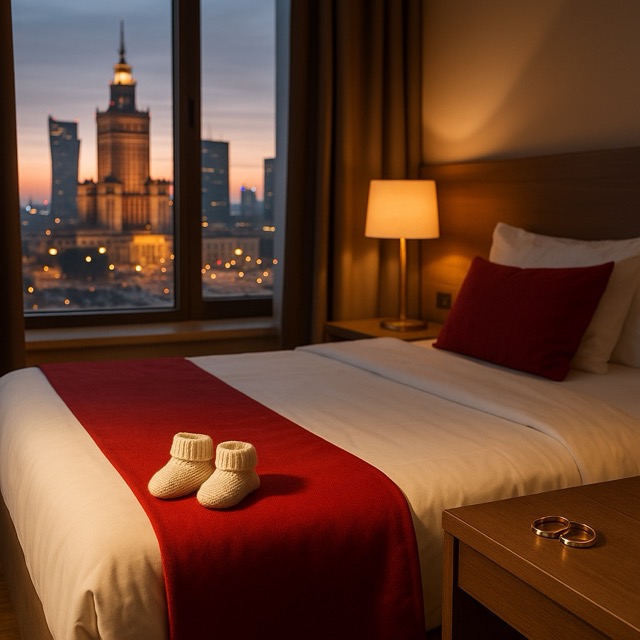
As birthrates plunge, the country’s largest privately owned hotel group dangles perks for couples who conceive during a stay—testing where marketing ends and social policy begins.
Warsaw
The pitch could have been dreamed up by a mischievous marketer: book a weekend escape, enjoy the spa and, if your holiday leads to a baby, come back for a celebration on the house. But the offer is real—and it speaks to a deeper worry about Poland’s future. Arche Group, now widely described as the country’s largest privately owned hotel company with 23 properties across Poland, has begun offering couples a free family party—such as a christening or secular gathering—if they can show they conceived during a stay. The proof is bureaucratic, not voyeuristic: a hotel invoice dated roughly nine months before the birth and a birth certificate.
The scheme, introduced in September and already trending on Polish- and English‑language social media, arrives amid a demographic dip that has spooked policymakers and employers alike. Poland’s total fertility rate has hovered around 1.1–1.2 births per woman—among the lowest in the European Union—and the country has recorded more deaths than births every year since the pandemic. National statisticians expect another year of natural population decline in 2025. For a nation that has relied on a steady supply of young workers to drive manufacturing and services, the numbers pose a slow‑burn challenge with fiscal, social and geopolitical implications.
Arche’s owner, Władysław Grochowski, says the program is equal parts publicity and prod. “We want to spark a conversation about a real problem,” he has argued in recent interviews, while also admitting the obvious: the idea is memorable, and that’s the point. In the age of viral offers and scarcity of attention, few campaigns cut through like promising a party for a baby conceived between check‑in and check‑out.
There are terms, of course. According to the company’s description of the rules, the birth must occur within 300 days of the stay. The reward—capped at a modest reception for around ten people—must be hosted at one of Arche’s venues. And this is not just a guest promotion. Inside the company, Arche has pledged a 10,000‑złoty (about €2,150) bonus to employees who have a child. The group—whose portfolio straddles hotels, adaptive‑reuse developments and events—has even signalled that buyers of Arche residential units could receive a similar child‑linked payout over the next five years.
Pronatalist incentives have a long, mixed history in Poland. The former Law and Justice (PiS) government bet heavily on direct transfers, building its “500+” child allowance into this year’s “800+” benefit indexed to inflation. The effect on births, however, has been underwhelming according to independent demographers, even as the payments helped reduce child poverty. Housing costs, precarious jobs, delayed partnerships, and the high price of time away from work all weigh on family decisions. Reproductive health policies have also tightened; access to abortion is among the most restrictive in the EU, and IVF funding has seesawed with politics—factors that, experts say, shape both the reality and the mood around having children.
Arche’s gambit is different: it is corporate, not state‑led; symbolic rather than lucrative; and as much about marketing as demography. Yet it taps the same anxieties. In small towns, maternity wards have shuttered as births decline—sometimes for want of specialists who cannot keep up their skills on low volumes. Employers from hospitality to construction voice labour shortages, increasingly filled by migrants from Ukraine, Asia and the Caucasus. Grochowski has been unusually forthright in saying Poland will need more immigration, a stance that puts him at odds with periodic anti‑migration rhetoric in national politics.
Will a free christening push anyone off the fence? Probably not on its own. Sociologists caution that fertility responds to broad conditions: confidence, income security, childcare access, flexible work and housing supply. Polished ads and boutique perks are no substitute. Still, companies can influence margins—by topping up parental pay, designing schedules that don’t penalize caregivers, reserving nursery places near workplaces, or simply normalizing that colleagues take time to build families. In that sense, Arche’s move could be read as a lightly humorous nudge paired with more material steps (notably its employee baby bonus).
From a business perspective, the calculus is straightforward. If the offer persuades even a small number of couples to choose Arche over Poland’s crowded mid‑market rivals, the publicity has paid for itself. The cost of hosting a ten‑person celebration is a rounding error on a successful events business; the potential lifetime value of loyal guests—now parents with a preferred venue for anniversaries, school communions and reunions—could be far higher. Early indications from booking channels suggest the campaign has lifted brand visibility and occupancy at the margins, at least in the short run.
Critics bristle at the optics. Some women’s groups characterize the promotion as trivializing reproductive choices or outsourcing public policy to private actors. Others see it as a harmless bit of levity, no more intrusive than hotel chains that sprinkle rooms with rose petals for “babymoons.” The line between whimsy and weirdness is thin. Arche insists it is not tracking or verifying intimacy; the company says it is merely extending a hospitality perk pegged to a future life event. In a polarized media environment, that clarification may not travel as far as the headline.
Abroad, similar stunts have popped up: Scandinavian towns have offered paid vacations to residents who conceive; one Russian region once drew headlines for a “Day of Conception” holiday with prizes for babies born nine months later. Most were tongue‑in‑cheek and short‑lived. What sets the Polish case apart is the scale and the backdrop: a large private hotel group stepping into a genuine policy vacuum, as successive governments wrestle with how to keep the workforce growing without pressuring women or excluding migrants.
The more serious test is whether businesses—and the state—can reduce the friction that makes parenthood feel risky. Urban rents in Warsaw, Kraków and Wrocław have surged; mortgage affordability has whipsawed with interest rates; public nurseries remain oversubscribed in many districts; and flexible, part‑time roles are patchy outside white‑collar hubs. If policymakers want births to stabilize, demographers say, they will need a long‑horizon package: more childcare places and longer opening hours, tax and pension rules that don’t penalize second earners, stable IVF financing, and immigration pathways clear enough to plan a life around.
None of that fits on a billboard. A free party does. That is the power—and the limitation—of Arche’s idea. It reframes the fertility debate in a register the hospitality industry knows well: welcome, celebrate, return soon. It will not reverse the population curve. It may, however, spur copycats, soften a conversation that often turns moralistic, and remind executives that demography is not a spectator sport. In that sense, a hotel promotion is a mirror: it reflects a country deciding, in dozens of boardrooms and ministries, how family‑friendly it wants everyday life to be.
For the couples who do take up the offer, the stakes are less abstract. A little financial help at an emotional milestone can matter, and a hotel that cheers a new baby may win a loyal guest. If the trend spreads—from hotels to employers more broadly—the cumulative signal could be meaningful: that Poland is adjusting everyday systems to match its demographic hopes. To get from slogan to stability, though, will take more than a clever campaign. It will take patient investments in the practicalities of raising children in cities and towns where the numbers, for now, are going the other way.
Sources:
Financial Times, “€2,000 bonuses and free parties: hotels enter Poland’s fertility fight,” Oct. 1, 2025.
Notes from Poland, “Polish property firm to reward customers who conceive in its hotels and apartments,” Sep. 19, 2025.
China Daily (Global), “Polish hotel group offers incentives to boost birthrate,” Sep. 23, 2025.
The Times (UK), coverage of Arche pronatalist scheme, Sep. 2025.




 The Tower Post