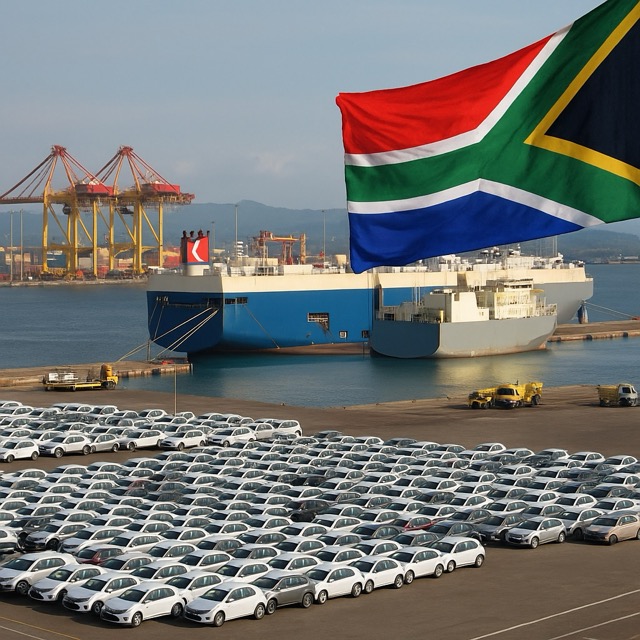
A sudden 25% U.S. levy and the looming lapse of AGOA threaten to unravel a flagship export industry—with metals, vehicles, and chemicals in the firing line
Johannesburg
For two decades, South Africa’s automotive sector has been the country’s model for export-led industrialisation. Now that success story is fraying. A new 25% levy on U.S. imports of South African automobiles and many parts has upended factory schedules, shipping plans and sales forecasts. At the same time, the African Growth and Opportunity Act (AGOA) expired this week without a guaranteed renewal, threatening the zero-tariff treatment that has underpinned the industry’s access to its most valuable market.
Executives from Port Elizabeth to Pretoria describe a whiplash few saw coming in its severity. ‘Two shocks landing together—sectoral tariffs and the end of preferences—change the equation overnight,’ says a senior manager at a major OEM. ‘Our U.S.-bound models were profitable at a 0% duty. At 25% plus the loss of AGOA, the sums don’t work unless we cut margins or volumes—or both.’
Why the U.S. matters
The United States has long been a cornerstone destination for locally built vehicles and components. Industry data show the U.S. ranked among South Africa’s top export markets for autos in 2024, with shipments approaching R30 billion—part of a record R270 billion in total automotive exports that year. Even before this month’s disruption, car and component exports accounted for a large share of South Africa’s non-commodity sales abroad and the bulk of its AGOA-related trade with the U.S. The sector supports hundreds of thousands of direct and indirect jobs through assembly plants, suppliers, logistics and dealerships.
The new levy’s ripple effects
The immediate effect of the 25% levy is simple: vehicles priced for American driveways arrive with a tariff-loaded sticker. Dealers push back; buyers hesitate; volumes slip. For high-volume models built in the Eastern Cape, even a few months of lost orders can destabilise plant utilisation rates that were finely tuned during the post-pandemic recovery. Component makers—especially those supplying interiors, wiring harnesses, catalytic converters and tyres—face cancelled call-offs and delayed tooling, while shipping contractors report blanked sailings on key U.S. routes.
The capillaries of the value chain are starting to constrict. Tier‑2 and Tier‑3 suppliers that invested on the promise of stable U.S. demand now face working-capital squeezes and shortened shifts. With domestic interest rates still high in real terms and banks cautious on manufacturing risk, companies are turning to export credit agencies and development financiers to bridge the gap.
AGOA’s expiry raises the stakes
The expiry of AGOA adds a second, potentially longer-lasting shock. Without renewal, South African manufacturers lose guaranteed zero-tariff access to the U.S. market for a wide range of goods. Independent estimates suggest the lapse could cut South Africa’s manufacturing exports to the U.S. by roughly 17%, with metals, vehicles and chemicals taking the heaviest blow. For autos, that means not only higher landed costs but also a strategic rethink of model allocation: Which vehicles stay U.S.-focused? Which switch to Europe, the Middle East or the rest of Africa? Which are mothballed altogether?
Policy makers in Pretoria and Washington both say they want continuity. But continuity requires Congress to act—and for South Africa to remain eligible. Until that happens, corporate planners must assume tariffs and uncertainty will persist into 2026 budgeting cycles.
Jobs and regional development at risk
Automotive anchors entire local economies. In Gqeberha (Port Elizabeth) and East London, assembly plants are among the largest private employers and taxpayers. A slump in export volumes cascades quickly: fewer shifts at the plant mean fewer purchase orders for seating foam and stamped metal, less overtime for freight forwarders and stevedores, and thinner revenues for municipal services already under strain. Suppliers operating on narrow margins warn that production interruptions could trigger layoffs and, in worst cases, closures.
Metals and chemicals feel the chill
Vehicles are only the visible tip. Behind each car is a pipeline of locally produced steel sheet, aluminium castings and catalytic materials, along with industrial chemicals used in paints, plastics and batteries. If U.S. orders falter, metals mills lose anchor customers; chemical producers see batch runs stretch out and unit costs rise. The 17% projected decline in manufacturing exports to the U.S. would therefore be felt far beyond assembly lines.
Can Europe, China or Africa fill the gap?
Automakers are already re‑routing shipments toward Europe and the Middle East where feasible, and courting customers across the African Continental Free Trade Area. But these markets cannot absorb U.S.-scale volumes at comparable margins in the short term. Europe’s emissions rules and consumer preferences complicate the reallocation of U.S.-spec models. China’s market is massive but intensely price‑competitive and crowded with domestic champions. Within Africa, logistics, financing and after‑sales networks remain uneven despite progress.
A policy playbook—fast
South Africa does have levers. First, intensify diplomacy in Washington to secure either an AGOA renewal or an interim arrangement that preserves duty‑free quotas for a defined number of vehicles and components while broader politics play out. Second, accelerate the long‑promised electric‑vehicle and battery roadmap at home: targeted investment allowances, accelerated depreciation for tooling, and a time‑bound production credit to offset the tariff shock and keep plants above breakeven until markets stabilise. Third, deepen regional value chains—especially for components—so that when U.S. demand dips, African demand can cushion the blow. Finally, unlock freight efficiencies at ports and on rail to strip out logistics costs that tariffs have suddenly magnified.
Business must adapt, too
Companies are revisiting the fundamentals: flexible platforms that can switch between left‑ and right‑hand‑drive; modular trim strategies that simplify customs classifications; redesigned supply footprints that reduce single‑market dependence; and pricing models that share tariff pain across OEMs, dealers and customers. Expect more local content where it is cost‑competitive, more risk‑sharing contracts with suppliers, and new hedging practices for freight and currencies.
What to watch next
Three signposts will tell us whether this is a temporary bruise or a structural break. First, the U.S. legislative calendar: a clean AGOA renewal—even for a year—would instantly remove the most destabilising uncertainty. Second, plant allocation decisions by global boards in the fourth‑quarter planning cycle; if future model lines are shifted away from South Africa, the consequences will stretch across the decade. Third, jobs: sustained short‑time or temporary layoffs at large assembly plants would signal a longer, deeper contraction.
Resilience under pressure
South Africa’s auto ecosystem has weathered currency crises, port bottlenecks and global shocks before. Its strengths—experienced workforces, a credible supplier base, and proven long‑distance export capabilities—remain intact. But tariffs and lost preferences change the arithmetic. Without swift policy action and nimble corporate responses, an industry that once symbolised South Africa’s integration into the global economy could become the latest casualty of weaponised trade.




 The Tower Post