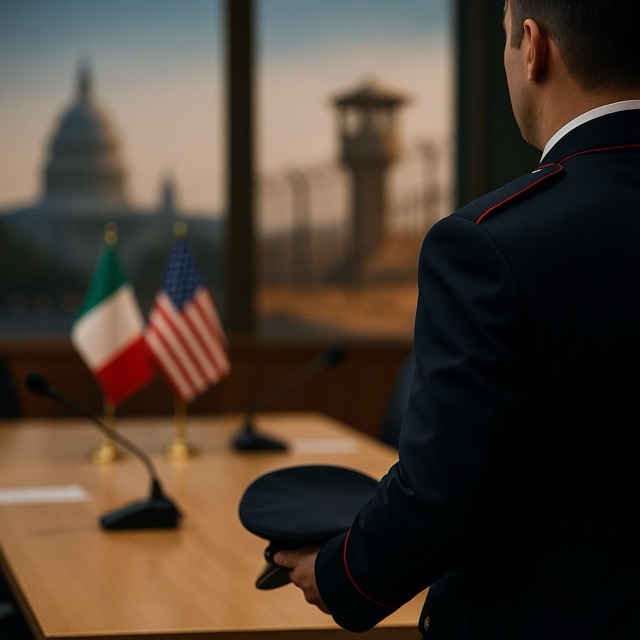
With domestic pressure mounting over the Gaza war, Italy’s premier seeks a reset in the U.S. — and a spotlight at the Italian‑American lobby’s October circuit

ROME/WASHINGTON — Italian Prime Minister Giorgia Meloni is weighing a high‑stakes U.S. swing this month that would include face time with President Donald Trump and a turn under the chandeliers of the Italian‑American lobby’s gala circuit, even as her government explores a sharper security role in Gaza that could involve deploying Carabinieri to an international monitoring or border mission, according to diplomats and officials familiar with the talks.
The outreach has two tracks. The first is political theater: a bid to reposition Meloni as a pragmatic Mediterranean problem‑solver in front of powerful Italian‑American donors and operatives who will gather on October 18 in Washington for the National Italian American Foundation’s (NIAF) 50th‑anniversary gala, and a separate Columbus‑weekend program in New York led by the Columbus Citizens Foundation in the days prior. The second is policy: a concrete Italian contribution to stabilizing Gaza under an emerging U.S. framework — one that may revive or expand European and multinational policing at border crossings and critical nodes.
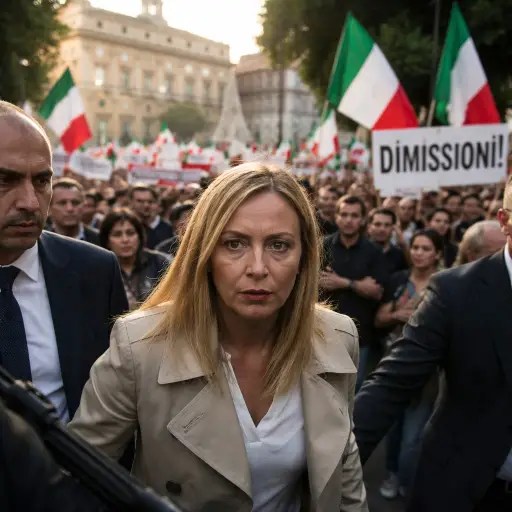
People close to the planning stress that no final travel schedule has been released by Palazzo Chigi, and that the optics are delicate. Meloni has already met Trump this year and publicly aligned Italy with the White House’s evolving Middle East plan. But domestic sentiment has shifted dramatically since late September, when Israel’s interception of the Global Sumud aid flotilla helped catalyze the largest wave of pro‑Gaza strikes and street protests Italy has seen in years. The resulting political pressure — port blockades, walkouts across schools and transit, and massive rallies — has pushed Rome to show it can both maintain Atlantic unity and respond to humanitarian imperatives.
That dual message is why the Carabinieri option has returned to the table. Italy’s paramilitary police have become a niche export of Italian soft power: trained for stabilization, crowd management and border monitoring, often embedded within European or UN umbrellas. Early this year, EU governments moved to reboot the European Union Border Assistance Mission (EUBAM) at Rafah, the crossing between Gaza and Egypt. Italian security planners subsequently scoped contributions drawn from the Carabinieri’s Second Mobile Brigade and the EUROGENDFOR network, alongside Spanish Guardia Civil and French gendarmes. Officials now see that template — or a broadened variant tied to a U.S.-backed ceasefire package — as the least escalatory way for Rome to be present on the ground.
In practice, an Italian component could take several forms. The most likely near‑term scenario, diplomats say, is an augmented border‑monitoring and transit‑protection mission at Rafah (and potentially Kerem Shalom), focused on safe passage for the wounded and the delivery of humanitarian goods. A second, more politically sensitive option — not imminent but under discussion in Euro‑Atlantic channels — would be a limited Carabinieri deployment to support civilian administration and public‑order tasks in designated zones, contingent on a ceasefire and consent from Israel, Egypt and a Palestinian interlocutor acceptable to Washington.
Either step would mark a visible shift for a premier who has spent much of the Gaza war standing close to Israel and to Trump’s Washington. In late September, after scenes of clashes and sit‑ins from Trieste to Rome, Meloni criticized the flotilla as a dangerous media stunt and warned organizers to halt their mission — a message that resonated poorly at home as the casualty count in Gaza mounted. Cabinet allies framed the strikes as politicized, but union leaders claimed millions in the streets and a rare unity across left‑wing and Catholic networks. By week’s end, even center‑right mayors were pleading for de‑escalation.
The U.S. channel offers Meloni a way to recalibrate without appearing to retreat. A photo‑op with Trump — whether at the White House or on the margins of Italian‑American events — would underscore Italy’s relevance to a U.S. peace architecture. A Carabinieri‑centered package, meanwhile, is legible to security professionals and carries far less political baggage than sending regular army units. It also taps into a well of diaspora pride: in Italian‑American circles, the Carabinieri are emblematic of order and service, a brand with cultural as well as operational cachet.
The timing is tight. NIAF’s golden‑jubilee weekend in Washington on October 18 has drawn a phalanx of business leaders and dignitaries; organizers have publicly noted that invitations went to both Trump and Meloni. In New York, Columbus‑weekend celebrations staged by the Columbus Citizens Foundation traditionally attract state and city power brokers and a constellation of donors. Advisers say Meloni’s team is weighing how to balance the Washington centerpiece with a high‑visibility New York stop, mindful that any appearance will be parsed as a signal about where she intends to anchor Italy within the American conservative orbit.
Policy substance could help quell skepticism. If Rome can point to tangible contributions — air‑bridge logistics via Pratica di Mare, medical evacuations under an EU flag, and a Carabinieri detachment keyed to a ceasefire regime — Meloni can argue that Italy is both humanitarian and hard‑nosed. That posture is already visible in diplomatic notes: Italian officials have quietly emphasized that border monitoring and police mentoring are the areas where the EU has muscle memory from the 2005–07 Rafah arrangements. Reviving that toolset, they say, is faster and more realistic than inventing a blue‑helmet mission from scratch.
Risks abound. Any deployment near Gaza carries exposure to rocket fire, drone attacks and militant infiltration — threats made vividly real by the recent strike on vessels accompanying the flotilla. Public‑order tasks are even trickier: mis‑steps by foreign police could ignite backlash, while a mission perceived as enabling Israeli control would be politically toxic in Italian streets. Inside the governing coalition, Atlanticists applaud closer alignment with Washington; sovereigntists worry about entanglement and costs. The opposition, for its part, will seize on any whiff of stagecraft if the U.S. trip looks more like donor‑circuit choreography than crisis management.
For Trump’s team, Italy is a useful case study in the administration’s “coalitions of the willing” approach: assemble culturally aligned partners who can move quickly on niche tasks, and showcase them in American media ecosystems. For Meloni, the pay‑off would be the image of a leader who can cross partisan lines in Washington and still speak credibly in European councils — especially after a summer in which Rome’s Atlantic credentials were burnished by hosting the G7 while its streets bristled over Gaza.
What to watch in the coming days: whether Palazzo Chigi formalizes a U.S. itinerary that pairs a Washington address to Italian‑American leaders with a New York cameo; if EU foreign ministers codify a larger civilian mission with explicit roles for Carabinieri; and how Italian unions calibrate their protest calendar if Rome commits to on‑the‑ground humanitarian security. Meloni’s bet is that diplomatic steps can cool domestic anger — and that the diaspora spotlight can help reintroduce her to an American audience that will matter for the next phase of the Middle East crisis.
In short, the premier is attempting a needle‑thread: turn a transatlantic charm offensive into a stabilizing imprint on Gaza policy, without alienating a public that is raw with images of destruction. Whether that means Carabinieri at Rafah, a photo line at a Washington ballroom, or both, the next two weeks will test the agility of Italy’s foreign‑policy machine — and the political instincts of its most polarizing modern leader.
Editor’s note: As of October 4, 2025, organizers list NIAF’s 50th Anniversary Gala for October 18 in Washington, D.C.; the Columbus Citizens Foundation’s Columbus Celebration Gala in New York is scheduled for October 11. Palazzo Chigi has not published a formal U.S. travel schedule for the Prime Minister.

 The Tower Post