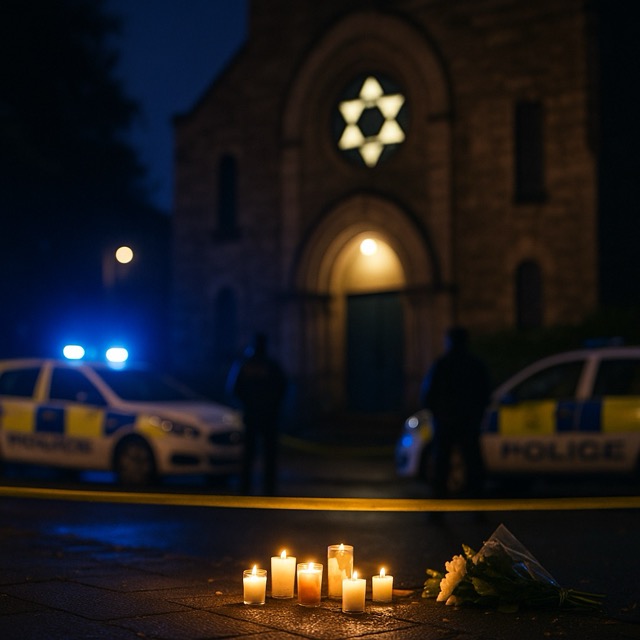
Two men killed, three seriously injured outside Heaton Park Hebrew Congregation; questions mount over police response and a wave of antisemitism that has surged since October 7, 2023.
The Jewish community in north Manchester is in mourning after a terror attack on Yom Kippur left two worshippers dead and three others seriously injured outside the Heaton Park Hebrew Congregation on Thursday, October 2. The assault, which unfolded within minutes as hundreds observed the holiest day of the Jewish calendar, has shaken a city long regarded as one of Britain’s most vibrant centers of Jewish life.
Police said the attacker—identified by authorities as 35‑year‑old Jihad Al‑Shamie—drove a vehicle toward congregants before emerging with a large knife and a fake explosive vest. He was shot dead at the scene by armed officers. In the chaotic exchange that followed, 53‑year‑old Adrian Daulby and 66‑year‑old Melvin Cravitz were fatally wounded. Daulby, a father of two, is believed to have been struck by a stray police bullet as he helped barricade the synagogue doors, according to investigators reviewing officers’ use of force.
The attack unfolded just after mid‑morning prayers. Witnesses described a rush to secure entryways as security volunteers and worshippers moved benches and metal barriers against the front doors. Some congregants sheltered in side rooms and a basement classroom; others ran toward nearby homes. ‘There was a split second where everything went quiet and then the screaming started,’ said one congregant, who asked not to be named. ‘People were incredibly brave.’
By Friday evening, flowers and handwritten notes crowded the pavement along Middleton Road. Vigils drew residents from across Greater Manchester, including Jewish and Muslim community leaders who stood together, calling for calm and unity. Prime Minister Keir Starmer and Chief Rabbi Ephraim Mirvis visited the site, meeting families of the dead and injured and thanking first responders.
Police later confirmed that counter‑terrorism officers had arrested multiple people in connection with the investigation, and that scenes remained in place at several addresses across Manchester and nearby Prestwich. Authorities said they were examining extremist Islamist motives and the attacker’s recent history; Al‑Shamie was reportedly on bail for a separate rape allegation at the time of the assault.
Among the wounded was a volunteer with the Community Security Trust (CST), the charity that protects Jewish schools, synagogues and communal sites. CST personnel were credited by witnesses with buying crucial moments that helped prevent a greater loss of life. ‘Our volunteers train for the worst day we hope never comes,’ a CST spokesperson said. ‘On Thursday, it came.’
For many, the terror of the day collided with a longer dread that has taken hold since the October 7, 2023 Hamas massacre in Israel and the subsequent war in Gaza. Across the United Kingdom, antisemitic incidents spiked to record levels in late 2023 and remained historically high through 2024, according to CST data. Manchester’s rabbis say that surge has translated into a grinding new normal: more guards at the doors, more drills, more fearful conversations with children.
Security professionals said that, despite the speed of the response, the attack raises difficult questions for policing and policy. If investigators confirm that a stray bullet killed Daulby while he was attempting to reinforce the entrance, it would mark an agonizing twist in a story already defined by courage. The Independent Office for Police Conduct has opened a probe into the shooting, and Greater Manchester Police have pledged a transparent review of tactics and training.
The shock has reverberated far beyond the city. In London and Leeds, synagogues reported increased attendance at safety briefings. Jewish schools reviewed perimeter controls and car‑drop procedures. Parents organized volunteer patrols during arrival and dismissal. ‘We’re living in a state of vigilance,’ said a headteacher at a Jewish primary school, ‘and that is no way for children to grow up.’
In Prestwich and Broughton Park—neighborhoods where kosher bakeries, yeshivas and synagogues dot the high streets—residents described a blend of grief and defiance. Friday night, store owners stayed open late to offer tea and pastries to mourners and police officers. ‘Shabbat’s coming,’ one baker said. ‘We’ll light candles for Adrian and Melvin. We’ll open our homes. We’ll carry on.’
At the national level, the Home Office faces renewed pressure over the scale and sustainability of security funding for Jewish institutions. The current £18 million annual grant underwrites guards and infrastructure across the community, but demand has surged as threats multiply and volunteer fatigue sets in. CST leaders argue that staffing and training must expand again, warning that the risk matrix has shifted since 2023.
Data collected by CST underscores that warning. The charity recorded 4,296 antisemitic incidents in 2023—the highest annual total since record‑keeping began—and a further 3,528 incidents in 2024, an 18% decline from the previous year but still 56% higher than the next‑worst year on record. Analysts say that while street‑level protest activity has ebbed and flowed, online harassment and threats remain pervasive, and Jewish institutions have become a focal point for intimidation campaigns.
Those numbers are not abstractions in Manchester. Parents describe fielding questions from children who now routinely spot high‑visibility jackets at synagogue gates. Teenagers report changing their routes to school to avoid hostile graffiti. University students say lecture‑hall debates have hardened, with Jewish students singled out for collective blame. Local officials warn that the city’s civic fabric—built on decades of interfaith cooperation—will fray if tensions go unaddressed.
Yet the week also produced reminders of solidarity. At a vigil outside the synagogue, Muslim and Christian leaders condemned the violence and read prayers for the dead. Imams from nearby mosques offered to coordinate volunteer escorts for those walking to shul on dark autumn evenings. ‘We will not allow extremists to divide our streets,’ said one imam. ‘Your pain is our pain.’
In the coming days, families will sit shiva for Daulby and Cravitz. Their friends describe them as steady presences: one a meticulous organizer of community charity drives, the other a patient mentor to new security volunteers. Neighbors recalled how both men were fixtures at lifecycle events—bar mitzvahs, weddings, funerals—‘the quiet hands that made things work.’
Community safety advisers say synagogues across the region will introduce immediate, practical steps: double‑door entry protocols, clearer rally points, pre‑positioned medical kits, and more frequent tabletop exercises with police. Several congregations are assessing bollards and planters to harden perimeters against vehicle attacks. At the same time, mental‑health providers are bracing for a wave of trauma responses and secondary stress among volunteers.
For the bereaved, the statistics and checklists recede behind the loss. As dusk fell on Friday, a group of teenagers placed memorial candles in a six‑pointed star beside the synagogue gate. An elderly man wiped tears with his sleeve. ‘We will fast again next year,’ he said softly. ‘We will stand together again. But this time, we will remember their names first.’




 The Tower Post