“We don’t trust Israel, but the gunmen should leave”: As delegations converge on Egypt, residents weigh promises of peace against the scars of war
GAZA CITY/CAIRO — The day before the latest round of talks, the lights flickered on and off in a Gaza neighborhood hooked to a tangle of generators, and a rumor moved faster than the sea breeze: a deal could finally be within reach. “We don’t trust Israel,” a shopkeeper muttered while counting out change in a darkened stall, “but the militants should go. We need our children to sleep.”
That uneasy balance — between a yearning for quiet and the exhaustion of conflict — is the emotional backdrop as delegations from Israel, Hamas and international mediators gather in Egypt this week to attempt what earlier rounds failed to deliver: a durable ceasefire that frees the remaining hostages, reins in armed groups, and sets the Strip on a path to reconstruction.
Talks are expected to open in Sharm el‑Sheikh after preparatory meetings in Cairo, according to Egyptian officials familiar with the logistics. The framework, heavily backed by Washington and Arab capitals, is billed as the closest the parties have come in months: a phased arrangement that trades the release of Israeli hostages for Palestinian prisoners, pauses Israeli operations, and begins a calibrated withdrawal of Israeli forces while a transitional civil authority takes root in Gaza.
On the ground, the war has not paused for diplomacy. Local health officials said Israeli strikes continued across the enclave over the weekend, with at least a dozen killed on Sunday and more overnight as negotiators packed their bags for Cairo. Residents who spoke to reporters by phone described blasts in central and northern districts and the hiss of drones that never seem to leave the sky. The Israeli military said its forces were targeting armed cells plotting attacks and operating from dense urban areas, a justification it has maintained throughout the campaign.
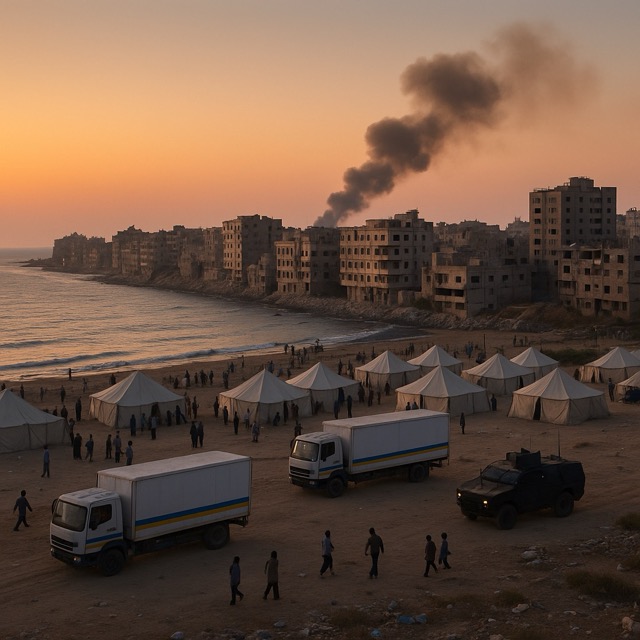
For families who have moved shelters half a dozen times since the war began, the geography of Gaza has shrunk to the few places where aid arrives and rumors say it’s safe. In makeshift camps along the coast, parents barter for cooking oil and water filters; teenagers scroll cracked phones for updates about the talks. When asked what they want from the negotiations, the answers are remarkably consistent: an end to nightly airstrikes, the reopening of formal border crossings, and a plan — any plan — that puts civilians, not militias, in charge of their streets.
“People here can want two things at once,” said a community organizer in the southern Strip, reached via messaging app. “We want the occupation gone and we also want the fighters out of our neighborhoods. Every time someone shoots a rocket, we pay the price.”
Diplomats are trying to meet that complexity with a layered proposal. In the first phase, Hamas would hand over a group of hostages and provide proof of life for others. Israel, in turn, would release a significant number of Palestinian detainees, widen humanitarian access, and halt most offensive operations. The second phase, far trickier, envisions the gradual disarmament of factions inside Gaza and the transfer of day‑to‑day governance to a technocratic administration under international supervision. Parallel talks would sketch the lines of an Israeli drawdown and codify security guarantees meant to prevent a vacuum that armed groups could exploit.
None of this is simple. Israeli officials must sell any deal to a public traumatized by years of rockets and the abductions that seared the national psyche. Hamas leaders face their own internal fissures over disarmament and power‑sharing. Egypt, which has brokered countless truces, wants credible partners on both sides and assurances that Sinai’s border won’t become an open conduit for weapons again. And the United States — whose envoys shuttled among capitals in recent days — is pressing for speed, while conceding that implementation would roll out in careful steps to avoid a collapse on day one.
Inside Gaza, the argument over militants is no longer abstract. In some neighborhoods, residents say they have confronted gunmen about storing explosives in apartment blocks or parking rocket launchers near schools. “We are tired of being human shields,” said a father of three from the central Strip. “If there is an agreement, the militias should leave the civilian areas and then leave Gaza.” Others, wary of appearing to side with any faction, speak more cautiously, warning that disarmament without a political horizon — jobs, freedom of movement, a credible path to self‑governance — will only recycle the anger that fueled past rounds of violence.
The humanitarian ledger is staggering. Health systems run on diesel and heroism. Surgeons operate by headlamp. Aid trucks line up at the border for inspections, inching into the territory with flour, medicine and tents, then disappearing into a maze of need. International agencies warn that waterborne disease and malnutrition will shadow Gaza long after the guns fall quiet unless reconstruction begins quickly and at scale. Any agreement reached in Egypt that does not front‑load relief — fuel for hospitals, heavy equipment to clear rubble, cash support for families — risks hemorrhaging public trust before it starts.
That trust deficit runs both ways. Israeli commanders say militants embed in civilian infrastructure and that pausing operations without ironclad safeguards invites renewed attacks. Palestinian families say they have heard promises before: of limited operations that turned limitless, of temporary closures that became permanent. “We measure hope in hours,” a grandmother in Khan Younis said in a voice memo. “If there is no bombing tonight, we cook. If the morning is quiet, we wash clothes. If we hear that the borders may open, we stand in line.”
The venue itself is a study in contrasts. In Sharm el‑Sheikh’s armored hotels, negotiators will shuffle between meeting rooms cooled to desert‑winter temperatures, while hundred‑page annexes circulate in binders and diplomats haggle over verbs. A few hundred miles north, families calculate the distance to the nearest shelter and whether a phone will have enough battery to last the night. For many Gazans, the legitimacy of any deal forged at the Red Sea will be judged not by the signatures but by the first week’s results: fewer funerals, more aid, a reduction in the number of men with guns on their blocks.
The political timetables are unforgiving. Leaders in Jerusalem face coalition pressures and hard‑right partners threatening to bolt if concessions go too far. Hamas’s external leadership must navigate the views of commanders on the ground — some of whom have lost relatives and homes — and regional patrons who want influence over Gaza’s tomorrow. Egypt seeks a diplomatic win that stabilizes its frontier and restores its status as the indispensable mediator. Washington is gambling that a deal that trades hostages for a real quiet on the border will be popular enough, in Israel and beyond, to withstand the inevitable setbacks once implementation begins.
Even if a ceasefire is agreed in principle, the mechanics will test everyone. Who secures the crossings and the aid corridors? Which courts arbitrate disputes over detainee lists? How quickly can a civilian authority take over salary payments, policing, trash collection? Where do the gunmen go — and who ensures they stay gone? What happens if a single rocket is launched on day three? Diplomats offer flowcharts and contingency clauses; residents offer a simpler metric: Do the strikes stop, and does help arrive?
Back in Gaza, the shopkeeper who wanted the fighters gone also wanted something less easily negotiated in hotel suites: the right to forget. “We don’t want revenge,” he said. “We want to wake up one morning and think about prices, about school, about football — about normal things.” On the eve of more talks, Gaza’s most radical demand is the most ordinary one: to live without calculating the distance from the front door to the next safe room, to trust that the sea breeze means the weather is changing, not that a fire is burning somewhere out of sight.




 The Tower Post