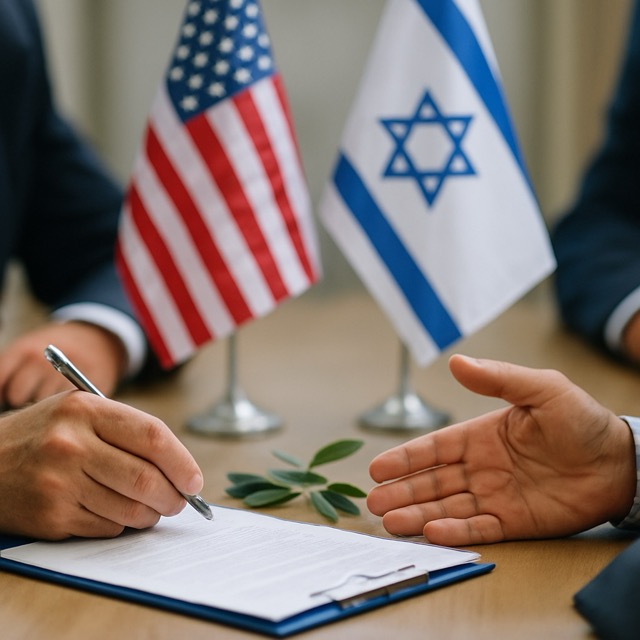
Inside the Trump-backed blueprint that boxed in Israel’s prime minister — and reopened a pathway to Palestinian statehood
New York / Jerusalem – Two weeks can redraw political red lines. In mid-September, Israeli Prime Minister Benjamin Netanyahu stood in the occupied West Bank and vowed to supporters that “there will be no Palestinian state.” By late September, in New York during the frenzy of the U.N. General Assembly, he was studying a Donald Trump–backed draft plan that, in its final clauses, sketched a pathway toward precisely that outcome. The reversal was less a change of heart than a collision of pressures: an exhausting Gaza war rolling into its second year, an American president intent on a legacy-defining deal, Arab states newly assertive, and a fractious Israeli coalition threatening to splinter.
Multiple versions of the U.S. document circulated among negotiators and diplomats in New York and Washington in late September. The language evolved, but the spine held: a 20- or 21-point framework to halt the fighting, free Israeli hostages, restructure Gaza’s governance under a technocratic, security-vetted authority, and commit the parties to a political process that, if milestones are met, would lead to internationally recognized Palestinian statehood. U.S. officials came armed with carrots and sticks — from a reconstruction fund seeded by Gulf money to a threatened freeze on certain arms transfers if Israel balked at defined humanitarian benchmarks.
For Mr. Netanyahu, the timing was treacherous. On September 11, he had stood at Ma’ale Adumim to sign a framework accelerating settlement development east of Jerusalem and declared that a sovereign Palestinian state would never emerge “west of the Jordan.” Days later, he flew to the United States for meetings punctuated by a rocky U.N. speech and private sessions where the White House and Arab interlocutors pressed him to accept the American blueprint. According to officials briefed on the discussions, the prime minister initially sought to bracket the plan’s political provisions — anything that could be read as a “statehood horizon” — but left Washington with an understanding that the document would stand or fall as a package.
Trump-world leverage mattered. President Trump, who has long cast himself as a master broker, had accumulated unusual influence over the Gaza file: a direct channel to Qatar, which hosts Hamas’s political leadership; improved ties with Saudi Crown Prince Mohammed bin Salman, whose imprimatur would be vital for financing and regional cover; and domestic pressure points inside Israel. When an Israeli strike in late September killed Hamas figures amid back-channel contacts, the uproar handed Washington an opening. People familiar with the talks say the White House demanded a pause in major operations to salvage hostage negotiations and made clear that Israeli pushback on the plan’s endgame would carry costs.
Inside Israel, the politics were combustible. National Security Minister Itamar Ben-Gvir and Finance Minister Bezalel Smotrich blasted even the notion of allowing former Hamas civil servants to remain in their jobs under a new authority, let alone signing onto a process that mentions Palestinian statehood. The opposition, led by Yair Lapid and joined by Benny Gantz, offered Netanyahu a lifeline of parliamentary support — but only if he moved forward on the American framework. The prime minister was thus pressed from both flanks: refuse, and risk a coalition crackup with no guarantee of U.S. backing; accept, and invite fury from his base while betting that a hostage deal and a quieter border would steady public opinion.
What, exactly, is in the document? The plan’s operational phases begin with an immediate, verifiable halt to air and artillery strikes, a freeze of front lines, and the return of all Israeli hostages within 72 hours of Israel’s formal acceptance. In parallel, Israel would release specified categories of Palestinian prisoners. A U.S.-led cell would monitor compliance using satellite imagery and ground-based verification teams. Humanitarian corridors into Gaza would be opened at scale, with trucks pre-cleared and inspected at staging hubs in Egypt and Israel to shorten delivery windows.
The governance track is the engine of the political horizon. The draft envisions a transitional Gaza Administration — staffed by technocrats vetted for ties to terrorism and answerable to a reformed Palestinian Authority — that assumes control of civil services, policing, and border management under strict security oversight. Hamas, as an armed actor, would be excluded from governing; individuals not implicated in violence could remain in administrative roles if they renounce affiliation and pass screening. Over 12–18 months, an international mission would help rebuild utilities and critical infrastructure while training local security cadres. Progress benchmarks would trigger phased Israeli withdrawal from remaining positions and unlock donor tranches.
Crucially, the final section — the point that turned Netanyahu’s September rhetoric on its head — states that if security benchmarks are met and the Palestinian Authority completes specified reforms (including an updated mandate via elections, judicial safeguards, fiscal transparency, and unified chains of command), the United States will convene a conference to recognize a Palestinian state alongside security guarantees for Israel. The wording stops short of an automatic U.S. recognition on day one; instead, it lays out a sequenced pathway conditioned on performance. To Arab capitals, that was the price of mobilizing billions for reconstruction and deeper normalization with Israel. To Jerusalem’s far right, it was anathema.
Diplomats speaking on background described a charged scene in New York hotel suites as Israeli officials proposed edits that would swap “state” for euphemisms like “political resolution.” U.S. envoys, backed by European and Arab partners, rejected those changes, pointing to polling that shows Israeli support coalescing around a hostage deal and an exit strategy, even if the long-term politics remain divisive. One senior Arab official dismissed semantic hedging: “If you want our money and our recognition, you cannot have an endless war or a vacuum in Gaza. There must be a horizon.”
Whether the plan sticks now hinges on three moving pieces. First, Hamas’s response: leaders abroad signaled conditional openness to a technocratic authority and hostage release, while commanders in Gaza resisted demilitarization. Second, Israel’s coalition math: if Ben-Gvir or Smotrich bolt, Netanyahu could fall — unless the opposition temporarily props him up to pass the plan. Third, enforcement: without credible penalties for violations or a neutral mechanism to adjudicate disputes, ceasefires in this conflict have tended to unravel under the weight of mistrust and spoilers.
The U.S. is trying to solve for that last problem with redundancy. The framework ties aid to performance, tasks a multinational monitoring group with publishing weekly compliance reports, and contemplates U.N. involvement in border and customs administration. A Gulf-backed reconstruction vehicle would release funds in stages, tied to audited milestones in power, water, housing and demining. Washington also reserved the right to suspend specific weapons shipments if humanitarian access is impeded, while pledging parallel upgrades to Israel’s defensive systems and regional air defenses to deter Iran and its allies.
Netanyahu’s allies insist that Israel has not accepted a Palestinian state in principle, only a process. But politics is often defined by the direction of travel. In September he drew a bright red line in the West Bank; by early October he was negotiating around a document whose destination signposts point unmistakably to statehood, provided that security and reform conditions are met. The prime minister is betting that the plan will be judged on the immediate dividends — hostages home, rockets silenced, humanitarian relief accelerated — rather than its distant horizon.
The endgame remains uncertain. The Gaza war is not yet over; armed groups retain capabilities, and any miscalculation could shatter the talks. Israeli politics could spin toward elections; Palestinian politics could fray over who, exactly, speaks for Gaza and the West Bank. But after a year defined by maximalist absolutes, the most surprising development of this autumn is a return to conditionality — a roadmap of ifs and thens. In that gap between vow and draft, between September’s defiance and October’s diplomacy, the shape of a different future has reappeared.




 The Tower Post