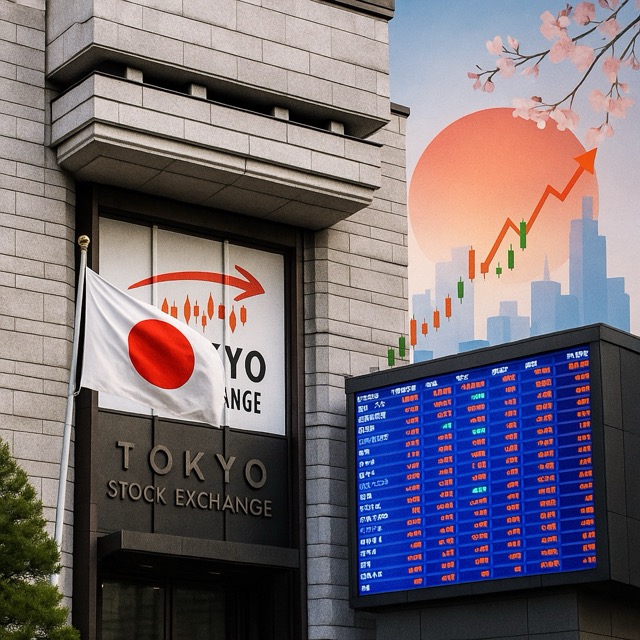
Investors wager that fiscal expansion under expected prime minister Sanae Takaichi will supercharge growth — lifting equities while pressuring the yen and long-dated bonds
TOKYO — Japan’s stock market roared to fresh records on Monday, October 6, 2025, as investors piled into what traders have dubbed the “Takaichi trade” — a bet that the country’s next prime minister, Sanae Takaichi, will unleash a new wave of fiscal stimulus and keep pressure on the Bank of Japan to stay accommodative. The Nikkei 225 leapt nearly 5% intraday to top 48,000 for the first time, while the broader Topix also notched an all‑time high. The rally accelerated after Takaichi secured leadership of the ruling Liberal Democratic Party (LDP), positioning her to become Japan’s first female prime minister.
The surge caps a dramatic week in which politics, policy and positioning converged. Traders had been building exposure for days — long equities and short longer‑dated Japanese government bonds (JGBs) — anticipating that Takaichi’s victory would revive elements of Abenomics: front‑loaded public works, targeted tax incentives and subsidies for strategic industries. Those wagers paid off. Industrials, machinery, defense and nuclear technology names led Monday’s charge, while banks lagged as odds of a near‑term BOJ rate hike faded.
Currency markets offered a mirror image. The yen, already fragile, slid sharply against the dollar and hit fresh lows versus the euro as investors priced in a looser fiscal‑monetary mix. At the long end of the curve, 30‑ and 40‑year JGB yields climbed on worries about heavier issuance and debt sustainability — the flip side of equity euphoria. Short‑dated yields, by contrast, were steady to lower as markets pushed out expectations for additional policy tightening from the BOJ.
“This is a textbook policy‑reflation rotation,” said a Tokyo‑based portfolio manager at a global asset manager, summarizing the day’s moves: cyclical stocks and capex winners up, financials mixed, the currency weaker and long bonds under pressure. “The new administration’s first 100 days will be critical for whether the rally broadens or stalls.”
A policy blueprint rooted in strategic investment
Takaichi has signaled an economic program built around state‑backed investment in semiconductors, AI and digital infrastructure, alongside renewed attention to defense and energy security — including nuclear restarts and next‑generation technologies. She has also floated measures to raise productivity and wages, such as accelerated depreciation, R&D tax credits and incentives for reskilling. Markets interpret this as an attempt to lock in Japan’s nascent capex cycle just as global manufacturers re‑wire supply chains.
Critically, the anticipated fiscal thrust comes as Japanese households are still contending with imported‑inflation aftershocks. Subsidies for energy and childcare — planks that could cushion real incomes — are seen as politically palatable ways to support consumption without overheating the economy. Yet the composition, not just the size, of the package will matter for markets: targeted, multi‑year outlays tied to productivity tend to command more investor confidence than one‑off handouts.
Market microstructure: who bought, who sold
Flows on Monday suggested both local retail and foreign institutions were active on the bid. Mega‑cap exporters benefited from the weaker yen, while mid‑cap engineers and heavy industry names saw outsized percentage gains. Derivatives desks reported brisk call‑buying in Nikkei futures and index‑heavyweights, with dealers hedging by purchasing underlying shares — a dynamic that can amplify upside in the short run.
Banks and insurers were relative underperformers. A flatter near‑term path for the BOJ — combined with volatility at the long end of the JGB curve — clouds the outlook for net interest margins and duration books. Still, some analysts argue that stronger nominal growth from fiscal expansion could ultimately be supportive for financials if loan demand and fee income improve.
The risks: debt math, yen stability and execution
Japan’s public debt burden — north of 250% of GDP — invites questions about how far any administration can push deficit‑financed stimulus before bond markets rebel. For now, the BOJ’s large balance‑sheet and captive domestic investor base provide insulation. But Monday’s jump in ultra‑long yields is a reminder that term‑premium can reprice quickly when fiscal ambitions swell. A persistently weak yen is another pressure point, both politically and socially, if it erodes purchasing power. Any sign of disorderly currency moves could revive speculation about coordinated interventions.
Execution risk looms as well. Cabinet appointments and bureaucratic alignment will shape the speed at which funds reach the real economy. If early measures focus on shovel‑ready infrastructure, the growth impulse could be front‑loaded; if programs tilt toward multi‑year industrial policy, the payoff may be slower but more durable. Either path demands clear communication to avoid whipsawing expectations.
What to watch next
First, the scale and design of the initial supplementary budget: headline size will grab attention, but markets will parse how much is genuine new spending versus repackaged allocations. Second, guidance from the Bank of Japan at its next meeting: even a modest tweak to bond‑purchase operations or yield‑curve control could temper the “risk‑on” impulse. Third, any early signals on corporate governance and labor reforms that could nudge Japan toward sustained, investment‑led growth.
Internationally, investors will monitor how a Takaichi government aligns with the U.S. on economic security and defense — a factor already boosting select contractors — and whether supply‑chain policies channel more high‑value manufacturing onto Japanese shores. Meanwhile, global cross‑currents — from commodity prices to the U.S. policy outlook — will continue to buffet sentiment.
A rally with roots — and a reality check
Japan’s latest breakout builds on a multi‑year re‑rating story: corporate governance reforms, improving return on equity, and an export complex leveraged to AI‑ and electrification‑driven capex cycles. The “Takaichi trade” adds a fresh catalyst, but it does not nullify the need for earnings delivery. If fiscal firepower translates into faster productivity and real wage gains, today’s highs could prove a base rather than a peak. If not, the market may again test the firewall between bold promises and bond‑market patience.
For now, bulls have the ball — and the scoreboard shows new records. The coming weeks will reveal whether policy can keep pace with price.



 The Tower Post