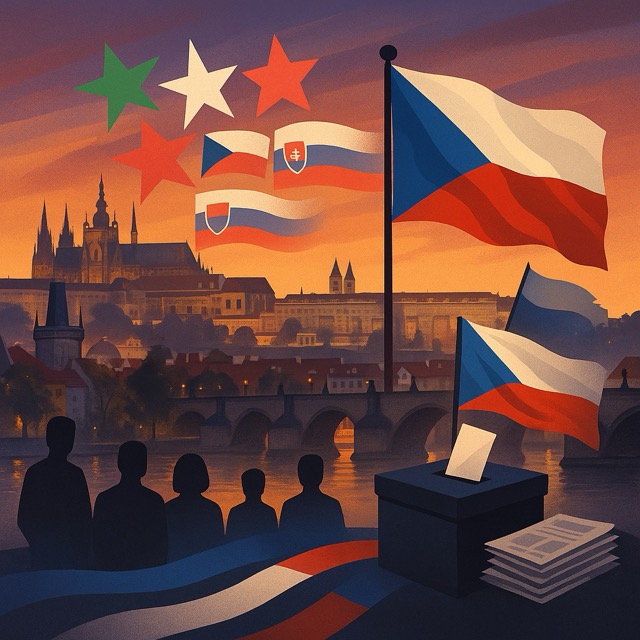
With the 2025 parliamentary upset, European media in Hungary, Poland, and Slovakia frame Andrej Babiš’s comeback as a turning point for the Visegrád Four—and a test of Czechia’s pro‑Western course.

The morning after election night, Prague woke to a political map redrawn in bold strokes. Andrej Babiš, the billionaire-turned-populist who governed Czechia from 2017 to 2021, has led his ANO movement to a commanding first place, securing 34–35% of the vote and roughly 80 of the 200 seats in the lower house. That leaves him short of an outright majority yet closer to power than at any point since his 2021 defeat. As coalition arithmetic begins, newsrooms across Central Europe are treating the result as something larger than a national switch: a potential pivot for the Visegrád Four and a test of whether Prague’s staunchly pro‑Western line of the last four years can hold.
Hungary’s pro‑government daily Magyar Nemzet wasted no time in casting the upset as a regional hinge. In a series of articles before and after the vote, the paper argued that a Babiš government could “strengthen the V4” and give “new momentum” to a sovereignist, patriotic agenda—shorthand in Budapest for a more skeptical posture toward Brussels on migration, climate policy and the war in Ukraine. The framing fits with Prime Minister Viktor Orbán’s long‑running effort to rebuild Visegrád as a counterweight within the EU, after years in which Prague often sided with Brussels and with Kyiv.
The numbers explain the stakes. ANO’s result eclipsed the pro‑Western SPOLU coalition of incumbent prime minister Petr Fiala by double digits, and it puts Babiš within striking distance of a working majority if he can secure support—formal or tacit—from smaller right‑wing parties. Early feelers have gone to Tomio Okamura’s Freedom and Direct Democracy (SPD) and the upstart Motorists movement. That arithmetic could deliver 108 seats, but it would also import sharp contradictions: SPD’s hard Euroscepticism and anti‑NATO rhetoric sits uneasily with Babiš’s post‑vote insistence that he is “pro‑European and pro‑Atlantic,” even as he pledges to curb military aid to Ukraine and to resist new climate and migration packages from Brussels.
Czech institutions will also matter. President Petr Pavel, a former NATO general elected on a liberal‑internationalist platform, has signaled he will scrutinize any cabinet for fidelity to the country’s treaty commitments. Pavel cannot choose the prime minister, but he can reject individual ministers deemed to threaten the state’s orientation. The Senate, where opposition parties are stronger, and an assertive Constitutional Court further constrain any radical swerve. In other words, even a Babiš comeback will be steered by guardrails that did not exist in illiberal success stories elsewhere in the region.
That is part of why European coverage has split along familiar lines. In Warsaw, conservative outlets have hailed the result as proof that a “patriotic axis” can expand beyond Hungary and Slovakia, potentially reviving V4 cooperation on migration and EU institutional reform. Public‑service channel TVP World framed Babiš as preparing for a renewed partnership with a future right‑leaning government in Poland—an aspiration as much as a forecast. By contrast, liberal and centrist media in Poland warned that Prague’s reliability on Ukraine and EU decision‑making could wobble if ANO relies on far‑right votes in parliament.
Slovakia’s press, seasoned by the return of Robert Fico in 2023, has mostly treated the Czech results as confirmation that the political tide across the region remains choppy and transactional. President Peter Pellegrini, elected earlier this year, openly suggested before the vote that relations with Prague would “improve” under Babiš—an unusually forthright foray that underscores Bratislava’s hope for a partner less critical of its own zigzags on Ukraine and rule‑of‑law disputes. Slovak commentators also note that Czech‑Slovak ties, rooted in shared history, could warm symbolically even if policy coordination remains selective.
Western European newsrooms have been cooler. In dispatches from Brussels and Berlin, correspondents describe a prospective “problem child” for the EU—not because Babiš is an ideologue in Orbán’s mold, but because his campaign promises point to friction: resisting new Ukraine aid packages, challenging climate targets that raise domestic energy costs, and railing against migration quotas. Analysts caution, however, that Babiš’s perennial pragmatism and his sprawling business interests tend to blunt confrontation. In 2019–2021, he split the difference between transactional bargaining and headline‑grabbing pushback; many expect the same, especially if he governs in minority or with fragile partners.
At street level in Prague, the mood is less about geopolitics than fatigue: energy prices, mortgage rates, and the cost‑of‑living squeeze still dominate conversations in cafés from Vinohrady to Holešovice. Babiš channeled that malaise with relentless retail politics, touring small towns and promising to “bring order to bills” rather than crusading on culture war. Yet foreign policy hovered over the ballot all the same. Outgoing premier Fiala had made support for Kyiv a calling card, marshalling an EU‑wide initiative to purchase millions of artillery rounds and turning Czechia into a logistical hub for repairing Western kit. A government led by ANO says it will not “undermine NATO,” but it will “prioritize domestic needs” over arms shipments—language that Kyiv and Brussels parse as a warning light, not a red line.
For Orbán’s Hungary, the election is a strategic opportunity. With Robert Fico’s Slovakia already a difficult partner for EU consensus on Russia sanctions and Ukraine assistance, a Prague more sympathetic to “peace first” narratives could tilt debates in Europe’s councils—even if only by slowing, not blocking, decisions. Magyar Nemzet’s celebratory tone captures that gambit: a re‑energized V4 that can coordinate veto threats on files from migration to climate and industrial policy. Whether that vision survives contact with Czech political realities is another matter. ANO’s urban voters are more EU‑friendly than Fidesz’s base, and Czech business remains tightly integrated with German supply chains that benefit from EU green‑industry subsidies.
The coalition puzzle could be decisive. A formal tie‑up with SPD would alarm Western partners and almost certainly provoke a clash with President Pavel. A looser arrangement—minority rule by ANO with outside support from Motorists and issue‑by‑issue votes from SPD—would dull the optics but leave legislation hostage to hardliners. Either way, European media emphasize, the government‑formation process may drag into November, as the president insists on constitutional procedure and background checks. The resulting cabinet, if it arrives, will likely be heavier on technocrats than firebrands, particularly in foreign and defense portfolios.
All this explains the intense regional attention. For Poland’s right, Babiš’s win is a morale boost after bruising years; for Hungary’s government, it is a chance to swap V4 isolation for tactical alliances; for Slovakia, it is a path to defuse rifts with a neighbor whose public opinion remains instinctively pro‑Ukrainian. For Brussels, it is a reminder that electoral cycles can scramble assumptions overnight. And for Prague, it is a return to the messy, transactional center of Central European politics—where values and interests are in constant negotiation, and where a single election rarely settles the argument.
In the coming weeks, the choreography will be closely watched: Pavel’s consultations at the Castle; ANO’s talks with potential partners; hints from Brussels about conditionality on funds; and the first signals to Kyiv about the pace and scope of future assistance. However they land, the stakes of this Czech story run far beyond the Charles Bridge. The V4 may not be restored to its 2015 heyday, but Prague once again sits on the hinge of Europe’s East‑West debate—and both friends and skeptics are reading the tea leaves in the same city squares.

 The Tower Post