Police arrest 60-year-old after up to 50–100 shots are fired across Croydon Park; investigators rule out terror links as the city asks how it happened
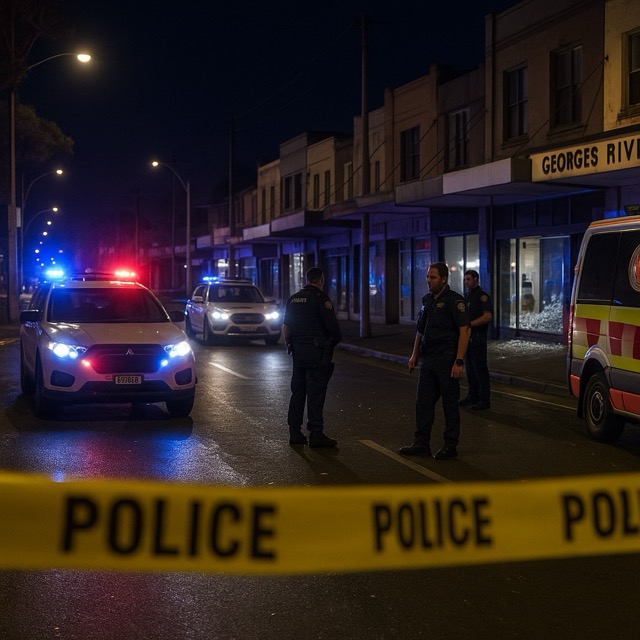
Sydney – For nearly two hours on Sunday night, a stretch of Georges River Road in Croydon Park—a normally sedate strip of bakeries, bottle shops and late-opening eateries—was transformed into a warlike scene. A 60‑year‑old man allegedly opened fire from an upper‑floor apartment, sending bullets ricocheting off shopfronts and cars and forcing residents to shelter in bathrooms and stairwells. By the time tactical police stormed the unit and took a suspect into custody, at least one person had been shot and seriously injured, and well over a dozen others had suffered wounds from flying glass and debris. Early tallies fluctuated through the night; by Monday morning, authorities said between 16 and 20 people had been treated, with one man undergoing emergency surgery after a neck wound.
The alleged gunman—identified by multiple officials as Artemios Mintzas—was arrested after what witnesses described as an intense exchange of fire with heavily armed officers. Detectives said a single .30‑calibre rifle was recovered from the premises. Police moved quickly to reassure the public that there were no signs of a broader plot or accomplices, and investigators said they had found no links to terrorism or organized crime. What remains unanswered is why the shooting happened at all—and how an older man in a quiet inner‑west block came to unleash dozens of rounds onto a busy Sydney street.
New South Wales Police said they began receiving emergency calls shortly before 7:45 p.m. on Sunday, reporting gunfire from a unit above a business. Within minutes, first responders arrived under fire, some officers narrowly avoiding bullets as they ushered pedestrians into cover and locked down surrounding blocks. Helicopters chopped overhead while armored vehicles edged into position. Tactical officers made their move around 9:30 p.m., detaining the suspect after deploying distraction devices. He suffered minor injuries during the arrest and was assessed at hospital before being questioned.
On Monday, investigators were still canvassing the street, photographing bullet‑scarred facades and collecting spent casings. Shattered plate glass littered footpaths where families had dined only an hour earlier; by daylight, shopkeepers swept up and taped makeshift plastic sheeting over windows. A popular restaurant displayed a constellation of holes punched through its front glazing. Residents spoke of crawling across lounge‑room floors to avoid the line of fire. “It was non‑stop—bang, bang, bang,” one local said. “I counted at least 30 before I stopped counting.”
Officials have been cautious about specifics as they reconstruct the timeline. Estimates of the number of shots vary widely—from more than 50 to as many as 100—reflecting both the intensity and the duration of the barrage. Senior officers said the weapon seized was capable of rapid fire but declined to confirm its make or magazine capacity. Police are now mapping each bullet impact to determine angles of fire and to corroborate witness accounts from multiple vantage points.
The most seriously injured victim, a man in his 50s who had been sitting in the back seat of a car, underwent emergency surgery overnight for wounds to his neck and chest. Hospital officials said he remained in a serious but stable condition on Monday. Paramedics treated scores of others for cuts, lacerations and shock, with two admitted for observation and later discharged. Authorities said it was “incredible nobody died,” given the density of evening foot traffic on the strip.
Police Commissioner Mal Lanyon praised the restraint and speed of the frontline response, noting that several officers drew fire as they shepherded civilians into nearby shops and homes. Premier Chris Minns called the episode “unprecedented” in recent Sydney memory, commending the courage of a probationary constable who came under direct fire while dragging a bystander to safety. Traffic was rerouted for much of the night and parts of Croydon Park remained cordoned off into Monday as forensic teams worked.
As details emerged, detectives pushed back at early social‑media speculation that the episode was ideologically motivated. Investigators said they had found no evidence of extremist materials, communications or planning, and that the suspect had no known affiliations with terrorist or gang networks. Nor was there any established history of significant mental health issues on police records, though a fuller picture will rely on medical assessments and interviews with family and colleagues. Transport for NSW confirmed the suspect had been employed with Sydney Trains; his employment status is now under review pending the outcome of the investigation.
At the heart of the probe are three urgent questions. First, motive: detectives are trawling devices seized from the unit, reviewing messages and search histories, and interviewing associates to determine whether a recent personal crisis—such as a relationship breakdown discussed by some acquaintances—played any role. Second, access: the provenance of the rifle and ammunition is a priority line of inquiry. Officers are examining whether the suspect held any firearms licence and how the weapon came into his possession. Third, opportunity: reconstruction of the hours leading up to the shooting aims to identify potential warning signs that were missed.
For residents, the policy questions arrived as quickly as the police tape. New South Wales maintains some of Australia’s strictest firearms laws, requiring licences, genuine reasons for ownership and secure storage. Even so, the Croydon Park rampage has renewed calls to audit leakage points—from theft and illicit importation to so‑called “grey market” firearms that pre‑date the national buyback. Gun‑safety advocates urged legislators to modernize tracing tools, speed up digital records sharing across agencies and tighten checks on high‑calibre, rapid‑fire platforms. Police said it was too soon to say whether any reforms would have averted Sunday’s attack, but promised a frank assessment when the facts are clearer.
Witnesses will likely be central to any prosecution. CCTV footage from shopfronts and buses captured portions of the fusillade and the police response; investigators appealed for motorists with dash‑cam vision from between 7:30 p.m. and 9:30 p.m. to come forward. The accused is expected to face multiple counts—potentially including attempted murder and a suite of serious firearms offences—once he is discharged from medical care and deemed fit for interview. Police said interviews would proceed in the presence of legal counsel.
Beyond the crime scene, the images that spread across Sydney were jarringly familiar to a city more accustomed to bushfire smoke than active‑shooter cordons: armoured vehicles edging into view; officers in ballistic helmets peering from behind riot shields; residents waving white tea towels from balconies as they requested evacuation. By Monday morning, school‑drop traffic threaded past plywooded windows; a florist delivered fresh stock to a shopfront where petals mixed with safety glass on the floor.
Community leaders urged restraint, warning against drawing conclusions in the vacuum left by an undeclared motive. Counselling services were offered to residents and business owners, and local councillors organized a dusk vigil. Clergy from nearby parishes opened halls for drop‑in support, while small‑business associations coordinated insurance assessors to expedite claims for damage and lost trading hours.
If there is a sliver of solace, it lies in the outcome that did not happen. Ballistics experts say that a rifle discharging at street level into a crowded commercial strip on a warm spring evening should, by any probabilistic measure, have produced fatalities. The lack of a death toll, they argue, speaks to a combination of luck, quick police containment, and hard lessons learned from previous critical incidents about how to lock down a moving scene.
In the coming days, the focus will shift from the shattered glass and patched‑over windows to quiet rooms where investigators piece together intent. Residents will want simple answers that may not come: why here, why now, and could it have been prevented? For now, Croydon Park reopens with a visible scar, and Sydney confronts a truth it hoped it had outgrown: even in a city with strict gun laws and relatively rare mass shootings, the risk of sudden, senseless violence is never entirely banished.


 The Tower Post