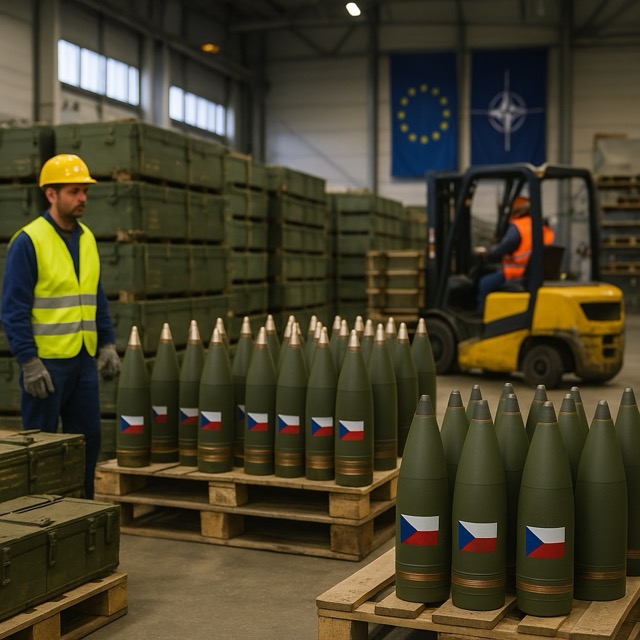
After ANO’s election win, Andrej Babiš signals an end to Prague’s high‑impact shell‑sourcing scheme for Ukraine. Industry, allies—and President Pavel—push back.
PRAGUE — In the immediate aftermath of his election victory on October 4, 2025, Andrej Babiš moved to redefine Czechia’s role in the war next door. The ANO leader, whose party captured roughly a third of the vote and now seeks partners to form a cabinet, has said he intends to end Prague’s signature “ammunition initiative,” the government‑run effort that scoured global markets for sorely needed 155mm artillery shells for Ukraine. The plan, launched in 2024 under Prime Minister Petr Fiala, became one of Europe’s most visible—and contentious—mechanisms for closing Kyiv’s shell gap.
The stakes are not abstract. According to figures cited by Czech and Ukrainian officials in recent weeks, the initiative has arranged deliveries on the order of 3.5 million large‑caliber rounds to Ukraine since its launch, with monthly shipments continuing this year. Foreign donors underwrote much of the tab while the Defence Ministry coordinated procurement through state channels and private brokers. Prague’s diplomats portrayed the scheme as a pragmatic fix while Western production ramped up—and as a model of middle‑power statecraft.
Babiš, by contrast, has attacked the programme as opaque and overpriced—“rotten,” in his own campaign phrasing. He has alleged that it created “war profits” worth up to tens of billions of crowns for intermediaries and promised to shine light on contracts. At the same time, he has said he will not forbid Czech companies from exporting to Ukraine, sketching a line similar to that of Slovakia’s Robert Fico: no state‑organised shipments, but no barrier to private trade.
That posture could mark a significant shift without an outright reversal. In practice, the initiative allowed the Czech state to pool allied money, guarantee logistics, and move fast in opaque markets where sellers feared Russian retaliation if named. Shifting responsibility onto firms alone would likely slow volumes and raise political risk. It would also test Babiš’s oft‑repeated claim that he can keep Czechia firmly in NATO and the EU while trimming support for Ukraine’s war effort.
A tense opening act has already played out between the president and the prime minister‑in‑waiting. President Petr Pavel—an ex‑NATO general who has championed the ammunition drive—met Babiš on Sunday and signalled he could push back on cabinet picks who threaten Prague’s pro‑Western orientation. Pavel has repeatedly argued the shells have had concrete battlefield effects and urged continuity. Diplomats in allied capitals are watching whether Prague tilts toward Hungary and Slovakia’s more restrictive stance or preserves a narrower, but still meaningful, channel of support.
Industry at the centre of the storm
No company has been more central to the initiative than the fast‑growing Czechoslovak Group (CSG), the defence‑heavy holding that has spent the past two years buying assets and expanding shell capacity. CSG says defence accounted for about four‑fifths of its 2024 revenues and more than three‑quarters of its sales mix. The group doubled revenue last year to roughly €4 billion and entered 2025 with an order backlog exceeding €11 billion, much of it in large‑calibre ammunition and vehicles. Alongside CSG, STV Group and Colt CZ Group have also been involved in supply chains feeding Ukraine—from heavy rounds and propellants to small‑arms and components.
Critics, including opposition senators and investigative outlets, have accused CSG and other contractors of applying steep mark‑ups—frequently citing comparisons that imply premiums of several hundred euros per 155mm shell. CSG has rejected the charge, arguing that headline factory‑gate prices don’t include transport, insurance, security, testing, or refurbishment and that the state set the terms and oversight. Defence officials add that sourcing in bulk from multiple continents in wartime conditions is costly by definition.
Supporters of the initiative point to outcomes. Czech and Ukrainian officials say that, thanks in part to the influx of rounds in 2024–25, Russia’s artillery advantage narrowed from roughly 10:1 to closer to 2:1. Ukrainian gunners also gained the flexibility to concentrate fire during local offensives rather than ration shells across the front. That tactical breathing room is fragile; commanders in Kyiv warn that any pause in deliveries will be felt within weeks at the line of contact.
Politics, not logistics, may now be decisive. Babiš insists he wants a one‑party cabinet but needs votes from smaller groups—the SPD and the Motorists—to win confidence in the 200‑seat lower house. Both have pressed for influence and hold harder lines on EU and NATO policy. Even if Babiš avoids seating openly anti‑NATO figures, his partners could shape budget priorities and put the ammunition project squarely on the chopping block during coalition bargaining.
For the defeated government, the change is abrupt. Petr Fiala has conceded and begun preparing his centre‑right coalition for opposition. Several ministers warn that ending the shell drive would erode Prague’s newly‑won clout in Europe, where the initiative was often cited as proof that a medium‑sized member state could move the needle on Ukraine. Diplomats involved in the donor pool say they could reroute money to other channels, but admit that Prague’s network of brokers and exporters would be hard to replicate quickly.
What changes—and what doesn’t
Even if the state steps back, Czech factories won’t go quiet. Demand for 155mm rounds remains hot as European militaries refill stockpiles and commit to higher spending. CSG has invested in new lines and vertical integration, while Colt CZ has moved upstream into energetic materials and ammunition through a series of acquisitions. STV Group continues to straddle procurement and production. The question is not whether these firms will sell shells, but whether Prague will curate those sales strategically—or leave them to the market and allied governments.
For Kyiv, the signal matters as much as the shells. Prague’s initiative did more than move metal; it rallied a coalition of funders and set a rhythm of monthly deliveries that commanders could plan around. If the new government shutters the programme, Ukraine will lean even harder on bilateral deals with France, Germany and the Nordics, and on NATO‑level coordination. That patchwork can work, but it is less nimble than a single national hub with political cover.
Babiš’s calculus runs through domestic economics. He campaigned on raising wages, taming prices, and re‑prioritising spending at home. Casting the ammunition initiative as a case of padded margins and “war profits” allows him to argue that billions of crowns should flow to households and public services instead of to middlemen. His opponents counter that the programme channelled foreign money into Czech factories and logistics firms, supporting jobs while serving a vital security interest on the EU’s eastern flank.
Two immediate tests will reveal the new line. First, whether ANO’s coalition agreement explicitly commits to ending the initiative—or punts the decision to a review couched in terms of transparency and efficiency. Second, whether Prague continues to coordinate allied procurement and logistics informally, even if the formal “initiative” brand disappears. Either path will reverberate in Brussels and Kyiv.
For Europe, the episode is a reminder of how much Ukraine’s lifelines still depend on politics in capitals beyond Kyiv. Czechia’s ammunition initiative filled a critical gap at a critical time. Whether it survives, mutates, or ends under Babiš will say a great deal about where Prague positions itself in the next phase of the war—and whether a success story of agile European security policy was a bridge to a broader, more institutional effort, or a brilliant one‑off.

 The Tower Post