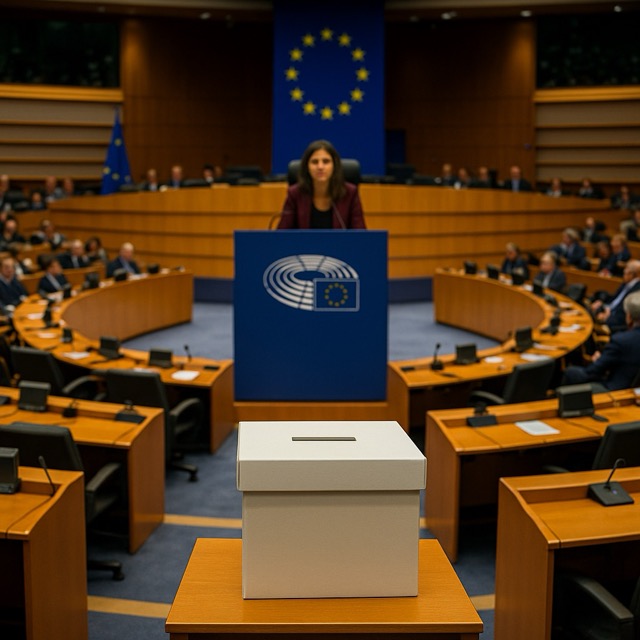
On Tuesday, October 7, the European Parliament will hold a secret ballot on the Italian MEP’s immunity as a Hungarian trial looms. A key committee report warns of ‘persecution’ against her.
Strasbourg/Brussels
The European Parliament is poised for a high‑stakes, secret vote on Tuesday, October 7, that will determine whether to uphold the parliamentary immunity of Italian MEP Ilaria Salis. The decision, expected around midday during the Strasbourg plenary, follows a razor‑thin recommendation from the Parliament’s Legal Affairs Committee (JURI) to reject a Hungarian request to lift her protections. The committee’s rapporteur, Bulgarian liberal Ilhan Kyuchyuk, warned of a clear ‘fumus persecutionis’—a presumption of political persecution—arguing that judicial actions by Budapest appear aimed at undermining Salis’s work as a newly elected member of the European legislature.
Salis, a former schoolteacher from Monza and a prominent antifascist activist, was arrested in Budapest in February 2023 after clashes around a far‑right demonstration. Hungarian prosecutors accuse her of causing bodily harm to three alleged neo‑Nazis and of involvement with a far‑left extremist group. Salis denies the charges. Images of her being led into a Hungarian courtroom in shackles in January 2024 sparked outrage across Italy and Europe, accelerating a debate over due process, detention conditions, and Hungary’s rule‑of‑law record.
The political backdrop is stark. Prime Minister Viktor Orbán’s government has repeatedly clashed with EU institutions over judicial independence and fundamental rights. While Hungary insists the Salis case is a straightforward criminal matter, JURI’s narrow 13–12 vote on September 23 signaled deep unease among lawmakers about the timing and tenor of the prosecution. The rapporteur’s report—now before the full chamber—asserts there is “concrete evidence” that the proceedings could weaken Salis’s political activity as an MEP, framing the issue as larger than one defendant: a test of the Parliament’s resolve to defend its members against politically motivated legal action.
At the same time, Tuesday’s outcome is anything but assured. The ballot will be secret, and party whip counts are wobbly. The center‑right European People’s Party (EPP) has hinted it will lean toward lifting immunity, stressing that elected office must not become a shield against serious allegations of violence. Liberals, Greens, and much of the Left are expected to back JURI’s line, while some conservatives and far‑right groups have campaigned for revocation. Several delegations, however, may break ranks in a secret ballot—particularly those haunted by the precedent the vote could set for their own members or political allies in contentious national cases.
For Salis, the stakes are immediate. If the plenary lifts her immunity, Hungary could press ahead in court with fewer procedural obstacles, potentially forcing repeated travel to Budapest and exposing her to pretrial restrictions that, supporters say, would hamstring her parliamentary work. If immunity is upheld, prosecutors could continue to seek evidence and build their case but would need fresh authorization to take most coercive steps against her. In either scenario, the Parliament is not adjudicating guilt or innocence; rather, it is weighing whether the judicial process in question is compatible with its duty to protect the integrity of the EU mandate.
In recent weeks, advocacy groups and legal associations have flooded MEPs with briefs. Civil‑rights organizations warn that granting Hungary’s request would ‘normalize political persecution’ within the EU, citing court findings and monitoring reports that criticize Budapest’s handling of dissent. On the other side, Hungarian officials and allied media outlets argue that Salis’s case involves violent acts, not speech, and that any suggestion of bias is a smear against the country’s judiciary. The rhetoric has sharpened as the plenary nears, with both camps claiming the mantle of the rule of law.
Procedurally, the Parliament’s rules require the Legal Affairs Committee to examine requests to waive immunity and to recommend a course of action to the full house. The final decision rests with MEPs voting by secret ballot. While such votes are uncommon, they are not unprecedented, and the secrecy is designed to reduce political pressure and allow for conscience voting. JURI’s report in Salis’s case is unusually forceful in its language, invoking ‘persecution’ and detailing a pattern of public vilification and prosecutorial zeal that, in the rapporteur’s view, crosses a line.
The case has also tested Italy’s fractious politics. Rome’s government has faced pressure from across the aisle to protect an Italian citizen subjected to what critics call degrading treatment during detention. After more than a year in custody, including periods described by her lawyers as unsanitary and punitive, Salis returned to Italy following her election to the European Parliament—a reminder of the protective function immunity can play. Yet even within Italy, opinion splits: some lawmakers emphasize the gravity of the alleged offenses and the need to let courts proceed; others frame the case as emblematic of democratic backsliding in an EU member state.
A broader institutional question looms over Tuesday’s vote: how should the EU balance respect for national judicial processes with its obligation to safeguard democratic institutions from abuse? Hungary’s detractors argue that the Salis affair cannot be divorced from years of rule‑of‑law disputes involving media freedom, academic autonomy, and the separation of powers. Budapest retorts that Brussels is meddling and that political labels—’far‑right,’ ‘antifascist’—should be irrelevant to a neutral assessment of evidence. The Parliament’s decision will inevitably be read as a signal to governments across the bloc about the standards it expects for fair trials and independent justice.
Diplomats in Brussels describe an unusually fluid endgame. Because the ballot is secret, public statements from political groups may not predict the final tally. A handful of swing delegations could decide the outcome, and amendments from the floor are not on the table; MEPs can only vote to lift or to maintain immunity. The vote is expected between 12:00 and 13:00 on Tuesday; results should surface shortly thereafter. Should immunity be maintained, the Hungarian government would likely denounce the decision and consider alternative avenues. Should it be lifted, the case could move swiftly back into a Hungarian courtroom, with immediate consequences for Salis’s schedule and legal exposure.
Beyond the parliamentary arithmetic, the human story remains. Salis has portrayed herself as a target of a political vendetta that intensified after her election. Victims in the Budapest incidents, and their supporters, say justice has been delayed and distorted by political theater. In a Europe already riven by debates over extremism and civil liberties, the Salis vote is a rare moment when abstractions about the rule of law collide with the fates of named individuals—defendant and alleged victims alike.
Whatever Tuesday brings, both sides claim to defend democratic values. That may be precisely why the decision matters beyond Strasbourg. If MEPs conclude that the proceedings in Hungary are tainted by political intent, they will assert a bright‑line defense of parliamentary independence. If they decide that national courts should proceed unimpeded, they will reassert the primacy of accountability when violence is alleged. Either choice will echo in the next rule‑of‑law debate, the next immunity case, and the next confrontation between EU institutions and a member state government at odds with Brussels.
What to watch on Tuesday, October 7
Secret ballot in Strasbourg between 12:00 and 13:00; immediate announcement expected.
Possible cross‑party defections despite official group lines.
If immunity is lifted: accelerated court proceedings in Budapest; travel and procedural constraints for Salis.
If immunity is upheld: political backlash from Budapest; renewed rule‑of‑law sparring in Brussels.
Reporting based on committee documents, parliamentary sources, and contemporaneous coverage from major European news outlets.



 The Tower Post