
With the co‑founder of EM&E now chairing Indra — and his elder brother leading the seller — Madrid’s drive for a national defence champion faces a conflict‑of‑interest stress test.
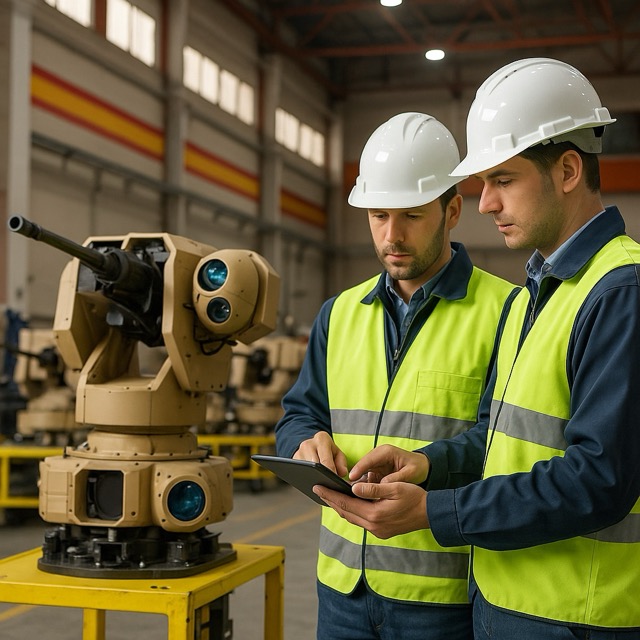
MADRID — A proposed tie-up between Indra, Spain’s state‑backed defence and technology group, and Escribano Mechanical & Engineering (EM&E) has pushed the country’s industrial policy into an awkward family conversation. Ángel Escribano, the former co‑founder of EM&E, became Indra’s executive chairman in January. His elder brother, Javier, chairs EM&E — and is seeking a transaction that could fold the weapons-systems manufacturer into Indra via a share‑for‑share deal. Supporters call it a logical consolidation to forge a Spanish champion; critics see a high-wire governance act that will define how far Madrid is willing to go to scale its defence industry.
Indra’s board has set up an ad hoc independent committee to evaluate the deal and wall off conflicted directors from deliberations. Even so, scrutiny has intensified after at least one member resigned in late August, a reminder that process matters when a potential €1–1.5 billion transaction is being advanced by siblings who also control the target and wield influence at the buyer. The optics would be delicate anywhere; they are especially so at Indra, where the state holding SEPI is the largest shareholder and where corporate setbacks are political stories as much as market events.
What is on the table? According to people familiar with the discussions, Indra is studying a capital increase and share exchange that would bring EM&E into the group without a cash outlay, leaving the brothers among Indra’s top shareholders. The structure aims to align incentives and keep manufacturing capacity in Spain, while avoiding leverage at a time of rising programme commitments. For Indra, the prize is vertical integration: EM&E’s remote weapon stations, electro‑optics and guided‑munitions kits would plug into Indra’s command‑and‑control, sensors and avionics business lines, tightening delivery schedules and margins across large domestic programmes.
The ambition is unmistakable. Indra has spent the past two years recasting itself from an IT‑and‑services conglomerate into a defence‑first platform that can credibly compete with Europe’s mid‑tier heavyweights such as Rheinmetall and Leonardo. Management has pushed deeper into land systems, signed cooperation pacts on armoured vehicles, and carved out a Space unit to ride demand for secure communications, navigation and Earth‑observation. Bringing EM&E inside the perimeter would add hard‑metal production heft to Indra’s electronics and systems integration, extending the group’s reach from software to steel.
Timing also favours scale. European defence budgets have surged since Russia’s full‑scale invasion of Ukraine; Spain has committed to lift spending toward NATO’s 2% of GDP benchmark and has queued up multi‑year purchases in sensors, air defence and ground‑combat vehicles. On the export front, EM&E has moved fast, selling to Middle Eastern clients and bidding more aggressively in Europe. A combined group would be positioned to capture work not only from the Spanish Ministry of Defence’s flagship programmes but also from pan‑European initiatives seeking resilient, sovereign supply chains.
Yet the very logic that excites investors is what alarms governance purists. EM&E is Indra’s second‑largest private shareholder; the brothers co‑own EM&E and have board‑level roles in the buyer and seller. Even with recusals and Chinese walls, the perception of influence lingers — on information flows, valuation assumptions and the selection of advisers. That perception risk is not abstract: it can translate into a higher governance discount in Indra’s equity, a tougher ride with regulators, and a vulnerability to legal challenges if minority investors feel process was rushed or opaque.
Indra has tried to get ahead of those concerns. The company formed a special committee to ring‑fence the analysis and brought in a roster of heavyweight banks to advise. People involved say the mandate is to run a textbook process: independent fairness opinions, sensitivity analyses on synergies and programme backlogs, and a clear sequencing of votes at both boards. Any deal will also need to navigate competition scrutiny and, potentially, Spain’s foreign‑investment screening regime, given EM&E’s export footprint and the strategic nature of certain technologies.
For Spain’s government, the trade‑off is stark. Madrid has long sought a homegrown champion capable of keeping higher‑value defence work onshore and giving the country clout in Brussels‑level industrial initiatives. French and German groups have scaled aggressively; Italy rebuilt Leonardo’s credibility; and the UK’s primes have locked in programmes for a generation. Allowing Indra to bolt on EM&E could accelerate Spain’s own catch‑up — but it also concentrates power in a single ecosystem tied to one family, which carries its own risks over the long arc of procurement politics.
Investors, for now, are inclined to look through the controversy. Indra’s share price has rallied sharply this year on expectations of backlog growth and margin expansion in defence, and several sell‑side houses have framed the EM&E transaction as strategically accretive if the price is disciplined. They cite synergies in electro‑optics, turrets and remote weapon stations; rationalisation of supplier lists; and faster bid‑to‑delivery cycles if design and manufacturing sit under one roof. The market reaction underscores a broader European pattern: in a security‑first policy phase, capital increasingly rewards consolidation moves that once might have met stiffer antitrust or governance headwinds.
Still, several fault lines bear watching. First is valuation. EM&E has grown fast — posting mid‑hundreds of millions of euros in revenue and targeting a steep climb by the decade’s end — but much of its value hinges on execution of new export campaigns and the stickiness of Middle Eastern demand. Second is programme risk: integrating manufacturing while Indra scales its Space and land‑systems units could stretch management bandwidth, especially if supply‑chain pressures persist. Third is process: the credibility of the independent committee, and the clarity with which recusals are documented and enforced, will colour perceptions long after any shares change hands.
There is precedent for Spain to thread this needle. Years of messy governance rows at Indra — including high‑profile boardroom shake‑ups — have given way more recently to a tighter strategic focus and improved execution. If the company can run a process that is boring by design — transparent, independently validated and paced to allow proper scrutiny — it may yet claim both the industrial logic of the deal and the legitimacy to carry it out.
For the Escribano brothers, the stakes are personal as well as strategic. Supporters say they have earned their influence by building EM&E from a small machining shop into an exporter of complex systems; detractors warn that the optics of brother‑to‑brother deal‑making are too combustible for a partly state‑owned buyer. Spain’s bid for a national champion now hinges on whether this family‑entwined transaction can be made to look — and be — as clean as its supporters insist.
Sources
— Financial Times, “Brothers in arms: Spanish defence merger raises conflict questions,” October 6, 2025.
— Cinco Días (El País), “Los analistas avalan la compra de Escribano…,” October 2, 2025.
— Cinco Días (El País), board/space coverage noting committee and governance steps, September 30, 2025.
— ARA, “Indra’s board debates the acquisition of Escribano…,” July 10, 2025.
— Indra company statements and corporate governance bio pages, January 20 & 19, 2025.



 The Tower Post