
Top investor warns the continent must accelerate sovereign launchers, satellites and defence-tech start-ups — or risk strategic dependence on Elon Musk’s group.
Brussels and Paris — Europe’s tech and security establishment is grappling with a blunt message from one of the region’s most seasoned venture capitalists: relying on Elon Musk’s SpaceX for critical launch and connectivity is a strategic gamble the continent can’t afford. Bernard Liautaud, managing partner at Balderton Capital, said Europe should sprint to build its own space industrial base and channel the venture boom in defence-tech toward satellites, launchers and dual‑use software that underpin military power.
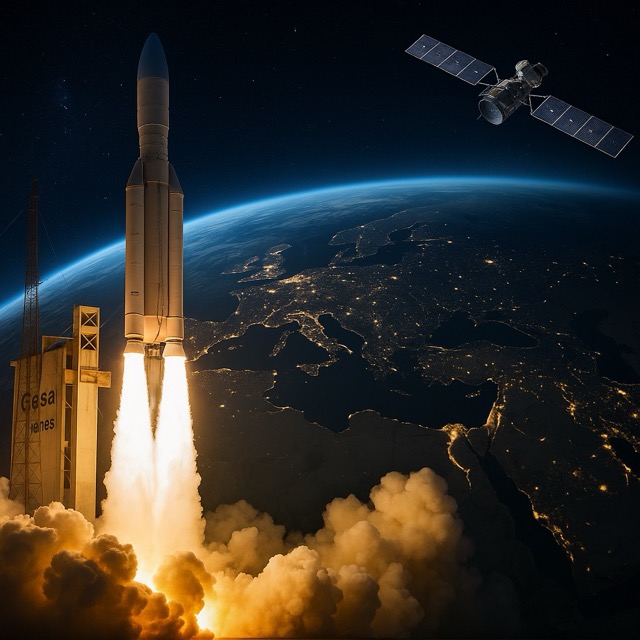
His warning lands as Europe’s access-to-space story enters a delicate phase. Ariane 6 finally notched its first fully commercial mission in March — lofting France’s CSO‑3 reconnaissance satellite from Kourou — yet the launcher’s cadence is still ramping and critics say its economics cannot match SpaceX’s partially reusable Falcon 9. After years of delays to Ariane 6 and the grounding of Italy’s Vega‑C, European governments routinely booked SpaceX to keep flagship science and security missions on track, undercutting the ideal of ‘autonomous access to space’.
Liautaud’s central concern is sovereignty. In an era when satellite internet, remote sensing and precision navigation are integral to battlefield advantage, Europe’s dependence on a U.S. commercial provider — however reliable and innovative — is a vulnerability. He is far from alone: security officials from Paris to Berlin have increasingly framed space as a strategic domain, directing public money to shore up domestic capability and to crowd in private capital.
That public effort is visible in the EU’s IRIS² secure-communications constellation, a €10.6 billion programme designed to give European institutions and partner governments an encrypted, multi‑orbit backbone. Alongside IRIS², France and the UK have tightened their embrace of Eutelsat/OneWeb as a European counterweight to Starlink, injecting fresh capital to accelerate deployments. The thread running through these moves: sovereign satcom capacity is no longer a luxury.
For launch, Europe’s house is only partly back in order. Ariane 6, operated by Arianespace and built by ArianeGroup, restored heavy‑lift capability with March’s CSO‑3 success. But the market has shifted under Europe’s feet. SpaceX has normalised weekly, often daily, launches at prices European rockets struggle to meet, while reusable vehicles from the U.S. — and soon Blue Origin’s New Glenn — push costs lower. If Ariane 6 cannot climb to a reliable tempo and competitive cost, European governments will keep sending payloads to Florida.
That tension is already shaping industrial strategy. Airbus, Thales and Leonardo have been in stop‑start talks over deeper satellite consolidation, and ESA officials have warned against creating a single national champion that stifles competition even as they seek the scale to take on Starlink. The balance — between sovereignty, competitiveness and resilience — is proving hard to strike.
Yet Europe has an advantage it lacked a decade ago: a flourishing defence‑tech start‑up scene. Since Russia’s 2022 invasion of Ukraine, venture investors have poured money into dual‑use software, smallsat constellations, space situational awareness and ISR tooling. Founders who once avoided the sector for fear of slow sales cycles now find ministries and procurement agencies actively courting them. Liautaud and his peers argue this is Europe’s moment to create dozens of space‑adjacent defence champions — if the regulatory and procurement bottlenecks don’t strangle momentum.
Policy is catching up. NATO’s DIANA network and the EU’s evolving defence procurement rules have opened doors for young companies. France’s DGA and Germany’s BAAINBw are experimenting with faster, milestone‑based contracts; the UK is funding prototypes to harden satellites against lasers and jamming. The broader lesson from Ukraine — that resilient, proliferated satellite networks, paired with AI‑accelerated targeting and secure comms, can change fights in real time — has filtered into European doctrine.
Still, three gaps loom. First, launch. Europe needs multiple, competitive options beyond Ariane 6: a revived Vega‑C, micro‑launchers for responsive tasks, and eventually reusable systems that bring per‑kilogram costs down. Second, satcom scale. OneWeb’s 650‑plus satellites remain far short of Starlink’s numbers and throughput; filling that gap will require years of investment and a ruthless focus on reliability. Third, procurement speed. Start‑ups cannot wait 24 months for a requirements document to be finalised. If Europe wants its own Andurils for space, it must buy quickly and iterate.
The investor case is strengthening. Defence budgets across the continent are at multi‑decade highs, with space now explicitly listed as a pillar of national security. A growing number of sovereign wealth funds and government‑backed vehicles are signalling that ‘sovereign tech’ — from microelectronics and compute to launch and satcom — is investable at scale. The opportunity is not just to match SpaceX; it is to build differentiated European strengths in secure networking, in‑orbit services, Earth observation analytics and debris mitigation.
This is not a call to wall Europe off from U.S. partners. Interoperability with allied systems will remain essential. But the ability to choose — to launch sensitive payloads from European soil and to route critical communications over European constellations — is what sovereignty looks like in space. Today, that choice is too often theoretical.
There are signs of momentum. Ariane 6’s orderbook includes government and commercial missions; European start‑ups are testing orbital transfer vehicles, refuelling tech and heat‑resistant materials; and national space commands are spinning up requirements for ‘responsive launch’ — the ability to replace or augment satellites in days, not months. Investors say those mission‑driven demand signals, rather than subsidies alone, will anchor sustainable businesses.
But Europe must confront hard arithmetic. Without reusability, annual subsidies and political guarantees may be needed to keep heavy‑lift capacity alive while new technologies mature. Meanwhile, the economics of mega‑constellations favour players willing to deploy thousands of satellites and fund constant refresh cycles. If Europe spreads capital across too many small programmes, none will reach escape velocity.
The good news is that Europe’s upstream space ecosystem — from propulsion to avionics and small launch — is richer than its reputation suggests. The missing piece has been a single, coherent doctrine that links procurement to industrial policy and capital formation. Liautaud’s provocation is useful precisely because it sharpens that doctrine: stop debating whether SpaceX is good or bad for Europe and get on with the work of competing where it matters.
What would a credible 2025–2030 playbook look like? First, lock in a predictable flight cadence for Ariane 6, with transparent cost targets and a glide path to next‑gen partially reusable systems. Second, scale OneWeb and IRIS² with multi‑year, multi‑country commitments that buy bandwidth like a utility — clear volumes, clear SLAs, and clear upgrade cycles. Third, put ‘fast lanes’ in place for dual‑use procurement so start‑ups can win defence‑grade sales in quarters, not years. Fourth, expand space‑domain awareness and debris mitigation as public‑private partnerships: every new constellation raises collision risk, and Europe can lead on norms and services to keep orbits usable.
Finally, communicate the opportunity. Europe’s decade in space will not look like NASA‑style prestige projects. It will look like new logistics chains, payload‑agnostic launch, high‑availability satcom, pervasive sensing, and software‑defined defence. If Europe can stitch those pieces together — and fund them at the scale the moment demands — it won’t need to ‘rely’ on SpaceX. It will trade with it as a peer.
Facts & Context: Ariane 6 made its maiden flight in July 2024 and its first fully operational mission on March 6, 2025, carrying France’s CSO‑3 military satellite. The EU’s IRIS² programme is budgeted at roughly €10.6 billion. France and the UK have led fresh funding in Eutelsat/OneWeb to scale a European alternative to Starlink. Industrial consolidation talks among Airbus, Thales and Leonardo continue amid calls to avoid unhealthy monopolies.
The stakes could not be higher. Space is the invisible scaffolding of Europe’s economy and defence. Autonomy does not mean isolation, but it does mean ensuring the continent’s critical orbits cannot be switched off by a decision taken in another capital. That is the frontier now opening to Europe’s start-ups — and the challenge its leaders must meet.
Sources
– Financial Times, Oct. 6, 2025: Bernard Liautaud warns Europe cannot rely on SpaceX and urges acceleration of sovereign space capabilities.
– Reuters, Mar. 6, 2025: Ariane 6 completes first fully operational launch carrying CSO-3 spy satellite.
– ESA (European Space Agency), Mar. 6, 2025: Ariane 6 first commercial flight (VA263) mission update.
– Reuters, Sep. 26, 2025: ESA officials warn against monopolies as Europe weighs satellite consolidation to compete with Starlink.
– Reuters, Sep. 30, 2025: France and UK back Eutelsat/OneWeb funding to counter Starlink; call for broader EU support.
– Light Reading, Oct. 2, 2025: IRIS² programme milestones and Eutelsat capital increase as Europe seeks Starlink alternatives.




 The Tower Post