Beijing’s South Asia forays—and why New Delhi fears an encirclement

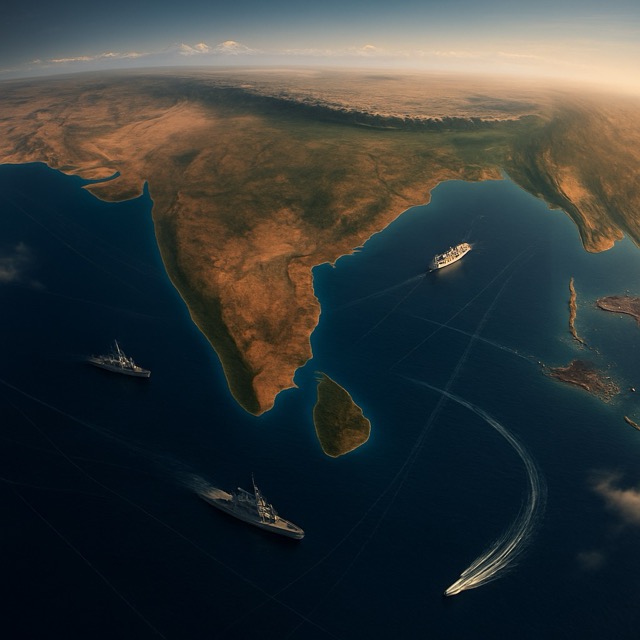
On an overcast August afternoon in Colombo, three warships crowded the skyline: a United States littoral combat ship making a courtesy call, an Indian destroyer refueling ahead of exercises with the Sri Lankan navy, and, just out of sight beyond the breakwater, a Chinese survey vessel awaiting clearance it would not receive. That tableau captured the strategic churn of South Asia in 2025—where Beijing’s diplomatic and maritime forays are testing the region’s balance and sharpening anxieties in New Delhi about being “encircled.”
Five years after clashes in the Galwan Valley pushed India–China ties to their lowest ebb in decades, the relationship is edging—cautiously—toward a managed thaw. Direct commercial flights are due to resume in late October after a five‑year freeze, following a sequence of confidence-building steps that included partial disengagements at remaining friction points along the Line of Actual Control and a resumption of the Kailash Manasarovar pilgrimage across Tibet. Yet the tentative stabilisation on the high Himalayas has been paired with a flurry of Chinese statecraft across India’s maritime and littoral neighbourhood—from Sri Lanka and the Maldives to Bangladesh and Nepal—that keeps Indian strategists on edge.
In Sri Lanka, Beijing’s economic and political imprint is long-standing: the 99‑year lease of the Hambantota port, the Colombo Port City project, and a steady tempo of naval and research‑vessel visits. After months of pressure from India and the United States, Colombo tightened approvals for foreign research ships, citing the need for new standard operating procedures. But the reprieve is narrow. A decision to lift the blanket ban on such visits from 2025 signals that China’s high‑tech survey fleet will likely return under new rules—an outcome New Delhi sees as a revolving door that can swing open with political winds.
The Maldives illustrates a different arc. Elected in 2023 on an ‘India Out’ platform, President Mohamed Muizzu demanded the withdrawal of roughly 90 Indian military personnel who had been stationed to support medical evacuations and maritime surveillance. By mid‑2025, a reset was underway. After trust‑building measures and incentives from New Delhi, Prime Minister Narendra Modi’s state visit in July—timed with the Maldives’ 60th Independence Day—signalled a pragmatic pivot back to cooperation. Even so, Beijing has not stood still: Chinese financing for housing, bridges, and renewable projects keeps the door open for influence, and Malé continues to court multiple patrons as a hedge.
Nowhere has China’s diplomatic energy been more visible in 2025 than in Bangladesh. Under the interim administration led by Nobel laureate Muhammad Yunus, Dhaka has pursued a sharper turn toward Beijing. The two sides marked the 50th anniversary of diplomatic relations this October with warm public messaging and momentum behind the long‑discussed Teesta River Comprehensive Management and Restoration Project. Dhaka has sought roughly $550 million in Chinese loans for the project’s first phase, and Beijing has agreed to dispatch a technical team. For India, which shares the Teesta’s waters and worries about strategic assets along its vulnerable ‘chicken’s neck’ corridor, the optics of a flagship Chinese‑backed river project in northern Bangladesh are unsettling.
Chinese diplomacy in Kathmandu has also quickened. Beijing continues to promote trans‑Himalayan connectivity, including the ambitious (and technically daunting) China–Nepal railway from Shigatse to Kathmandu. While timelines remain nebulous and cost and terrain challenges are acute, China has expanded rail‑road multimodal freight services to Nepal and strengthened political ties. New Delhi’s response has been to double down on its own connectivity playbook: cross‑border transmission lines, trade facilitation, and steady budgetary support, couched in the language of ‘neighbourhood first.’
Against this backdrop, India has sought to harden its own perimeter. With Bhutan, New Delhi moved ahead this month with plans for the first‑ever cross‑border rail links, following a fresh inter‑governmental MoU and a high‑level visit by Foreign Secretary Vikram Misri. These steps come as China and Bhutan report “advancing” boundary talks, including sensitive exchanges about the Doklam plateau overlooking India’s Siliguri corridor. For Indian planners, accelerating physical and economic integration with Thimphu is both development policy and strategic insurance.
Meanwhile, India’s security engagement with island neighbours has expanded. New Delhi has boosted logistics support and training for Sri Lanka and the Maldives and pressed for more transparency over foreign research‑vessel activities that can map seabed features crucial for submarine operations. The Indian Navy’s exercises with Colombo (SLINEX‑2025) and stepped‑up joint patrols underscore a maritime strategy aimed at denial rather than dominance: make it harder, costlier, and more politically fraught for extra‑regional navies to operate persistently in India’s near seas.
For Beijing, the South Asia push serves multiple ends. First, it dilutes India’s primacy in its own neighbourhood, complicating New Delhi’s crisis calculus. Second, it secures diversified access to the Indian Ocean via ports, dual‑use infrastructure, and logistics nodes—critical to China’s energy security and blue‑water ambitions. Third, it offers diplomatic leverage on the Himalayan front: if the border remains a pressure point, Beijing can apply counter‑pressure in the Bay of Bengal and Arabian Sea by tightening ties with India’s smaller neighbours. This is not a formal ‘string of pearls’ so much as a flexible lattice that expands and contracts with opportunity.
India rejects the narrative of encirclement, arguing that the region’s democracies are not easily bought and that Indian growth, market access, labour mobility, and security public goods remain unmatched. Even so, officials concede that the diplomatic playing field is flatter than at any time since the end of the civil war in Sri Lanka. Political volatility in Dhaka, the lingering imprint of Hambantota’s debt‑for‑equity swap, and domestic pressures in Kathmandu create openings that a patient and well‑resourced China can and does exploit.
The limited thaw in India–China ties this year has mostly been transactional. The resumption of flights will reconnect business communities and families and could marginally improve a trade relationship that remains lopsided in China’s favour. Indian concerns about a near‑$100 billion trade deficit persist, and New Delhi continues to deploy industrial policy to reduce dependencies in telecoms, solar, and electronics. Border protocols, too, remain brittle: in the eastern sector, China has continued to rename locations in Arunachal Pradesh on its maps, while both militaries sustain high‑altitude infrastructure build‑ups and forward deployments—even as they experiment with new patrolling arrangements at disengagement sites.
Looking ahead, three tests will shape whether ‘managed competition’ can stick or relapse into crisis. The first is maritime transparency. If Sri Lanka finalises clear, non‑discriminatory SOPs for research and survey vessels—and enforces them—the friction generated by opaque high‑frequency port calls could ease. If the rules become a revolving door, the Indian Ocean will remain a theatre of signalling and counter‑signalling. The second is water and connectivity. Chinese execution of the Teesta project and any concrete movement on the China–Nepal railway will be watched in India not just for environmental or financial risk, but for strategic externalities. The third is border discipline. Quiet working‑level disengagements need to be insulated from domestic politics in both countries, and hotline diplomacy must be routinised rather than episodic.
There are also opportunities. Climate resilience and disaster response in the Bay of Bengal is an obvious one: India and China are both investing in early‑warning systems, coastal infrastructure, and renewable power. Coordinated assistance—through the SCO or ad‑hoc coalitions—could reduce duplication and build habits of cooperation. Limited confidence‑building on Himalayan hydrology and glacial lake outburst flood (GLOF) warnings would have direct humanitarian benefits downstream in India, Nepal, and Bhutan. Even modest success in such areas could create political space to keep economic normalisation on track.
But the strategic reality is clear: Beijing will keep probing India’s near abroad, and New Delhi will counter with a mix of inducements, pressure, and public‑goods provision. The risk is not a grand bargain or a dramatic rupture; it is the slow accretion of facts on the water and concrete on land that shifts regional alignment by increments. In that contest of corridors, ports, and policies, smaller South Asian states will continue to maximise their options—taking what they can from both giants while trying not to be squeezed between them.
If India wants to allay fears of encirclement, it must move faster on delivery: finish promised grid links and rail spurs, keep visas and flights open, and sustain predictable lines of credit without onerous conditionalities. China, for its part, will try to keep the heat low on the border while raising it—subtly—in the Bay of Bengal. For the rest of South Asia, the smartest strategy is to turn rivalry into leverage, extracting infrastructure and market access from both while insisting on transparency and environmental prudence. The new great game is not zero‑sum, but the side that shows up on time with affordable, durable solutions will win more rounds.
Sources (accessed Oct 6, 2025)
• Reuters: India and China to resume direct flights by late October 2025.
• AP News / Al Jazeera / Indian Express: coverage of the flight resumption and routes.
• The Diplomat (Jul 17, 2025): India seeks to stabilise newly thawed relations; disengagement steps in late 2024.
• CFR Backgrounder (Sep 10, 2025): Resumption of the Kailash Manasarovar pilgrimage in 2025.
• IISS Analysis (Apr 23, 2025): India steps up defence and security engagement with island neighbours; research vessels issue.
• OE/TRADOC (Sept 2025) and Sri Lankan reporting: suspensions/controls on research vessel visits and SOPs debate.
• DD News & PTI/Daily Pioneer (Oct 2025): India–Bhutan rail links MoU and follow‑up visit by Foreign Secretary Misri.
• Bangladeshi outlets (Prothom Alo, The Financial Express, TBS News, Daily Sun): Chinese technical team and loan requests for the Teesta project; official PRC/Bangladesh statements marking 50 years of ties.
• East Asia Forum (Sep 5, 2025): Modi’s July 2025 Maldives visit and reset.



 The Tower Post