
From Gaza and Lebanon to Myanmar, the Taiwan Strait and the South China Sea, how October 2025 is reshaping Asia’s security map
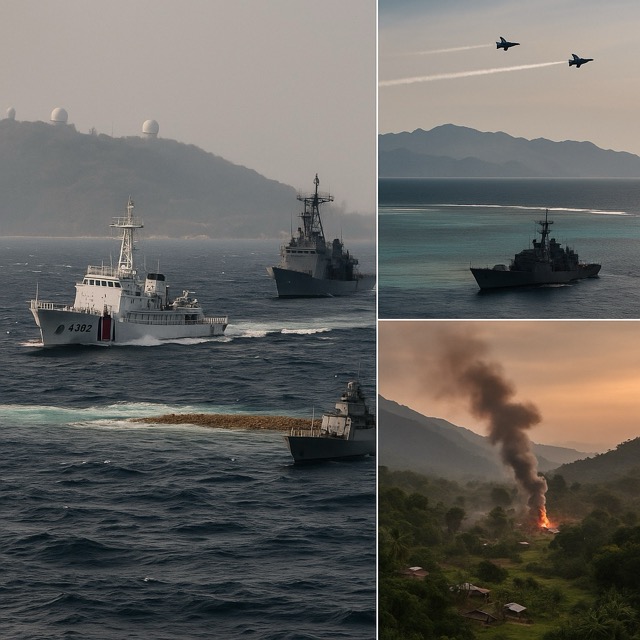
Asia enters October 2025 with multiple active war zones and flashpoints that overlap geographically, politically, and economically. The scale and simultaneity of these crises—in Gaza and now southern Lebanon, across Myanmar’s civil war, around Taiwan and the broader Western Pacific, and at contested reefs in the South China Sea—are testing regional alliances and the credibility of international law. What follows is a field-by-field snapshot of where the fighting stands, why it matters, and what to watch in the weeks ahead.
Gaza and Southern Lebanon: A Two-Front War with Regional Ripples Fighting between Israel and Hamas is now in its second year since the October 2023 attacks. As of early October 2025, mediators in Egypt are working to translate a U.S.-backed framework into a ceasefire-and-hostage-release package. The plan envisions Hamas relinquishing control and disarming in stages in return for prisoner releases and a phased Israeli withdrawal, while a multinational structure would oversee security and reconstruction. Yet combat has continued, underscoring how fragile the diplomacy remains.
The war has also spilled northward. Israeli ground operations inside Lebanon followed months of exchanges with Hezbollah that depopulated border communities and destroyed critical infrastructure. The Israel–Hezbollah front now functions as a second, distinct theater—one that adds escalation risks for the entire Levant. Even limited breakthroughs in Gaza talks will not automatically pacify Lebanon, where red lines differ and local trigger points can ignite independent cycles of retaliation.
Humanitarian tolls continue to mount. Gaza’s health system and basic services have been repeatedly degraded by bombardment and siege conditions. Southern Lebanon, meanwhile, has absorbed significant displacement and targeted strikes, including episodes that decimated civilian areas and energy networks. The cumulative effect is to harden public opinion, complicate diplomatic trade-offs, and make any ceasefire contingent on credible enforcement and sustained aid flows.
Myanmar: A Nationwide Civil War Enters a Deadlier Phase Four years after the 2021 coup, Myanmar’s civil war remains one of Asia’s most intense and complex conflicts. The military (Tatmadaw) is fighting a patchwork of ethnic armed organizations and anti-junta People’s Defense Forces across multiple fronts. In recent weeks the junta has launched campaigns to retake strategic towns and transport corridors in Shan and Rakhine states, relying on air power, artillery, and scorched-earth tactics that have displaced hundreds of thousands. In Rakhine, Rohingya communities caught between combatants face renewed mass atrocities and hunger.
Battlefield momentum has swung repeatedly since late 2023, when resistance coalitions overran dozens of outposts along the Chinese border. The junta’s current counteroffensives aim to reopen trade routes, restore revenue, and create conditions for elections on its own terms. But territorial control remains fragmented. For civilians, daily life hinges on access to informal cross-border aid, mobile communications that are often cut, and dangerous travel on mined roads. The war’s persistence is pushing more refugees toward Bangladesh, India, and Thailand, raising the stakes for regional actors who have struggled to coordinate humanitarian access.
Taiwan Strait: Constant Pressure, Managed Risk In the Western Pacific, the Taiwan Strait has become a theatre of chronic military pressure rather than open combat. Chinese People’s Liberation Army aircraft and ships now operate in large, frequent packages crossing the notional median line and probing Taiwan’s air defense identification zone. Taiwan has responded by intensifying its own exercises, accelerating asymmetric procurement, and hardening infrastructure.
Neither side appears to want a war now, yet both are training and signaling for worst-case scenarios. For Beijing, the tempo of sorties normalizes a new status quo and strains Taiwan’s readiness. For Taipei and its partners, the focus is on deterrence by denial—complicating any invasion plan and building the logistics for rapid resupply. The risk is less a bolt-from-the-blue assault than a crisis sparked by an accident at sea or an escalatory response to a blockade-style pressure campaign.
South China Sea: Ramming, Water Cannons, and the Edge of Force Farther south, confrontations between Chinese coast guard and maritime militia units and Philippine vessels have intensified around Second Thomas Shoal and Scarborough Shoal. Incidents now regularly involve collisions, water-cannoning at close range, and deliberate disabling of ships—actions that risk fatalities. Manila has doubled down on its treaty ties with Washington and deepened cooperation with Japan and Australia, while Beijing has fortified outposts and warned against “provocations.”
Unlike a classic naval battle, this is a contest of gray-zone coercion: calibrated force just below the threshold of war, layered with information operations. The danger lies in miscalculation—if an incident produces significant casualties or a sunk ship, alliance commitments could be tested rapidly. The United States has reiterated that armed attacks on Philippine vessels or forces in the Pacific would invoke mutual defense obligations, and allied states are rehearsing contingency logistics and attribution mechanisms.
Other Active and Latent Fronts Across South and Central Asia, lower-intensity conflicts simmer. Afghanistan’s Taliban government faces a persistent Islamic State Khorasan Province insurgency that carries out mass-casualty attacks even as the regime tightens internal control. In Pakistan, militant networks exploit porous borders and political volatility to strike security forces. Kashmir remains a potential flashpoint for India and Pakistan despite a relatively quiet Line of Control compared with past peaks. In Indonesia’s Papua region, sporadic clashes and kidnappings continue. None of these fronts approach the destructiveness of Gaza or Myanmar, but each could escalate under the wrong conditions.
Economic and Humanitarian Overhang The wars are reshaping trade, energy, and insurance calculations across Asia. Shipping premiums in and around the South China Sea have crept higher, and rerouting to avoid contested areas adds time and cost. In the Levant, damaged grids and displaced workforces impede recovery. Myanmar’s economy has partially dollarized informally as the kyat slides, while cross-border commerce increasingly flows through illicit channels. Aid groups warn of hunger spikes where conflict and climate shocks intersect—from cyclone-prone Rakhine State to drought-hit swathes of Afghanistan.
Diplomacy’s Narrow Path Three diplomatic dynamics will shape the remainder of 2025. First is whether Gaza diplomacy can produce a verifiable ceasefire that addresses hostages, demilitarization, and governance in a way that is durable enough to reduce spillover into Lebanon. Second is whether Beijing and Manila can install guardrails—such as workable incident-at-sea protocols—or whether outside powers will have to provide escorts and crisis communications to avert tragedy at contested shoals. Third is whether Myanmar’s neighbors, especially Thailand and India, can assemble an aid corridor and political framework that reduces civilian harm while keeping channels open to a post-conflict settlement.
What to Watch Next
• Triggers on the Israel–Lebanon front: Attacks on command nodes deep in Lebanon or high-casualty strikes in northern Israel could overwhelm existing deconfliction channels.
• Humanitarian benchmarks in Gaza: A ceasefire without sustained aid access and accountable policing risks collapsing quickly.
• PLA air and naval operating patterns: Watch for extended-duration encirclement drills or live-fire exclusion zones around Taiwan.
• South China Sea incidents: Any event that causes deaths or the sinking of a state vessel could force sudden alliance decisions.
• Myanmar battlefield momentum: If resistance forces hold their gains through the dry season, the junta’s political timetable could slip, inviting harsher tactics.
The through-line across these theaters is strategic time. Governments are trying to buy it—through ceasefire frameworks, deterrent deployments, or domestic crackdowns—while non-state actors try to disrupt it. The war scenarios open in Asia are not a single conflict but a connected map of risks. Managing them will depend on whether local and external players can widen the space between coercion and catastrophe, and on whether humanitarian lifelines arrive before exhaustion turns into radicalization. October 2025 offers both peril and a slim chance for course correction.




 The Tower Post