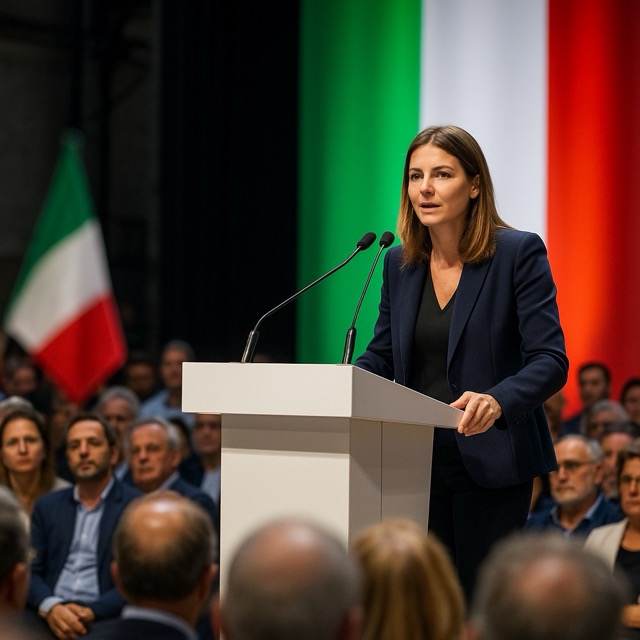
On the Florence stage of the storied Leopolda gathering, Genoa’s mayor floats a bold idea — a “Ministry of the Future” — and makes the case that unity is the center‑left’s true strength.
Silvia Salis arrived at the Stazione Leopolda with the easy stride of someone who knows the room and, at the same time, refuses to be owned by it. The mayor of Genoa — elected last spring as the surprise standard‑bearer of a broad progressive coalition — stepped into Matteo Renzi’s annual political showcase, paid her respects, and then carefully drew a chalk line around her autonomy. She is, as she keeps reminding anyone who asks, a mayor with a city to run. But the Florence stage handed her something else on Sunday: a national microphone and a chance to sketch what she calls a politics of the long view.
Her headline offering had the crispness of a tech brief and the ambition of a constitutional reform: create a Ministry of the Future. Not a gimmick portfolio glued onto the bow of a creaking bureaucracy, she insisted, but a cross‑cutting engine that forces Italian policy to anticipate instead of react — on energy and industry, on demographic decline and skills, on artificial intelligence and climate transition. A country addicted to ribbon‑cuttings, she argued, needs an institution designed to ask what comes after the ribbon. The proposal, equal parts provocation and roadmap, sent a visible shiver through the room of reformists, pragmatists and party switchers gathered under the Leopolda’s iron trusses.
Salis’s appearance was always going to be read as a test — of her appetite, of Renzi’s ability to curate a centrist‑left tent, and of the progressive field’s capacity to stop punishing itself with small schisms. In front of national and local leaders, she offered a message calibrated to disarm the old reflexes: unity, she said, is the center‑left’s latent advantage — the muscle the right can’t match if the progressive camp decides to use it. That assertion, simple and almost unfashionable in an era of factional branding, wasn’t an abstract plea. It was an argument grounded in her own victory in Genoa, a city that had drifted right for years and that returned a center‑left mayor only after an unusually broad alliance learned to row in rhythm.
The political choreography of the weekend underscored the point. Salis stopped first at the Greens and Left Alliance gathering before walking into the renzian living room, telegraphing an almost stubborn refusal to be portrayed as anyone’s exclusive property. If the center‑left hopes to govern, her sequence suggested, it will have to practice this cross‑aisle muscle openly: speak with environmentalists in the morning, share a stage with reformists in the afternoon, and spend the evening back in city hall’s engine room, doing the work that builds credibility.
For Renzi, the mayor’s presence was a small coup and a reality check. It confirmed that he can still convene an audience and attract promising administrators who aren’t members of his party. But Salis’s tone — grateful for the invitation, cool about speculation — made clear that the gravitational center she cares about sits outside the Leopolda’s spotlight: public services that function, ports that modernize, neighborhoods that trust city hall again. Her pitch, in that sense, was less about personal ascent than institutional posture: Italy, she said, needs leaders who can be omnivores of competence and coalition at the same time.
The notion of a Ministry of the Future may sound avant‑garde, but European policy labs have been experimenting with similar instruments for years — strategic foresight units, inter‑ministerial task forces, scenario cells. What Salis adds is an insistence that foresight be anchored where citizens can feel its consequences: in industrial policy that keeps factories competitive; in energy choices that protect bills and climate; in a school‑to‑work pipeline that trains technicians and nurses as well as coders. She framed the ministry not as a think tank but as a referee and accelerator, charged with testing long‑term trade‑offs and auditing short‑term populism.
Critics will ask, of course, whether Italy needs another ministry more than it needs discipline in the ones it already has. Salis pre‑empted some of that skepticism by emphasizing coordination over empire‑building. Her imagined department would have the authority to convene, evaluate and publish benchmarks, not to hoard budgets. It would measure whether the country’s big words — transition, resilience, productivity — are advancing beyond press conferences. And it would speak in a language that local governments can use, translating distant targets into project pipelines and talent maps that matter in a port city like Genoa or a manufacturing hub in Emilia.
The subtext was political as well as technocratic. Since her election, Salis has been courted as a possible future national figure — by admirers who see in her a post‑ideological pragmatism, and by operators who see in her a winning brand. She tried to close that conversation without slamming it, reminding the room that she has been in office for only a season and that front‑line mayors cannot moonlight as full‑time candidates. That deflection was also a kind of statement: the center‑left’s renewal, if it comes, will come less from primaries and more from results — from places where broad coalitions are building trust by fixing the ordinary.
What made the Leopolda appearance resonate was this refusal to choose between imagination and maintenance. The future ministry was the imagination piece — a rhetorical lever to pry politics out of the comfort of the next news cycle. The maintenance piece was the steady drumbeat of municipal verbs: pave, staff, digitize, connect, renovate. Together they formed a theory of change that has felt scarce in progressive politics: win the right to dream by demonstrating the capacity to deliver.
Inside the hall, the atmospherics aided the message. The mayor spoke without over‑spinning her lines, and her references — to ports and skills, to clean tech and industry — signaled a practical fixation. Renzi, for his part, cast the gathering as a home for reformists who prize competence, but he also made room for a broader civic grammar that could eventually talk to the Democratic Party, civic lists, and the environmental left. Whether that grammar becomes a coalition is the open question. Salis offered at least a hypothesis: coalitions form when they practice together, not merely when they negotiate.
In the days ahead, the national commentary will do what it does — draw arrows on organizational charts, place bets on who is seducing whom, ask whether this was a recruitment drive or a truce meeting. The narrower but more consequential question is whether the country’s progressive ecosystem can institutionalize foresight without hollowing it out. If a Ministry of the Future becomes merely a showroom for announcements, it will fail quickly. If it becomes a clearinghouse for evidence and a governor against amnesia, it might inoculate Italy against some of the short‑termism that has made reforms fragile.
Salis ended where she began, on the terrain that made her candidacy viable: the dignity of competence. Unity, she said, is not a slogan but a kind of operational ethic — a way of doing politics that lets different traditions share a results ledger. In Genoa, that ethic translated into a coalition that cut across progressive factions and pragmatic centrists. In Florence, she invited a national audience to treat that outcome as a rehearsal, not an exception.
The applause that followed was real, but the verdict will be written far from the Leopolda’s stage lights — in council chambers and procurement ledgers, in port terminals and training centers, in whether citizens feel that someone is finally planning more than one mandate into the future. If that happens, the Ministry of the Future will no longer sound like a slogan. It will sound like common sense.


 The Tower Post