
How a landlocked nation of 13 million slid into what observers call the worst economic crisis in a country not at war — and what it will take to climb out
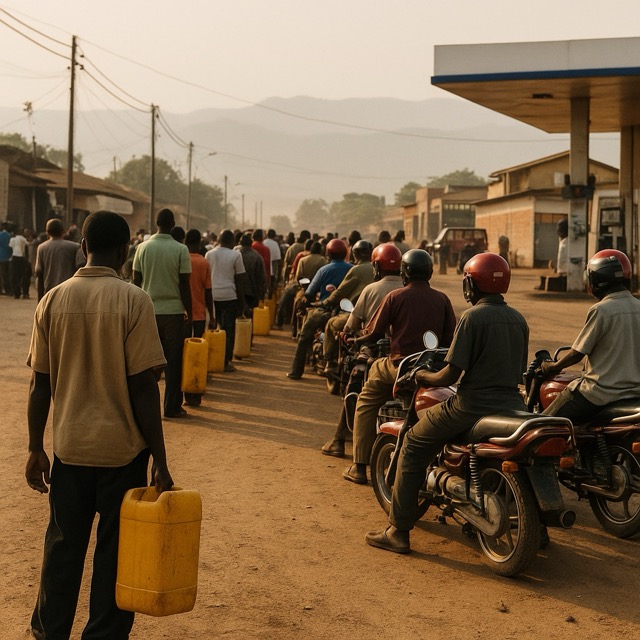
Outside petrol stations in Bujumbura, the queue is the story: men with yellow jerrycans, women perched on motorbike taxis, drivers dozing in the heat as lines creep forward by inches—or not at all. On bad days, the pumps do not open. On worse ones, rumors do. In the absence of fuel and foreign currency, time itself has become Burundi’s scarcest commodity.
This landlocked nation of roughly 13 million has slid into what some observers describe as the worst economic crisis in a country not at war. Prices are volatile, basic goods are scarce, and a grinding shortage of dollars has throttled imports from petrol to medicines. The government has promised reform and growth. For ordinary Burundians, the daily arithmetic is simpler: how to find transport to work, food for the evening meal, and cash whose value holds until tomorrow.
The inflationary spiral tells part of the story. After a brief lull in early 2024, inflation surged again, averaging close to 40% in the first months of 2025 as money supply expanded and shortages bit. When inflation runs that hot, every queue is also a price, and it rises while people wait.
Fuel has become the crisis’s most visible choke point. Since mid‑2024, drivers have reported multi‑day lines for gasoline; by mid‑2025, transport strikes periodically paralyzed cities as pump stations ran dry. An informal trade in jerrycan runs, sometimes stacking several containers on a single motorbike, has taken root—with predictably deadly accidents. For businesses, the costs are brutal: production schedules warp around sporadic deliveries; workers can’t reliably commute; and generators, where they exist, go silent.
The shortages are the symptom of a deeper constraint: foreign exchange. Burundi imports most of its fuel and many essentials, but its export base—coffee, tea, a small mining sector—does not generate enough hard currency. Official reserves have hovered around weeks of import cover, while a yawning gap between the official exchange rate and the parallel market signals deep stress. When dollars are scarce, they are rationed; when they are rationed, scarcity multiplies.
To its credit, the government has reopened channels to international lenders after years of isolation. In mid‑2023, the IMF approved a 38‑month Extended Credit Facility worth roughly $270 million, aimed at stabilizing the macroeconomy, overhauling the exchange‑rate regime, and restoring confidence. Officials also pushed an ambitious public‑spending agenda, lifting the 2024/25 budget by about 16% to fund wages and infrastructure.
But policy zigzags have blunted momentum. Subsidy reforms stall; parallel‑market premia widen; and the state leans on the printing press to bridge fiscal gaps—fuel for the very inflation it hopes to tame. Meanwhile, routine public‑service disruptions compound the pain: in many districts, the ‘triple crisis’ of fuel, electricity, and water constrains schools, clinics, and small firms. Only a sliver of households have access to grid power, and diesel generators are only as useful as the last delivery.
The social ledger is stark. The World Bank estimates that roughly three‑quarters of Burundians live in poverty. When transport fails, food markets thin out; when prices leap, nutrition suffers. Teachers, nurses, and civil servants watch salaries erode in real terms even as bonuses are unfrozen. The result is a slow‑burn erosion of human capital: fewer classroom hours, delayed vaccinations, and a generation whose prospects shrink as they reach for adulthood.
At street level, coping mechanisms proliferate. Shops in Bujumbura open late and close early to match fuel deliveries. Minibus cooperatives form ad‑hoc schedules to conserve scarce petrol. Riders split fares and walk the last mile. Farmers delay the transport of coffee cherries, risking quality penalties. Each workaround is rational; together, they entrench a lower baseline of productivity.
What could turn the tide? First, a credible, unified exchange‑rate regime that narrows the spread with the parallel market—backed by tighter monetary policy and a clear plan to exit monetary financing of the budget. Second, a targeted fuel‑supply stabilization program—transparent tenders, better storage, and short‑term credit lines ring‑fenced with development‑partner oversight—to break the cycle of queues and strikes. Third, a medium‑term export push that goes beyond slogans: rehabilitating coffee washing stations, upgrading tea factories, and de‑bottlenecking cross‑border logistics to the Central Corridor and the Tanzanian port at Dar es Salaam.
None of this will stick without governance gains. Investors and multilateral partners alike point to corrosive leakages at the nexus of procurement and state‑owned enterprises, along with recurring human‑rights concerns that chill engagement. Burundi’s recent charm offensive—promising billions in energy, rail, and agribusiness—will only convert to shovels‑in‑ground if contracts are competitive, audits are credible, and the rulebook is clear.
There are bright spots to build on. Regional rail plans linking Burundi to Tanzania could, if financing is secured and governance assured, cut logistics costs and reduce import vulnerability. Electrification projects, from small hydro to solar mini‑grids, can harden resilience in clinics and schools even before the main grid improves. And the diaspora, long sidelined, is an untapped channel for skills and finance—provided remittance rules and banking rails are predictable.
For now, though, the measure of progress is painfully local: shorter lines at the pumps, a more reliable bus route, fewer blackouts during evening study. If policy can cool inflation, unlock foreign exchange, and put fuel back in circulation, Burundians will do the rest. They always have. But time is not an infinite resource. In a country not at war, an economic war of attrition is being waged against patience itself—and patience is beginning to run out.
Sources (selected)
• International Monetary Fund (Apr. 15, 2025): Staff Statement following Article IV Mission to Burundi (inflation near 39% early 2025).
• World Bank (updated 2025): Burundi Overview and Macro Poverty Outlook (poverty ~75%, reserves ~1.6 months of imports, inflation context).
• Bloomberg (July 17, 2024): Reporting on multi‑week fuel queues amid FX shortage.
• SOS Médias Burundi (July 30 & Aug. 21, 2025): Fuel shortages, transport paralysis and the ‘triple crisis’ of fuel, electricity and water.
• IMF (July 17, 2023): Approval of 38‑month ECF (~$270m) for Burundi.
• Reuters (June 13, 2024): 2024/25 budget increase (~16%).
• Financial Times (Oct. 2025): Overview describing Burundi’s situation as the worst economic crisis in a country not at war.



 The Tower Post