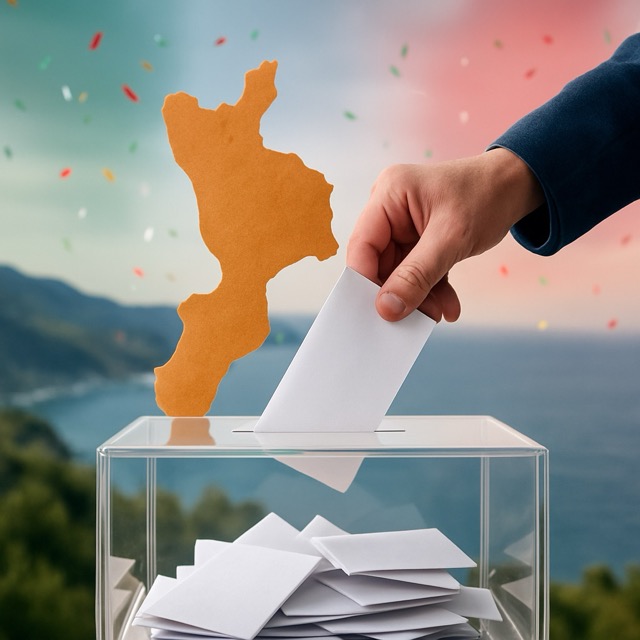
After a bruising campaign marked by a corruption probe and early resignation, the center‑right consolidates power; turnout sinks to 43% as Forza Italia edges ahead of the PD among parties.
Reggio Calabria — Roberto Occhiuto has secured a commanding second term as president of Italy’s southern region of Calabria, defeating the center‑left challenger Pasquale Tridico by roughly sixteen points in a contest that doubled as a referendum on governance, justice, and the power of incumbency. The Forza Italia heavyweight turned what began as a political crisis—his July resignation after receiving a notice of investigation in a corruption case he denies—into a resounding mandate. “Those who wanted to defeat us in the courts were defeated at the polls,” Occhiuto told supporters after the count, casting the result as vindication as much as victory.
With vote counting complete on Tuesday morning, regional results showed Occhiuto and the center‑right coalition hovering near the 57% mark, while Tridico, the former INPS president and current M5S MEP leading the broad center‑left alliance, settled just above 41%. The margin—about sixteen points—exceeded most late‑campaign expectations and cements Calabria as one of the most reliable bastions of the Italian center‑right. Prime Minister Giorgia Meloni, who campaigned alongside center‑right leaders, hailed the outcome as proof that the coalition’s administrative record still resonates in the South.
The composition of the vote adds a notable twist: among party lists, Forza Italia emerged as the single largest force with almost 18% of the vote, pulling ahead of the Democratic Party (PD). Occhiuto’s personal list also performed strongly, reinforcing a model of regional personalization that has been a hallmark of Italian politics in recent years. Fratelli d’Italia (FDI) and the League trailed FI inside the governing bloc, while the PD led the opposition parties and the Five Star Movement underperformed in a region that has long been a complex battleground for anti‑establishment appeals.
Yet the other headline number is a sobering one: turnout slid to about 43%, among the lowest in Italy, continuing a long‑running southern pattern of disengagement from regional contests. The figure is more than a statistic; it is the quiet referendum voters did not attend. For Occhiuto, the low participation rate is both challenge and opportunity: a large mandate on paper, but one delivered by a smaller pool of voters.
Occhiuto’s road to re‑election began with a gamble. On July 31, he announced he would step down and push for a snap return to the polls, arguing that only voters—not magistrates—should decide Calabria’s political future. The move, criticized by opponents as opportunistic, set up a high‑stakes confrontation between a governor under investigation who insisted on his innocence and an opposition seeking to frame the race as a test of ethical renewal. By dissolving the ambiguity quickly, Occhiuto set the terms of the campaign: competence and continuity versus distrust of the old order. The electorate chose continuity.
Tridico, an economist known nationally for piloting the ‘citizenship income’ during his INPS tenure and for his current role in the European Parliament, attempted to knit together a ‘broad camp’ of center‑left and progressive forces. His pitch centered on jobs, services, and a promise to break clientelistic habits that have historically weighed on Calabria’s development. Despite credible rallies and name recognition, he could not overcome the combined machinery of the center‑right nor Occhiuto’s incumbency advantage—a mix of administrative visibility, media familiarity, and an ability to present the judicial probe as the backdrop, not the banner, of the race.
Inside the coalition, Forza Italia’s primacy is politically significant. Since the passing of Silvio Berlusconi, FI has fought to define its post‑founder identity while maintaining relevance within Meloni’s right‑wing‑led alliance. Calabria’s outcome offers a clear template: local leadership, pragmatic branding, and service delivery can outpace ideological heat. It also hands Deputy Premier and Foreign Minister Antonio Tajani a tangible dividend in intra‑coalition bargaining ahead of national fiscal and justice reforms expected to test the government’s cohesion this autumn.
Policy continuity is likely in the near term. Expect the Occhiuto administration to claim a popular green light for ongoing infrastructure projects, health‑care stabilization, and transport links meant to integrate the region more firmly into national and EU networks. The government will also face pressure to tighten transparency rules and procurement oversight, both to reassure investors and to neutralize the opposition’s critique that Calabria remains vulnerable to influence networks. The judicial investigation, while outside the regional executive’s direct control, will continue to cast a long shadow over political discourse.
For the center‑left, the diagnosis is thornier. The PD’s runner‑up finish among parties offers a modest consolation, but the broader ‘campo largo’ project has yet to turn moral argument into majorities in southern regions where party loyalty is fluid and turnout is chronically depressed. Strategists will likely revisit two questions: how to reclaim disaffected abstainers, and how to compete with personalized governing brands that blend technocratic delivery with emotive narratives of pride and redemption. Without clearer ownership of concrete policy wins—on hospitals, roads, schools—the message risks sounding aspirational where voters demand proofs.
Turnout itself deserves a closer look. At just over four in ten eligible voters, Calabria’s regional election confirms a worrying disconnect between institutions and citizens. Factors range from economic emigration and demographic aging to persistent skepticism about the ability of regional administrations to change daily life. While the center‑right proved adept at mobilizing its core, neither camp cracked the code of re‑engaging the indifferent. Absent a civic shock—greater participatory tools, visible anti‑corruption wins, or a surge of youth activism—the South’s electoral abstention risks becoming structural.
National reverberations will be felt in Rome. Meloni can claim momentum: another southern region remains safe for the coalition, strengthening her narrative of ‘good government rewarded’. But the map underneath is nuanced. Forza Italia’s first‑place finish in party votes complicates any simplistic reading of right‑wing hegemony; it shows a center‑right electorate comfortable splitting the brand between national leadership and regional stewardship. For the opposition, the lesson is that scandal alone will not lift vote share—organizational density and credible governance offers matter more than hashtags.
What comes next in Calabria is a stress test in three acts. First, whether Occhiuto can convert a large electoral victory into faster execution on hospitals, roads, and procurement—areas where bottlenecks have long stalled progress. Second, whether the administration can raise transparency and co‑design policies with civil society to reduce the cynicism that feeds abstention. Third, how the ongoing judicial process evolves: if it clears the governor, the narrative of politically motivated lawfare will harden; if it advances, the region may face renewed instability. For now, the ballot box has spoken clearly.
For a region too often caricatured as peripheral, Calabria just delivered a core message to national politics: competence backed by a credible machine still beats anger without arteries. The center‑right owns the map today; the harder work begins tomorrow, when maps give way to milestones.



 The Tower Post