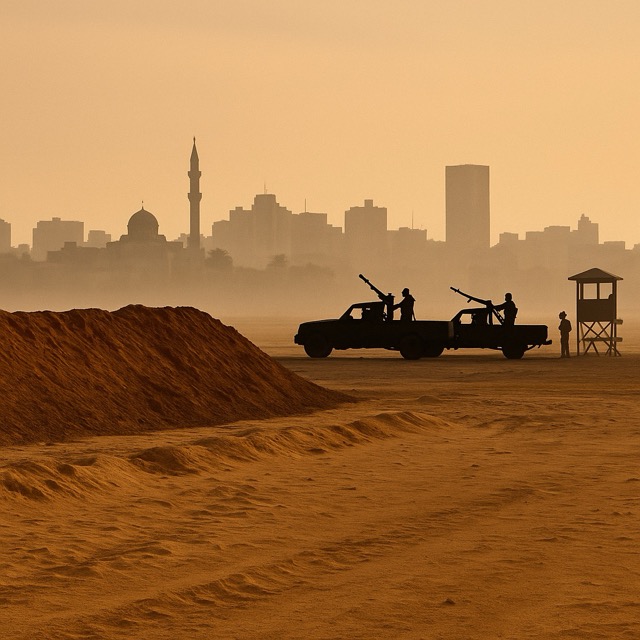
Tripoli’s militia brinkmanship, low-intensity warfare along the berm, and a contained—but lingering—insurgency on the Sinai Peninsula
Libya: Tripoli’s Uneasy Calm After a Bloody Spring
Tripoli’s skyline still carries the echo of the gunfire that rattled the capital in mid-May, when the 444th Brigade clashed with the Stability Support Apparatus (SSA) following the killing of SSA commander Abdelghani al-Kikli, known locally as “Ghaniwa.” A ceasefire, announced within days, ended the worst fighting the city had seen in years and ushered in an uneasy calm. But “calm” only describes the intervals between confrontations in western Libya’s splintered security environment.
In the months since the May battles, Prime Minister Abdulhamid Dbeibah has tried to convert the truce into a political opportunity—vowing to dismantle irregular armed formations and fold loyal elements into state structures. That ambition runs into the same structural impediments that have defined Libya’s post-2011 landscape: fragmented command and control, overlapping chains of financing, and local militia fiefdoms that double as providers of security and patronage.
September brought renewed tension as rival groupings in and around Tripoli tested red lines with mobilizations and sporadic skirmishes, including in Zawiya to the west—a recurrent flashpoint tied to smuggling economies and shifting alliances. The resulting standoffs didn’t spiral into a replay of May’s street battles, but they underscored a dangerous reality: there is no single veto player in western Libya. Instead, security is negotiated day by day among armed actors with divergent interests, thin civilian oversight, and ample firepower.
The east-west fault line remains, even if large-scale front-line warfare has been dormant since the 2020 nationwide ceasefire. Khalifa Haftar’s Libyan National Army (LNA) retains its entrenched position in the east and much of the south, backed by a network of local allies and foreign support. The LNA’s posture is calibrated to deter encroachment and leverage any crisis in Tripoli to extract concessions. Meanwhile, in the capital, the GNU’s dependence on allied militias limits its freedom of maneuver. When Tripoli’s balance of power shifts—as it did in May—governance decisions can quickly turn into triggers for armed confrontation, with civilians caught in the crossfire.
Four dynamics to watch will shape the risk of renewed fighting this autumn: First, whether the GNU can corral Tripoli’s factions into a more coherent security chain without provoking new turf wars. Second, whether residual grievances from May’s clashes—detentions, asset seizures, and institutional shakeups—are addressed or fester. Third, whether Zawiya’s armed economy, anchored in coastal smuggling routes, drags the capital into escalation cycles. And fourth, whether developments in the east—political or military—prompt opportunistic moves around Tripoli. For now, the guns are mostly silent, but the architecture of instability remains firmly in place.
Western Sahara: A War of Attrition Along the Berm
Five years after the collapse of the 1991 ceasefire, Western Sahara’s conflict has settled into a pattern of low-to-medium intensity hostilities along and east of the Moroccan-built berm. The Frente Polisario reports regular raids, rocket and mortar fire, and harassment of Moroccan outposts; Rabat, for its part, relies on layered defenses—earthen walls, sensors, drones, and forward positions—to blunt guerrilla action and maintain control west of the barrier. The tempo remains far below conventional war, but well above the frozen conflict many assumed had taken hold after 1991.
A diplomatic track exists but is stalled. The UN Secretary‑General’s reports through mid‑2025 describe persistent tensions and sporadic exchanges, while the Security Council has struggled to generate momentum beyond calls for restraint. Meanwhile, external politics keep shifting around the edges of the file. In early October, the European Union and Morocco moved to regularize trade in agricultural goods originating in Western Sahara with new origin labeling, an effort to reconcile commerce with EU court rulings and political sensitivities. The move is unlikely to alter facts on the ground, but it signals how the dispute’s legal and economic dimensions continue to evolve even as the military situation grinds on.
On the battlefield, neither side is positioned for decisive breakthroughs. Polisario’s tactics—hit‑and‑run attacks, indirect fire, and attempts to impose costs across a long, exposed front—aim to stretch Moroccan defenses and keep the conflict politically alive. Morocco’s counter is to harden the berm, leverage superior surveillance and strike capabilities, and deny Polisario the ability to mass forces. Civilian risk spikes when projectiles fall near populated areas or when miscalculation invites escalation. While casualty figures are uneven and often politicized, the pattern is clear: a grinding attritional contest, fought largely out of sight, with a steady but limited human toll.
The near-term variables are diplomatic as much as military. Can the UN’s envoy coax the parties into a formula that both sides can stomach after years of maximalist positions? Will regional dynamics—especially Algeria‑Morocco competition—tighten or relax the strategic vise? And will European legal-policy adjustments, like the new labeling regime, either incentivize calm or inflame grievances? For now, the war remains neither frozen nor full‑blown—dangerous precisely because it is sustainable.
Egypt (Sinai): Insurgency Contained, Not Concluded
Egypt’s long struggle against jihadist militancy in the Sinai Peninsula has receded from the headlines, but it has not disappeared. Through 2023–2025, the operational tempo of Islamic State–Sinai Province (IS‑SP) attacks declined sharply compared to the mid‑2010s peak, due to a mix of heavy security operations, tighter territorial control, and cooperation with local tribal auxiliaries. Yet residual threats persist: sporadic ambushes, IED incidents on remote roads, and occasional attempts to hit fixed positions or sensitive infrastructure.
Security incidents today are fewer, smaller, and more geographically contained—primarily in parts of North Sinai—than at the height of the insurgency. That said, the risk profile is uneven. Militants retain the ability to stage one‑off, opportunistic attacks, and the vast terrain, with its smuggling corridors and difficult topography, complicates any claim of total suppression. The state has adapted by emphasizing checkpoints, intelligence‑led raids, and co‑opting tribal networks—tactics that reduce attack frequency but also carry human‑rights trade‑offs that Cairo’s critics say could sow seeds for renewed radicalization if not paired with credible development and governance.
Two tests loom over the medium term. First is whether economic rehabilitation—housing, services, and legitimate livelihoods—keeps pace with security stabilization in the towns most affected by the fighting and past displacement. Second is whether cross‑border shocks (from Gaza or Libya) intersect with Sinai’s local dynamics to give militants new oxygen. For now, the insurgency is diminished, but its embers are hot enough to reignite under the right—and wrong—conditions.
Bottom Line
Across all three theaters, 2025’s common thread is managed instability. In Libya’s west, a bruising militia showdown gave way to a tense balance that could tip with little warning. In Western Sahara, a war of attrition endures, insulated from decisive outcomes but charged with political symbolism and regional rivalries. In Egypt’s Sinai, a long war has become a low burn—lighter than before, yet not extinguished. None of these fronts is primed for a breakthrough absent shifts in incentives and leverage. All are vulnerable to sudden escalations that outpace diplomacy.
For policymakers and businesses with exposure across North Africa, the operational guidance is similar: monitor micro‑shifts—local militia alignments around Tripoli, incident clusters east of the berm, and outlier attacks in North Sinai—rather than waiting for headline‑grabbing turning points. The risk is in the drift: conflicts that are “quiet enough” to recede from view, until they aren’t.


 The Tower Post