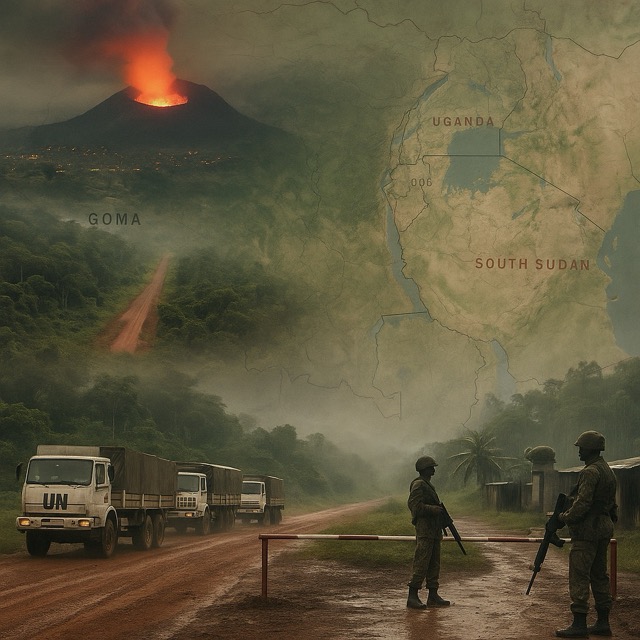
Why the wars in North/South Kivu, Bangui’s hinterlands, and Cameroon’s North-West/South-West still burn—and what to watch next
A region-spanning arc of conflict stretches from the volcanic slopes of eastern Democratic Republic of Congo (DRC) through the savannahs of the Central African Republic (CAR) to the forested hills of Cameroon’s Anglophone regions. Each war has its own cast and cadence. Yet they share common drivers: state fragility, armed groups that profit from disorder, and external actors whose security investments collide with local grievances. As of October 2025, fighting, displacement, and abuses against civilians persist across all three theatres.
EASTERN DRC | The M23 war enters a hard new phase
The eastern DRC’s war with the Rwanda-backed M23 rebellion hardened through 2025, with offensives and counteroffensives coursing around Goma and across North Kivu. UN experts reported in July that Rwanda exercises command-and-control over M23 and has supplied advanced kit designed to neutralize Congolese air assets. Kigali denies it backs M23 and says its posture is defensive against genocidal militants on Congolese soil. On the ground, however, civilians read the reality in fresh displacement, new checkpoints, and rebel rule in captured territories.
By early 2025, rebels had pushed to the edges of Goma and later projected power southward into South Kivu, while the Congolese army (FARDC) relied on a patchwork of auxiliaries—some accused of abuses—to hold lines. Humanitarian corridors flickered on and off as shelling, drone strikes, and artillery exchanges made movement perilous. With diplomatic tracks sputtering, a U.S.-backed push for economic cooperation between Kinshasa and Kigali stalled again this month amid disputes over foreign troop withdrawals. The signal to eastern communities is bleak: a war with regional fingerprints that neither side appears able—or willing—to decisively end.
Inside rebel-held enclaves, daily life has shifted into a regimented ‘normal.’ Local reporting from Lubero and surrounding areas shows the M23 embedding administrative routines—taxation, security patrols, and the licensing of commerce—alongside coercion. For people uprooted from Goma and its periphery, towns like Beni double as waystations and trauma clinics. The coping mechanisms are as striking as they are fragile: even stand-up comedy nights now function as mass therapy sessions for a population that has known little but war.
What to watch next in DRC: (1) whether M23 presses a bid to consolidate a contiguous corridor linking North and South Kivu; (2) the durability of any Rwandan withdrawal commitments amid UN scrutiny; (3) FARDC’s reliance on irregular allies; and (4) the humanitarian squeeze as displacement swells and access narrows.
CENTRAL AFRICAN REPUBLIC | Africa Corps steps in, abuses persist
CAR’s long war never truly stopped; it simply changed masks. The Kremlin-linked Wagner network’s footprint has been reframed under the Russian defense ministry’s ‘Africa Corps,’ but the allegations look painfully familiar: summary executions, disappearances, and conflict-related sexual violence documented by UN bodies and rights groups. In mid-2025, Bangui faced pressure to formalize a transition from Wagner to Africa Corps and to pay cash for security services even as budget stress and public skepticism deepened.
On the battlefield, government forces (FACA) and their foreign partners have contained some rebel incursions while fueling fresh grievances in rural prefectures where gold and timber routes are lifelines. MINUSCA recorded hundreds of violations affecting more than a thousand victims this spring. Communities caught between armed groups, mercenaries, and state forces report extortion, forced labor, and sexual violence—abuses that erode any claim of restored order.
What to watch next in CAR: (1) whether Africa Corps prioritizes training over combat and how that shifts battlefield dynamics; (2) the financing model—cash or concessions—and its governance risks; (3) MINUSCA’s capacity to deter abuses and protect civilians amid evolving rules of engagement; and (4) whether armed groups fragment further or coalesce around resource hubs.
CAMEROON (ANGLOPHONE CRISIS) | A grinding stalemate of violence, taxation, and kidnapping
In Cameroon’s North-West and South-West, the conflict between Anglophone separatists and government forces is locked in a costly stalemate. Through 2024 and into 2025, protection monitors documented persistent patterns: kidnappings for ransom, illegal taxation rolling from roads to markets and farms, arson attacks, and tit-for-tat reprisals. Civilians are squeezed between separatist ‘no-school’ edicts and state crackdowns, while aid workers navigate checkpoints and insecurity just to deliver the basics.
The violence is hyper-local yet structurally entrenched. Non-state armed groups rely on extortion to sustain operations; security forces respond with sweeps that often net civilians. Dialogue efforts sputter amid fragmented separatist leadership and political caution in Yaoundé. The result is a war that rarely captures headlines yet reshapes daily life—school calendars, market prices, and the simple act of traveling from village to clinic.
What to watch next in Cameroon: (1) whether back-channel talks can build toward a credible mediation format; (2) trends in abductions-for-ransom and ‘ghost town’ enforcement as barometers of separatist cohesion; (3) accountability for abuses by all sides; and (4) whether humanitarian access improves as needs deepen.
Cross-currents: minerals, militaries, and the missing politics
The three wars share structural features that keep them burning. In eastern DRC and CAR, resource corridors—from coltan and gold to timber—remain both prize and fuel, inviting foreign meddling and empowering local militias that tax movement as a business model. In Cameroon, taxation is the model. Across all three, security responses lean heavily on force multipliers—foreign troops, mercenaries, or militias—whose short-term gains are offset by long-term legitimacy costs.
Meanwhile, diplomatic tracks struggle to keep pace with battlefield facts. A leaked UN experts’ report in July undercut confidence in Rwanda’s denials over M23, even as Washington sought to pair security de-escalation with economic incentives. In CAR, the rebrand from Wagner to Africa Corps has not answered the core accountability question. In Cameroon, the absence of a unified separatist interlocutor and the government’s red lines have kept talks theoretical.
For civilians, the metrics that matter are painfully concrete: can they farm, trade, go to school, and give birth safely? On those counts, 2025 has brought little relief. Aid groups report continued access constraints and rising protection incidents. Displacement pushes families into towns already strained by inflation and joblessness, while trauma accumulates in ways not easily measured.
Outlook
None of these conflicts is fated to last; all are the product of choices. Three steps would bend the curve: (1) align ceasefire diplomacy with verifiable security benchmarks—especially on cross-border support and militia co-option; (2) finance civilian protection and justice mechanisms commensurate with the scale of abuses; and (3) invest in local governance and livelihoods along the very routes that war economies exploit. Absent that, the region will remain a proving ground for external security experiments—and civilians will continue to pay for ‘stability’ they rarely experience.
Note on sources: This analysis draws on recent reporting by UN bodies and peacekeeping missions; humanitarian protection updates for Cameroon’s North-West/South-West; and independent journalism and research on eastern DRC’s M23 conflict and the evolution from Wagner to ‘Africa Corps’ in CAR, including July–October 2025 materials.


 The Tower Post