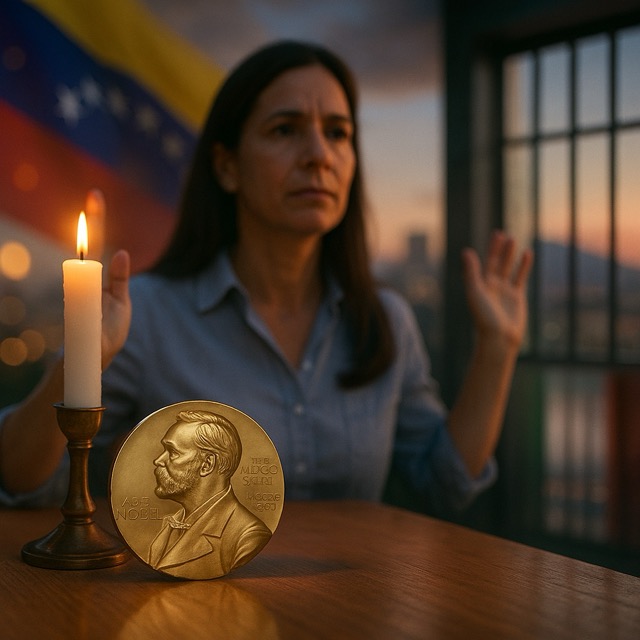
Why María Corina Machado’s Peace Prize spotlights a forgotten Italian aid worker and Nicolás Maduro’s old feud with Rafael Ramírez
OSLO/CARACAS/ROME — María Corina Machado, the Venezuelan opposition figurehead who spent much of the last year in hiding, was awarded the 2025 Nobel Peace Prize on Friday. The committee cited her non‑violent struggle to restore democratic norms after Venezuela’s disputed 2024 election. The choice sidelined the most polarizing contender for the prize, former U.S. president Donald Trump, and instantly reframed the Venezuelan crisis from a regional stalemate into a global test of how—if—peaceful civic pressure can open a path out of authoritarian entrenchment.
The symbolism is powerful. A decade of rolling crackdowns, contested ballots and hemorrhaging migration has conditioned Venezuelans to brace for the next blow rather than the next breakthrough. By elevating Machado, the committee did more than recognize a leader: it put the Venezuelan people’s patient insistence on ballots over bullets on the world’s front page. Yet the award also throws an unforgiving light on the system’s human toll—most starkly in the case of Alberto Trentini, a 35‑year‑old Italian humanitarian worker who has been detained for hundreds of days with scant access to his family or lawyers.
Trentini was arrested in mid‑November 2024 at a checkpoint while traveling to a project site in Apure state, according to the international NGO Humanity & Inclusion and Italian diplomatic notes. Since then, he has been shuffled through a fog of arbitrary detention: scarce hearings, opaque accusations, sporadic and heavily monitored calls home. For much of the year, his relatives in Veneto could only piece together his condition from second‑hand updates. They now count his permitted conversations on one hand. His case is not unique; Venezuelan rights groups document a pattern of security‑led detentions that swell and recede with the nation’s political tides.
In Rome, the prize for Machado set off a chain of reactions that blended relief with resolve. Italian officials reiterated demands that Caracas clarify Trentini’s legal status and allow full consular access. Humanitarian networks that had been campaigning in relative obscurity found their cause suddenly amplified by a global headline. For them, the Nobel is leverage: an invitation to trade statements of concern for practical concessions—unfettered visits, independent medical checks, due‑process timelines—and ultimately, releases.
Inside Venezuela, the political calculus is more complicated. President Nicolás Maduro has long relied on a strategy equal parts attrition and division: disqualify adversaries, co‑opt rivals, atomize movements, and control the tempo of negotiations. After the 2024 vote, when opposition standard-bearer Edmundo González was widely believed to have outpolled Maduro, security forces intensified the pressure—raids at dawn, governors and organizers in handcuffs, party headquarters under surveillance. Machado, barred from the ballot but central to the opposition’s mobilization, was forced into a cat‑and‑mouse existence. The Nobel resets optics but not realities: the same hard men still command the same levers.
The Trentini case sits at the intersection of those realities. Humanitarian access in border states such as Apure is routinely filtered through security priorities, and foreigners—particularly those working in conflict‑adjacent zones—are often treated as useful signals to domestic audiences. A prominently publicized detention projects vigilance; a guarded, conditional release projects magnanimity. In that sense, the fate of one Italian aid worker has become a micro‑negotiation within the macro‑negotiation for Venezuela’s future.
Another thread tugged loose by Machado’s Nobel is the regime’s long, barbed history with Rafael Ramírez, the former oil czar who once commanded the state oil company PDVSA and now lives in Italy. For years, Caracas has portrayed Ramírez as the archetype of the old order’s corruption, blaming him for gaping holes in the public accounts. Ramírez, for his part, casts himself as a scapegoat turned dissident who broke with Maduro over governance and ideology. Their feud has ricocheted through court filings, extradition requests and dueling media campaigns—an ideological rupture wrapped around a $100‑billion oil economy.
Italian courts have repeatedly been asked to rule on whether Ramírez should be sent back to face charges. While judicial steps have seesawed over the years, the broader picture is clear: the extradition saga has strained ties and fed the mutual suspicion framing today’s diplomatic disputes. When Rome pushes for transparency on a detained NGO worker, Caracas hears echoes of the Ramírez battle; when Caracas brandishes anti‑corruption rhetoric, Italian officials hear a bargaining chip. The two dossiers—human rights and hydrocarbons—keep crossing paths.
What changes now that the world is watching? History counsels modesty. Peace prizes can shield dissidents but rarely dissolve impunity overnight. Yet they also reorder incentives. For Maduro, doubling down on repression risks converting a domestic standoff into a multilateral crisis. For the opposition, the prize provides a measure of deterrence and a narrative of inevitability: peaceful civic pressure, validated by Oslo, will outlast any single crackdown. For Europe, the United States and Latin America’s democracies, it is a prompt to tighten coordination—calibrating targeted sanctions to specific abuses, broadening humanitarian corridors and conditioning any oil trade relief on verifiable steps toward rule‑of‑law benchmarks.
In the immediate term, three tests loom. First, whether those detained in the post‑election sweeps—including foreign humanitarians—gain regularized access to counsel and family. Second, whether electoral institutions reopen space for independent oversight and a credible path back to competitive politics. And third, whether the security complex that props up the government can be enticed—or pressured—into accepting a transition that protects basic guarantees for all sides. None are easy; all are made slightly likelier by the harsh light of global attention.
Machado’s camp understands both the symbolism and the limits. Her message since the announcement has been to widen the lens: this is not about a single leader but about a society that has endured scarcity, exile and fear without abandoning the civic arena. That framing invites the international community to match rhetoric with mechanisms. One concrete step would be a robust detainee‑monitoring regime, led by neutral third parties, with the access and authority to certify conditions and report violations in real time. Another would be to anchor negotiations in a timetable that links specific institutional reforms to incremental sanctions relief—something both credible enough to tempt participation and tight enough to deter backsliding.
For families like the Trentinis, the calculus is intimate, not geopolitical. They want the next phone call not to be a monitored courtesy but a homecoming. They have learned to read silence as a message and headlines as opportunity. The Nobel gives them a tool—to mobilize broader advocacy, to press ministries for answers, to insist that humanitarian workers are not pawns. Whether that tool becomes leverage depends on what governments do in the next several weeks, not merely what they say.
As for Ramírez, the prize indirectly revives hard questions about accountability within the opposition’s own historic circles and within the state that replaced them. A genuine transition cannot afford selective memory. If Venezuela is to escape the boom‑and‑bust cycle that turned the world’s largest oil reserves into a generator of poverty, it will need credible audits, judicial independence and protections for whistleblowers. Those principles are not anti‑government; they are pro‑society. They will also determine whether former power brokers like Ramírez face evidence‑based justice rather than politically engineered retribution.
The Nobel Peace Prize does not certify that peace has arrived in Venezuela. It certifies that the world believes a civic route to peace still exists. In the coming days, watch the granular signals: courtroom calendars, access passes for consuls and lawyers, notices to families. If those start to move, Machado’s medal will have done more than decorate a cause—it will have nudged a system. And if they do not, the same logic applies in reverse: the glare of Oslo can strip alibis from delay, making isolation costlier than accommodation.
Meanwhile, in the gray spaces of detention centers on the outskirts of Caracas, time ticks differently. Alberto Trentini’s horizon is measured in minutes of permitted conversation, in whether a guard decides a package of medicine meets protocol, in the rumor mill that travels faster than any official notice. A democracy worthy of the name is built on the routines that make these anxieties unnecessary. If the Nobel Prize means anything in Venezuela this week, it is the promise that the routines can return.

 The Tower Post