
In Florence, the prime minister sharpens her message—mocking the opposition, dismissing UN envoy Francesca Albanese, and framing Italy’s Gaza stance as ‘principled realism’ ahead of high‑stakes talks in Egypt
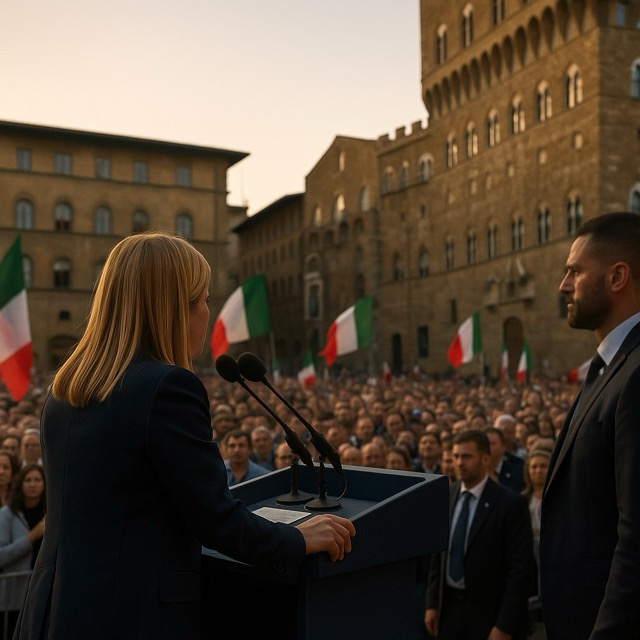
FLORENCE — Under the antique arches of Piazza San Lorenzo, where the center‑right staged its thunderous finale to Tuscany’s regional race, Prime Minister Giorgia Meloni delivered one of her starkest broadsides against the opposition in months. The Italian left, she said, is “more fundamentalist than Hamas,” a line that rippled through the crowd, instantly ricocheted across social media, and set off a day of political whiplash across Rome and the regions.
The remark came as Meloni sought to rally conservative voters for the center‑right’s bid to flip one of the country’s most symbolically red regions. Her argument was blunt: that the left, trapped in an ideological cul‑de‑sac, hesitated to support in Parliament a U.S.‑brokered path to a cease‑fire and hostage deal—only to watch Hamas signal openness to it. “They are more extremist than the extremists,” Meloni declared, extending the comparison to reject what she called a ‘Leoncavallo‑wide’ opposition, a jab at the famed Milan social center that on the right has become shorthand for radical activism.
If the line sounded designed to provoke, it also dovetailed with the day’s choreography: the premier standing shoulder‑to‑shoulder with coalition partners Matteo Salvini, Antonio Tajani, and Maurizio Lupi, projecting unity after a bruising year of governing under the pressure of two wars—Ukraine’s and Gaza’s—plus a domestic economy slogging through flat growth and stubbornly high prices. In Florence, Meloni’s message mixed culture‑war shorthand with foreign‑policy positioning: Italy as a humanitarian broker that will not, however, confuse compassion with naiveté.
That framing carried a second target: Francesca Albanese, the UN Special Rapporteur on the situation of human rights in the Palestinian territories. “She has no merits,” Meloni scoffed—dismissing the jurist whose mandate has polarized Western capitals and triggered a barrage of partisan responses. The comment was a tell: Meloni’s foreign‑policy shop is keen to signal continuity—support for Israel’s security, skepticism of Hamas, and humanitarian corridors—while distancing itself from UN voices Rome views as biased or impracticable.
Timing was not incidental. Meloni speaks just as Europe’s attention turns again to Egypt, where regional mediators are corralling leaders for what could be a pivotal summit on Gaza’s fragile truce, the release of hostages, and the outlines of a painstakingly sequenced plan toward disarmament and reconstruction. She is expected to fly in early next week, joining a roster that, if finalized, would include European and Arab counterparts and U.S. representation. The calculus in Rome is straightforward: be present, be pragmatic, and avoid becoming a spoiler in a process that could stabilize a conflict now nearing its two‑year mark.
Meloni’s critics pounced on the Hamas comparison as reckless and unbecoming of a sitting premier. Opposition leaders accused her of trivializing terrorist violence and poisoning the well of domestic debate at a moment requiring institutional sobriety. Elly Schlein, the center‑left leader, said the rhetoric was ‘unheard‑of in a democracy,’ while labor figures blasted the government for picking fights with unions and civil society even as wage growth lags and public services strain.
But in the square, the political calculus looked different. The center‑right’s gamble is that voters in Tuscany are as attuned to international security and migration as to local services—and that Meloni’s plain‑spoken posture on Gaza and Italy’s conditional openness to Palestinian statehood resonate beyond her base. In New York last month she set two hard preconditions for recognition: the release of all hostages and the exclusion of Hamas from any future governance. That line, echoed by coalition allies, aims to keep Italy aligned with Washington while hedging against the more expansive positions now circulating in parts of Europe.
There is also a personal subtext. Earlier this week, Meloni revealed that she and several senior ministers had been reported to the International Criminal Court for alleged complicity in genocide over arms ties to Israel—a filing her team condemned as performative lawfare. The disclosure sharpened Italy’s political edges ahead of the Florence rally, reinforcing the government’s narrative of a premier under siege from what it portrays as hyperbolic activism at home and abroad.
Beyond the rhetoric, however, policy work is grinding on. Italy has touted medical transfers for wounded Gazan children, support for humanitarian aid convoys, and diplomatic pressure—on Hamas to release hostages and on Israel to accept limits to military operations and settlement expansion. Meloni’s aides say the premier intends to use the Egypt stop to push for credible verification of any truce, protection for aid workers and journalists after months of deadly strikes, and a framework for Gaza’s civil administration that avoids both Hamas entrenchment and a chaotic vacuum.
Still, the politics at home will not wait for Middle East diplomacy to deliver. The Tuscany contest, while provincial on paper, has become a litmus test of Meloni’s national momentum after a year of incremental reform within the constraints of Italy’s public finances. Her government can plausibly claim durability and discipline, but every stumble—on energy prices, on migration shocks, on Brussels dossiers—lands harder when the prime minister herself chooses maximalist rhetoric. The Florence speech will thrill supporters who prize her combativeness and irritate moderates who want less heat and more deliverables.
For the left, the episode is clarifying, if uncomfortable. Meloni’s comparison will dominate headlines, but the deeper challenge is whether opposition forces can articulate a Gaza policy that is morally clear, strategically realistic, and domestically persuasive. Backing humanitarian law and Palestinian rights is not, in itself, a governing plan; nor is reflexive skepticism of U.S. diplomacy. As Egypt prepares its stage and the choreography of summitry accelerates, Italian voters will watch not just what Meloni says next—but whether anyone on the other side can match her message with a credible alternative.
The stakes abroad and at home, in other words, are now fused. If the Egyptian talks consolidate into a durable cease‑fire and a sequenced release of hostages and prisoners, Meloni will claim validation for a line that has tried to thread firmness with humanitarian optics. If the process stalls or collapses, Rome’s careful positioning could look like hedging without influence. Either way, the Florence stagecraft has already done its work: it ensured that, on the eve of high diplomacy, the argument in Italy is still being conducted on Giorgia Meloni’s terms.


 The Tower Post