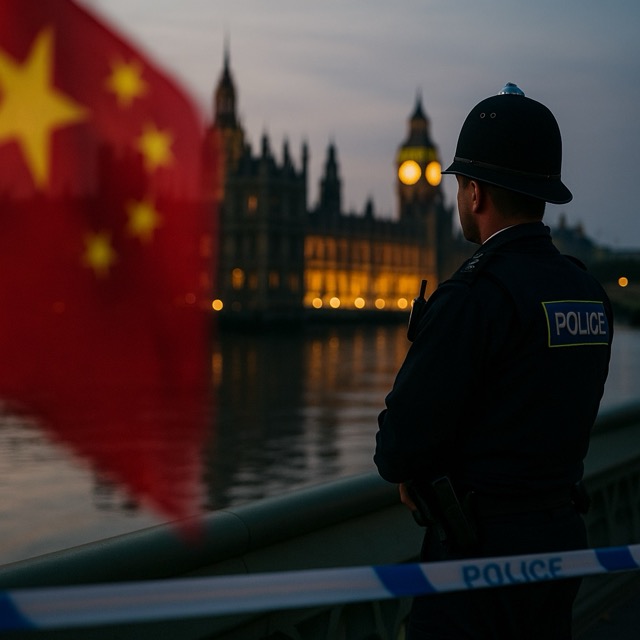
The former cabinet secretary says Beijing is a clear danger to Britain’s national security—raising fresh questions for prosecutors and ministers after a high‑profile trial fell apart.

LONDON — The collapse of a landmark espionage case alleging that two Britons spied for China has detonated a political and security row in Westminster, with Lord Mark Sedwill — the former cabinet secretary and national security adviser — declaring that Beijing is “of course” a threat to the United Kingdom’s national security.
Sedwill’s intervention came after the Crown Prosecution Service (CPS) abruptly dropped proceedings that were due to test the most sensitive question at the heart of the case: whether, at the relevant time, China met the legal threshold of being a “threat to national security.” Prosecutors said they were unable to proceed because the government would not provide the necessary confirmation or call a key expert witness — a decision that has baffled veterans of Whitehall’s national security machinery and triggered a rush of demands for transparency from across the political spectrum.
“I’m genuinely puzzled — to put it politely — by the idea that China was not considered a national security threat,” Sedwill said in public comments this week, arguing that the intelligence community and successive governments have long treated Beijing as a primary strategic challenge to the UK’s security and economic resilience. His remarks, echoed by other former officials, cut directly across the explanation that the trial collapsed due to uncertainty over the threat definition.
The aborted case centered on allegations that Christopher Cash, a parliamentary researcher, and Christopher Berry, a teacher, covertly obtained and passed sensitive political information to contacts linked to Beijing. Both men denied wrongdoing. The trial, slated to begin this month, would have been the first major courtroom test of China‑focused espionage allegations in the UK’s modern era. Instead, its implosion has left a vacuum of answers and a glut of questions: Who decided not to supply the threat assessment? On what grounds? And what does it mean for future counter‑espionage prosecutions?
A failure of process — or policy?
At issue is the interface between national‑security policy and the justice system. Prosecutors insist they “did everything possible” to bring the case, but say they were left without the government testimony needed to establish a foundational element of the charges. Ministers, for their part, insist they did not interfere. That leaves the spotlight trained on the National Security Secretariat in the Cabinet Office and the current national security adviser’s team — the place where the state’s risk assessments, intelligence, and legal positions are fused before they meet the courts.
Sedwill’s critique matters because he once ran that apparatus. As cabinet secretary and national security adviser between 2017 and 2020, he oversaw the cross‑government response to hostile state activity, including from China and Russia. His public stance — that Beijing clearly constituted a threat during the period in question — implies that, at minimum, there has been no change in the underlying intelligence picture that would justify withholding an authoritative statement of risk from prosecutors. If anything, heads of MI5 and MI6 in recent years have sharpened their warnings about Chinese espionage and interference.
Legal thresholds and political blowback
The CPS’s explanation has revived a long‑running dilemma: translating classified threat assessments into legally robust, court‑admissible evidence without compromising sources and methods. The UK’s framework for prosecuting espionage has been modernised, but still depends on the state’s willingness to present expert testimony about hostile activity — and to do so consistently with what ministers and the security agencies say in public. Critics argue that the state cannot have it both ways: sounding the alarm about Beijing on the airwaves while refusing to stand up that assessment in court.
Meanwhile, the collapse has ricocheted through Westminster. Opposition parties have called for a formal review by independent watchdogs. Jonathan Hall KC, the government’s reviewer of terrorism legislation — who also scrutinises state-threat laws — has announced he is examining the episode and reiterated that China is indeed a national security threat. Senior backbenchers have demanded the release, in closed session if necessary, of the government’s reasoning for withholding witness evidence. And questions are mounting for the Cabinet Office over whether policy trade‑offs — notably a desire to stabilise relations with Beijing — trumped the public interest in prosecuting alleged espionage.
Implications for the Five Eyes and deterrence
Britain’s allies are watching closely. Within the Five Eyes intelligence partnership, the UK has been a vocal advocate for collective vigilance on Chinese espionage, technology theft, and political interference. A failed prosecution on the grounds of “no declared threat” risks muddying that message and could complicate operational cooperation if partners fear legal hesitancy will blunt future cases. It may also embolden hostile actors to probe the seams between intelligence judgments, political risk, and evidential standards.
Sedwill’s broadside also reopens the question of deterrence. Successful state‑threat prosecutions are rare; most counter‑intelligence victories happen in the shadows. But when public cases collapse, they can have the opposite effect of emboldening adversaries and chilling would‑be witnesses. For Parliament and the civil service, the episode is a reminder that insider‑threat defences — from vetting to access controls and cybersecurity hygiene — must be matched by a coherent pathway to prosecution when lines are crossed.
Where this goes next
Three immediate tests loom. First, can the government reconcile its public rhetoric with the evidential posture it adopts in court? A clear, written statement from the National Security Council — however carefully worded — that sets out the standing threat from Beijing would go some way to repairing the damage. Second, will independent overseers be given full access to the decision‑making trail that led to the CPS being left without a witness? Anything less will prolong the political storm and deepen suspicions of undue interference. Third, can prosecutors rapidly reboot other live investigations without encountering the same evidential roadblock?
For Sedwill, whose words carry weight among officials, the answer begins with clarity. The former cabinet secretary is not urging a new cold war; he is arguing for intellectual honesty about the nature of the challenge. China is a systemic competitor whose state apparatus blends espionage, industrial strategy, technology acquisition and influence operations at scale. Recognising that reality openly — and reflecting it consistently in both policy and prosecutions — is, in his view, a baseline requirement for national security, not a rhetorical flourish.
The political theatre will continue. Prime Minister Keir Starmer has denied that ministers intervened; the Cabinet Office has kept its counsel; and Beijing has rejected the UK’s accusations as “groundless”. But the centre of gravity has shifted. In the space of a week, the question changed from “was there enough evidence?” to “does the government stand behind its own threat assessments?” Sedwill’s answer — “of course” — may yet force one of Whitehall’s most sensitive conversations into the open.



 The Tower Post