
Beijing steps up enforcement on chip imports to accelerate a pivot away from Nvidia and other American suppliers
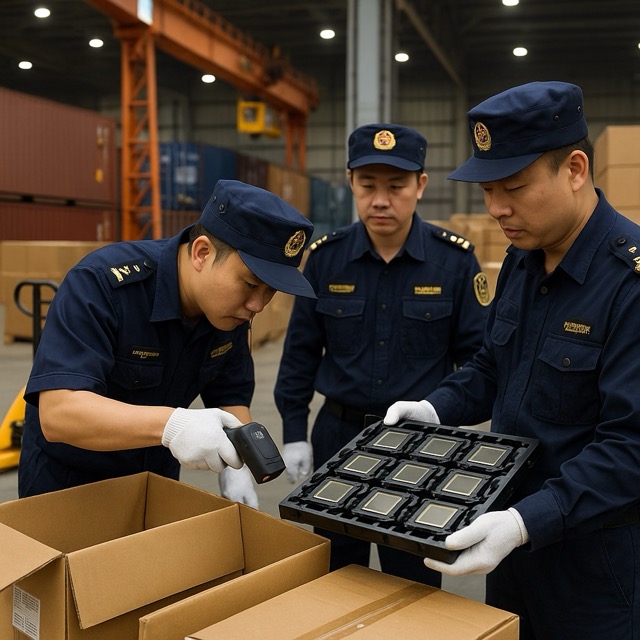
China has begun enforcing sweeping new controls on imports of high‑end semiconductors, intensifying a campaign to wean its technology sector off U.S. suppliers and accelerate the adoption of domestic alternatives. In recent days, customs teams have been dispatched to major ports to subject shipments of advanced processors to heightened scrutiny, with particular attention on Nvidia’s “China‑compliant” AI accelerators such as the H20 and the RTX Pro 6000D. The stepped‑up checks target not only overt violations of U.S. export rules but also gray‑market channels that have emerged to feed China’s booming demand for artificial intelligence computing.
The enforcement push marks a pivot in Beijing’s approach. For two years, China largely reacted to successive rounds of U.S. export controls by stockpiling chips and promoting substitution. Now it is actively restricting inbound flows. Officials and state‑run outlets frame the effort as necessary to safeguard “national information security” while building “independent controllable” supply chains—a phrase that has become shorthand for import substitution across strategic technologies.
Several developments help explain the timing. In mid‑September, Chinese regulators reportedly urged major tech companies to halt purchases of Nvidia chips and to cancel prior orders, amid an antimonopoly probe tied to the U.S. firm’s products sold into China under tightened American rules. Those products—including the H20—were engineered to comply with successive U.S. curbs on performance and interconnect speed. Yet they remained attractive to Chinese cloud providers and AI labs because of mature software support and strong price‑performance relative to nascent domestic options. The new customs checks, described by multiple outlets as “sweeping,” aim to close a gap between policy intent and marketplace reality.
The crackdown has practical effects at the dock. Importers now face longer inspections, more frequent requests for end‑use and end‑user declarations, and, in some cases, seizures pending technical evaluations. Logistics managers report selective holds on shipments flagged for containing AI accelerators, networking cards, or high‑bandwidth memory modules that could be paired with restricted processors. Brokers say the guidance is fluid, but the message is clear: reduce reliance on U.S. compute wherever feasible, and expect closer oversight if you do not.
China’s strategy is not purely negative—blocking imports—so much as it is dual‑tracked: actively nudging demand toward domestic providers. Provincial procurement rules and guidance to state‑backed computing hubs increasingly set quotas for “local core components,” and Beijing has set market‑share targets for Chinese AI chips over the next two years. Huawei’s Ascend line, in particular, is positioned as the primary beneficiary. Earlier this year, Huawei moved to scale production of its 910C accelerator—an architecture that combines two 910B dies—as large Chinese model developers evaluated migration paths away from Nvidia. Engineers acknowledge performance and ecosystem gaps remain; but with hardware scarcity and policy pressure rising, many see a tipping point for first‑party and homegrown stacks.
At the macro level, the customs campaign underscores how export controls invite mirror responses. Washington has long tightened restrictions on selling advanced chips and chipmaking tools to China, culminating in frequent rule updates and new entity listings. Beijing’s latest step—making it harder for U.S. chips to enter China even when technically allowed—turns the screws from the other side, reshaping demand through administrative levers. The result is a feedback loop: controls beget counter‑controls, which accelerate de‑coupling and the regionalization of semiconductor supply chains.
For China’s tech giants, the calculus is shifting from optimizing for absolute performance to optimizing for available, compliant compute. In the short term, that likely means a patchwork: migrating inference workloads to domestic accelerators, keeping scarce Nvidia parts for training frontier models already tuned on CUDA, and expanding heterogeneous clusters that can mix different chips behind a single service layer. Cloud providers are racing to offer customers compatible toolchains built around Ascend and other local chips, while startups in the model‑ops space adapt frameworks to abstract away underlying hardware differences.
Still, technical friction is unavoidable. Nvidia’s software ecosystem—CUDA, cuDNN, NCCL, Triton Inference Server—and the vast body of third‑party optimizations built atop it represent a moat that hardware alone cannot bridge overnight. Porting models and rewriting kernels carries costs and risk. Chinese labs will likely maintain mixed fleets for some time, incurring complexity even as they diversify sources of compute. That may slow the cadence of model upgrades and complicate reproducibility across research teams.
Globally, the ripple effects could be significant. Multinationals with R&D hubs in China must reassess hardware sourcing plans and prepare for widened variance in latency and throughput as workloads move off familiar Nvidia platforms. U.S. chipmakers face another headwind in a market that was once a large share of their revenue, even as they juggle restrictions at home and licensing hurdles abroad. Meanwhile, equipment makers in allied countries—Japan, the Netherlands, South Korea—are navigating their own policy constraints while watching China harden its import screen on the finished chips their tools help produce.
For Beijing, success will be measured less by immediate performance parity with U.S. hardware than by whether Chinese firms can build sustainable, self‑reliant compute stacks that are “good enough” for mainstream AI tasks. If customs enforcement narrows the aperture through which Nvidia products enter the country, it buys time and market share for domestic alternatives—and reduces exposure to the next round of sanctions or supply shocks. Combined with export controls on critical inputs such as rare earth technologies, it also gives China additional levers in a broader geoeconomic contest.
Yet the policy carries trade‑offs. Tighter import screening risks constraining the very AI boom China hopes to cultivate, especially for startups that lack privileged access to state‑backed compute clusters. It could also spur a rise in gray‑market arbitrage and component mislabeling, prompting further enforcement cycles. And if domestic accelerators do not mature quickly enough, companies may confront a compute deficit that slows both research and commercialization.
The next phase will hinge on ecosystem execution. If Chinese chip vendors can ship reliable hardware at scale and provide robust SDKs, compilers, and framework integrations, they stand to lock in share as migrations proceed. If not, enterprises will seek workarounds. Either way, the new customs reality is already reshaping procurement playbooks. In China’s AI economy, the red lines now start at the port.
References (selected):
• Financial Times, Oct. 10–11, 2025: reports of Chinese customs dispatching teams to inspect semiconductor shipments, targeting Nvidia’s H20 and RTX Pro 6000D chips.
• Reuters, Oct. 10, 2025: confirmation that China intensified enforcement of import restrictions on U.S. chips, citing FT.
• Al Jazeera, Sept. 17, 2025: report that Chinese regulators told tech firms to stop buying Nvidia chips during an antimonopoly probe.
• Reuters, Apr. 21, 2025: Huawei readying mass shipments of 910C AI chip as domestic alternative gains traction.
• CSIS analysis, Apr. 14, 2025: overview of U.S. export controls and subsequent tightening in 2023–2025.




 The Tower Post