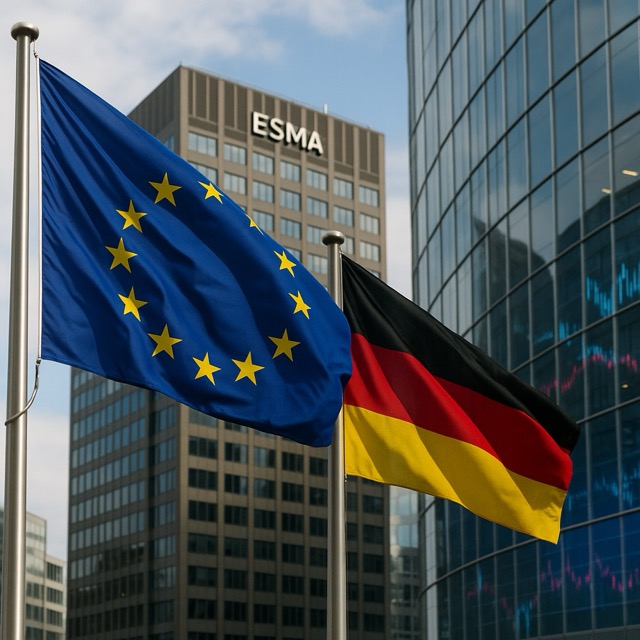
A pivotal shift in Berlin’s stance could unlock Europe’s long‑stalled Capital Markets Union — even as Germany keeps red lines on what Brussels may supervise
Lede
Germany has signalled it is ready to hand more powers to the European Securities and Markets Authority (ESMA), a reversal that removes one of the biggest political obstacles to the European Union’s capital markets union (CMU). “
Berlin’s pivot, championed by Finance Minister Lars Klingbeil and backed by Chancellor Friedrich Merz, amounts to a rare moment of alignment among the bloc’s largest economy, Brussels regulators and Paris — which has long argued that the only way to thicken Europe’s thin pools of equity and risk capital is through tighter, centralised supervision.
Context
For a decade, the promise of CMU has been a political slogan more than an operational reality. Europe’s savings remain trapped in bank deposits and insurance contracts; IPOs are scarce; scale‑ups depart for deeper markets abroad. “
The EU has chipped away at plumbing — a consolidated tape for equities and bonds, common prospectus rules, ESG data and ratings oversight — but supervision has been stubbornly national. Berlin’s reluctance to cede authority from BaFin in Bonn to ESMA in Paris has been the single most consequential brake. With that obstacle now easing, a path opens for ESMA to take on direct supervision of select cross‑border market infrastructures and data utilities, reducing fragmentation and compliance duplication for issuers and intermediaries.
What Germany is now willing to accept
Officials involved in the Franco‑German talks say Berlin is open to a staged extension of ESMA’s direct powers. The first targets are the entities whose business is, by definition, pan‑European: consolidated tape providers; ESG rating agencies; and the largest trading venues and clearing houses that already serve users across multiple member states. “
Centralising supervision here would address long‑criticised inconsistencies that have allowed regulatory arbitrage and inflated costs for cross‑border listings, trading and post‑trade services. It would also spare market participants the chore of answering 27 variations of the same question — a boon for smaller brokers and growth‑stage companies that lack the legal budgets to navigate a patchwork.
Why Berlin shifted
The German rethink blends economics and geopolitics. After successive years of weak growth, industry lobbies and policymakers are searching for private‑market risk capital to finance retooling in energy, defence and digital infrastructure. The Draghi competitiveness review underscored that Europe cannot out‑subsidise the United States or China; it must mobilise domestic savings and invite global investors at scale. “
At home, the Merz government has framed capital‑market deepening as a competitiveness and Mittelstand survival agenda. With Germany’s bank‑centric model under strain from higher rates and balance‑sheet constraints, pushing more financing through markets is pragmatic — and politically easier to sell if supervision is seen as robust and uniform.
But Germany still has red lines
Berlin’s openness is conditional. People familiar with the talks describe three areas where Germany is holding off. “
First, crypto‑asset supervision: while EU officials are exploring whether ESMA should directly oversee the largest cross‑border platforms under MiCA’s regime, Berlin has asked to keep crypto out of the first wave of centralisation. Sensitivities range from supervisory capacity to the political optics of appearing to promote a sector many voters still view warily. “
Second, proportionality for smaller institutions and regional market segments: Germany wants explicit safeguards so that ESMA’s horizontal rule‑setting does not swamp Sparkassen, local issuers or specialised markets with one‑size‑fits‑all processes. That means carving out thresholds and home‑host arrangements where national competent authorities remain in the lead, with ESMA coordinating rather than commanding. “
Third, sequencing and governance: Berlin insists reforms move in sync with an enhanced “single rulebook” and clearer accountability for ESMA’s Board of Supervisors. The preference is to avoid repeating the banking union’s asymmetry — where the ECB assumed supervision while fiscal backstops and resolution tools lagged.
What changes on the ground
If agreed, the compromise would matter quickly in three ways. “
Data and transparency: ESMA’s direct authorisation and supervision of consolidated tape providers — the utilities that stitch together trade data from across exchanges and venues — could finally deliver reliable, real‑time price and volume data at EU scale. That promises better best‑execution, cheaper market data for challengers, and a more compelling sell to global investors accustomed to the US consolidated tape experience. “
Market infrastructures: A clearer line of sight from a single supervisor over major exchanges and clearing houses should rationalise cross‑border access, collateral and margining models, and crisis playbooks. During market stress, that can translate into fewer contradictory instructions and more nimble coordination with the ECB and ESRB. “
Issuers and intermediaries: Fewer duplicative filings, more consistent enforcement, and faster approvals for prospectuses and market‑abuse investigations. For growth companies, the cumulative friction saved across listing, disclosure and research rules is meaningful.
Politics and the road ahead
None of this is guaranteed. Smaller member states with outsized financial centres, such as Luxembourg and Malta, have already warned against a Paris‑centred bureaucracy. Others worry about losing national levers to cultivate local champions. “
Within Germany, ceding authority will be tested by Länder sensitivities and the legacy of Wirecard, which still shapes perceptions of supervisory credibility and accountability. The government will need to show that stronger EU‑level supervision complements, rather than supplants, BaFin’s improvements since 2021 — and that ESMA has the resources to match its mandate. “
In Brussels, the Commission will have to translate political momentum into legal proposals that are targeted, enforceable and litigation‑proof. Expect a phased package that extends ESMA’s direct remit where the benefits are clearest, paired with upgrades to the rulebook and cooperation colleges elsewhere.
The stakes
Europe’s capital markets will not converge overnight. But Berlin’s shift removes the largest political veto point. Consolidating supervision where market activity is inherently cross‑border can lower the region’s cost of capital, deepen liquidity pools, and strengthen Europe’s ability to finance its strategic priorities at home — from defence to decarbonisation — without structurally relying on US markets. “
That is the prize: not centralisation for its own sake, but scale, trust and simplicity in a market that investors can navigate without a map of 27 regimes. If Germany follows through — even with carve‑outs on crypto, proportionality and governance — CMU may finally move from ambition to architecture.


 The Tower Post