As a U.S.-brokered truce takes hold, Israeli forces pull back from parts of the Strip, limited hostage-and-prisoner exchanges begin, and aid agencies race to scale relief for a shattered enclave.
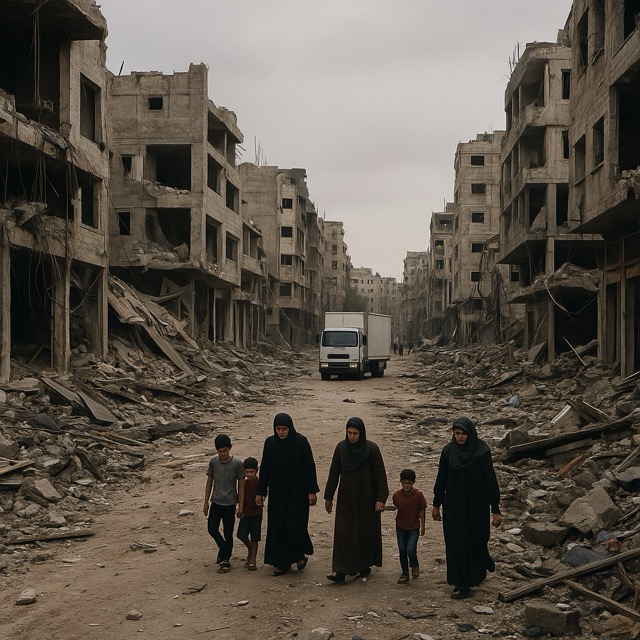
GAZA CITY / JERUSALEM — A tenuous ceasefire between Israel and Hamas entered its second day on Saturday, loosening—if only slightly—the vise that has gripped the Gaza Strip for two years. Israeli units continued a partial pullback from dense urban areas as crowds of displaced Palestinians picked their way through gravelled streets toward blasted apartments, searching for intact doors, water taps, or a safe place to sleep. Israel has warned it will return to war if demilitarization benchmarks are missed; Hamas cadres have reappeared in some districts, directing traffic and basic municipal tasks.
What the deal does—and doesn’t do
Under the first phase of the agreement, Hamas is expected to release an initial tranche of living Israeli hostages while Israel frees roughly 2,000 Palestinian prisoners. Israeli forces are to reposition from several population centers, with later withdrawals tied to progress on disarmament and the deployment of an internationally backed stabilization force. Officials on both sides acknowledge that disagreements over sequencing could still derail the process.
Hostages, prisoners, and politics
In Israel, families of captives gathered for Shabbat with a flicker of hope that this could be their last without loved ones. Officials say dozens of hostages remain unaccounted for. The government has excluded high‑profile Palestinian prisoners—including Marwan Barghouti—from the exchange lists, arguing their release would destabilize security and Palestinian politics. Prime Minister Benjamin Netanyahu, whose popularity remains weak after the 2023 attacks and a bruising war, has framed the truce as leverage gained through force and warned that fighting could resume if Hamas balks at disarmament.
Humanitarian triage at scale
Relief agencies are racing to expand aid corridors after months of sporadic access. The U.N. humanitarian office has outlined a 60‑day plan to surge food, fuel, medical supplies and shelter materials if safe passage holds. In the south, logisticians tested new inspection lanes and warehousing; in the north, returnees waited for potable water and power. Public health officials say only a fraction of hospitals can deliver essential services, and malnutrition has deepened into pockets of famine.
By the numbers: a costly pause
The toll is staggering. As of early October, Gaza’s Health Ministry reported approximately 67,000 Palestinians killed and more than 169,000 injured since October 2023; independent researchers caution the true death toll is likely higher when accounting for indirect deaths from disease and hunger. Israeli authorities report nearly 2,000 Israelis killed since the war began. Aid agencies say over 200 humanitarian workers and more than 200 journalists and media workers have been killed. Two years of bombardment and ground operations have damaged or destroyed large parts of Gaza’s housing, water, sanitation and health infrastructure.
Inside Gaza: fragments of normal
In Gaza City’s Zeitoun and parts of Khan Younis, a few shops raised metal shutters to sell bread, batteries and bottled water. Parents coaxed children away from unstable stairwells while municipal crews—augmented by volunteers—cleared rebar and glass from intersections. Elsewhere, families sheltered in schools and half‑standing clinics, trading rumors about neighborhood booby‑traps and the next aid convoy.
The fragile regional perimeter
The truce’s durability may depend on arenas beyond Gaza. Along Israel’s northern border, exchanges with Hezbollah have slowed but not stopped. Iran and its regional partners are testing the diplomatic space opened by Washington and Arab capitals. Donors have linked reconstruction funds to credible security guarantees and governance reforms—an arrangement that could stall if spoilers escalate elsewhere.
Who governs after the guns?
The most contentious question is who will run Gaza if fighting ends. Israel insists Hamas must be disarmed and removed from day‑to‑day control. Talks continue over an interim administration with technocratic figures and international backing; the Palestinian Authority’s role remains disputed, given its low standing among Gazans. Without a clear security and governance architecture, diplomats warn, the ceasefire could harden into paralysis.
A narrowing window
For returnees dragging suitcases over pulverized concrete, abstractions about sequencing and mandates feel distant. They are looking for clean water, a working socket and a lock that still turns. The next ten days—when exchanges, withdrawals and aid surges are meant to move in tandem—will show whether this pause is a bridge to stabilisation or a detour back to war.
Methodology note
This report draws on official statements by Israeli authorities and Hamas, humanitarian reporting by the United Nations and independent agencies, on‑the‑ground dispatches, and wire service accounts as of October 11, 2025.



 The Tower Post