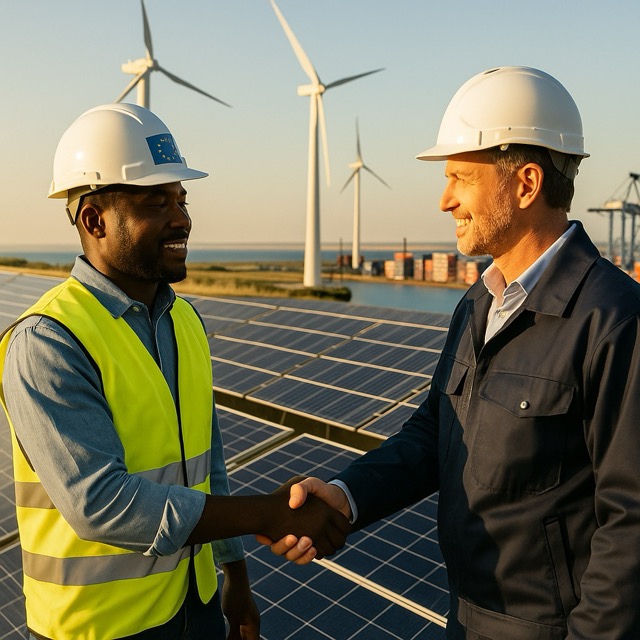
Commissioner Jozef Síkela urges a harder‑edged Global Gateway as Brussels accuses Beijing of setting ‘loan traps’ and vows to scale up beyond the original €300bn target
The European Union is refitting its flagship €300 billion Global Gateway programme into a more overtly geopolitical instrument, as the bloc seeks to contest influence with Russia and China from the Sahel to Southeast Asia. In remarks ahead of and around the 2025 Global Gateway Forum, Jozef Síkela, the EU Commissioner for International Partnerships, said the initiative must move from ‘good intentions’ to ‘results that shape the world map,’ arguing that Europe has been too cautious in converting its vast development spend into strategic leverage. He cast the EU as a ‘lifestyle superpower’ that should offer partners a compelling alternative to debt‑fuelled projects.
Síkela singled out Beijing’s lending model, saying some loans have functioned as ‘traps’ for vulnerable countries—terms that have inflamed a debate over whether Chinese state banks have saddled borrowers with expensive and opaque debts. The Commissioner’s blunt language marks a tonal shift for Brussels, which for years stressed complementarity with China’s Belt and Road Initiative (BRI) but now frames competition more directly. The sense of urgency is sharpened by Russia’s inroads in parts of Africa and the Middle East, often through security and resource deals that undercut European influence.
Launched in 2021 as Europe’s answer to the BRI, Global Gateway promised to mobilise €300 billion in public and private finance for clean energy, transport, digital, health and education projects by 2027. Brussels now says the original target has effectively been met ahead of schedule and that the programme is on track to surpass €400 billion by 2027, with a new investment hub to speed matchmaking between governments, development financiers and industry. The European Investment Bank (EIB) says it is underwriting roughly a third of the total mobilisation, while the Commission touts a pipeline that ranges from green hydrogen corridors to education partnerships designed to build skills where infrastructure lands.
Behind the headline numbers lies a tactical rethink. Officials concede that EU offers have sometimes arrived slower—and with heavier paperwork—than Chinese proposals. To fix that, the Commission and Team Europe development banks are streamlining due diligence for vetted partners, bundling feasibility studies with blended finance, and pre‑clearing procurement frameworks to shrink project timelines. The new approach prioritises projects that either secure critical raw materials, diversify clean‑tech supply chains, or harden digital and energy infrastructure against coercion. In plain terms: Brussels wants fewer ribbon‑cuttings that look good on brochures and more assets that shift dependencies.
Africa remains the proving ground. European officials point to green steel and renewable power ventures in Namibia and North Africa, electricity interconnectors in the Sahel and Maghreb, and health supply chains that reduce exposure to shocks. But the EU also faces a credibility test: several African governments remain wary after years of slow disbursements and overlapping EU‑member programmes. Síkela’s answer is to bind training and local industrialisation into every deal—’value‑added at home, not just exports out.’ That echoes a new development orthodoxy: infrastructure is only strategic if it builds capabilities and creates jobs on the ground.
Security is the other axis of competition. Russia’s Wagner‑successor formations and state‑linked firms have traded protection and propaganda for mining rights and political access. European diplomats say that Global Gateway cannot substitute for security partnerships, but it can stabilise by building reliable power, roads and digital networks—projects that make communities less vulnerable to coups and disinformation. The Commission is also experimenting with ‘economic security compacts’ that bundle investment with safeguards for data, critical infrastructure and export controls, seeking to prevent strategic assets from being leveraged against EU and partner interests.
The charge that China lays ‘debt traps’ is contested. Beijing rejects the label, and many economists note that debt distress often stems from a mix of domestic mismanagement, commodity shocks and global interest‑rate cycles. Still, a growing body of restructurings—in Sri Lanka, Zambia, and beyond—has made terms a political issue wherever BRI construction cranes rise. EU officials see a window: if Brussels can deliver financing that is predictable, transparent and cheaper over the life of a project, then governments balancing Beijing, Moscow and Western backers may tilt toward Europe.
Money alone will not decide the contest. Speed and simplicity will. To that end, the Commission is leaning on a new Global Gateway Investment Hub to triage proposals, narrow the gap between announcements and disbursements, and give companies a single front door. The aim is to pull in pension funds, export‑credit agencies and private‑equity dry powder with risk‑sharing tools rather than open‑ended subsidies. The bet: that blended finance, paired with predictable regulation and standards‑based procurement, can outcompete turn‑key offers that come with sovereign guarantees and fewer questions asked.
There is also a domestic politics dimension. With European budgets tight and elections reshaping priorities, Síkela and Commission President Ursula von der Leyen are arguing that strategic development spending pays dividends at home—by securing critical minerals, building markets for European clean‑tech, and reducing irregular migration pressures through job‑creating growth. The case is sharpened by uncertainty over future U.S. aid leadership. If Washington’s development footprint contracts, Brussels believes it can step into a vacuum with a calibrated mix of grants, loans and guarantees.
Critics counter that Global Gateway is still a label stitched onto disparate projects that were happening anyway; that pipelines are long on MoUs and short on groundbreakings; and that the EU’s own state‑aid and export‑control debates risk slowing delivery. They warn that pushing the programme as a geopolitical tool could also blur lines between development and power politics, alienating partners who prize non‑alignment. Commission officials respond that values and interests are not at odds—arguing that high standards on labour, environment and debt transparency are themselves a competitive asset—and that the best antidote to scepticism is execution.
For now, momentum is building. The Commission says it has already mobilised the initial €300bn target and is tracking toward €400bn in total by 2027. Flagship projects at the 2025 Forum showcased renewable corridors, digital backbone investments, and education partnerships. Whether this amounts to a decisive pivot will be clear in the next 18 months: Do disbursements accelerate? Do offtake agreements lock in critical minerals with value‑add in partner countries? Do local workforces see training turning into jobs? These are the metrics that will determine whether Europe’s model—partnerships over patronage, sustainability over short‑term wins—can genuinely outcompete rivals.
The geopolitical race is no longer abstract. Ports, power lines, data cables and training centres are now the currency of influence. Síkela’s message is that the EU must compete on that terrain—faster, clearer and with a sharper sense of strategic purpose—while keeping its promise that Global Gateway builds connections without strings that tighten later. If Brussels can marry speed with standards, the bloc may turn Europe’s development heft into the kind of power that shapes choices in capitals far beyond the EU’s borders.
Sources: Financial Times interview with Commissioner Jozef Síkela (October 2025); Reuters report on Global Gateway scale-up (October 2025); European Commission statements and factsheets on Global Gateway and the College of Commissioners; EIB President Nadia Calviño’s remarks at the 2025 Global Gateway Forum; World Bank press release on EC–WBG partnership (October 2025).
 The Tower Post