As of October 13, 2025, Russia targets Ukraine’s power grid while Kyiv leans on air defenses, long‑range drones, and a shifting aid landscape to brace for the cold months ahead.

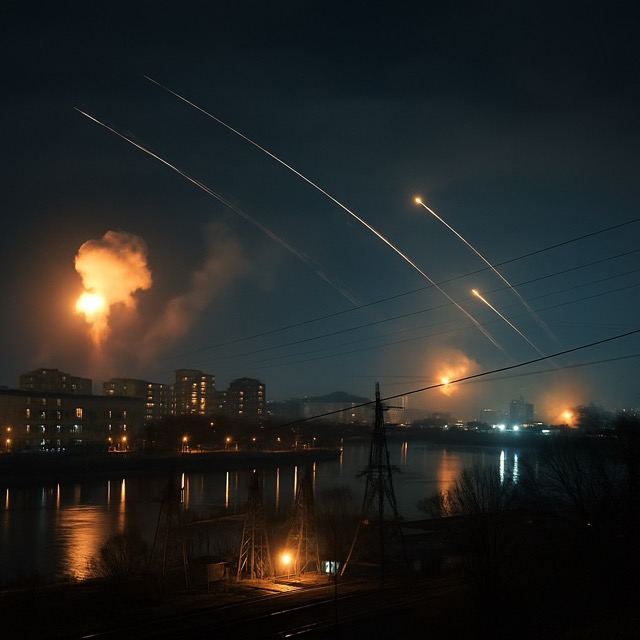
KYIV — In the small hours of Friday into Saturday, sirens wailed across Ukraine as waves of missiles and drones streaked toward major cities and energy hubs. By daybreak on October 13, officials in the capital said power had been restored to large swaths of Kyiv after one of the most concentrated barrages against the grid this season. The latest strikes — featuring ballistic and cruise missiles alongside swarms of Shahed drones — underscore how Russia is again making electricity a battlefield objective as winter approaches.
President Volodymyr Zelenskyy said Moscow waited for poor weather to reduce the effectiveness of air defenses by roughly a quarter, a tactic that Ukrainian commanders have long anticipated. Emergency crews raced to repair substations and transmission nodes; metro service and water supplies, briefly interrupted in parts of the capital, gradually resumed. Officials cautioned, however, that localized outages could persist as damaged equipment is rotated out and stockpiles of critical components are stretched.
The strikes hit multiple regions, including areas around Kharkiv and Zaporizhzhia. Residential neighborhoods were not spared: local authorities reported casualties in apartment blocks and injuries from falling debris in central Kyiv. Ukraine’s Air Force claimed a high interception rate overnight, but the numbers also highlighted the sheer volume of incoming threats — a pattern familiar from previous winters when Russia probed for weak points in both the sky and the grid.
On the front lines, Russia currently holds the initiative in several sectors, pushing incrementally in the Donetsk region and continuing pressure near key logistical nodes. Ukrainian officials say their forces repelled attacks near Dobropillia and along segments of the Kharkiv axis, even as Russian artillery and glide bombs continue to exact a steady toll on fortifications and civilian infrastructure. The front line has been relatively fluid in places but remains dominated by attrition: advances measured in fields, not cities; months of grinding fire superiority punctuated by drone‑driven surprises.
Ukraine’s response has leaned on long‑range, low‑cost drones that can reach strategic targets deep behind the front. Fuel depots and oil refineries across western Russia have faced intermittent shutdowns this year, complicating logistics and forcing the Kremlin to harden air defenses inland. Ukrainian planners concede that drone strikes alone cannot decide the war, but they can raise costs, degrade sustainment, and sow uncertainty — especially when paired with precision strikes on ammunition depots and command nodes near the line of contact.
Energy is where the war’s military and civilian dimensions most visibly intersect. After last winter’s punishing campaign, Ukraine has rebuilt parts of its grid with more dispersed generation and mobile substations, while accelerating repairs to high‑voltage transformers — the system’s Achilles’ heel. Officials say the country now fields denser belts of point defense around critical assets, but the calculus remains stark: even a handful of missiles that leak through can set off cascading failures that take days to stabilize. Every successful intercept saves gigawatts; every miss risks a neighborhood going dark.
The question hanging over Kyiv is whether air‑defense stocks can keep pace with the tempo. Ukraine’s inventory of Patriot, NASAMS, IRIS‑T, and other systems has grown, yet commanders warn that interceptor expenditure during massed raids remains unsustainably high without steady resupply. In recent weeks, allies have discussed new pathways to finance and source munitions — including mechanisms that draw funding from a coalition of European states to backfill U.S. stock drawdowns — even as debates continue over the scope of future packages.
Washington, for its part, is cautiously restarting weapons flows under arrangements funded by allies, after months of political wrangling slowed deliveries earlier in the year. European support has thickened: Germany and several Nordic and Baltic states have upped commitments for air defenses and artillery ammunition; the EU is working to expand shell production capacity; and discussions continue across G7 capitals on how to leverage frozen Russian assets for Ukraine’s defense and eventual reconstruction. The sums needed are daunting: Kyiv estimates defense requirements through 2027 in the tens of billions of euros annually, with energy repairs adding another steep, recurring bill.
On the Russian side, the Kremlin casts the latest grid attacks as strikes on dual‑use energy infrastructure supporting Ukraine’s war effort, touting the employment of hypersonic Kinzhal missiles alongside cruise munitions and drones. Moscow says its own air defenses have downed scores of Ukrainian drones over border regions in recent nights. Russian commanders claim incremental gains on the ground, particularly in sectors where Ukraine’s defensive lines were stressed during summer and early autumn by shortages of artillery shells and air defense missiles.
That attritional arithmetic is why the looming winter matters. If Russia can degrade electricity supply and heating during the coldest weeks, it can force trade‑offs: surge more interceptors to protect power plants and cities, or conserve missiles to shield troops and industry near the front. If Ukraine can blunt the barrages and keep the lights on — while persisting with its own deep strikes — it can deny Moscow major leverage and keep domestic morale steady. Either scenario pivots on logistics: transformer deliveries, interceptor production lines, drone manufacturing, and the ability to patch holes faster than the enemy can punch them.
Civilian life in Ukraine continues in a register of resilience. City authorities in Kyiv and other regions have reopened thousands of public ‘heating points’ as a contingency, tested backup generators at hospitals, and pre‑positioned repair crews near vulnerable nodes. Retailers have replenished stocks of power banks and gas heaters; residents who can afford it have installed double‑glazed windows and reinforced shelters. Yet for many, especially those displaced from front‑line oblasts, the prospect of another winter in limbo compounds financial hardship and fatigue.
Diplomatically, the war’s center of gravity remains a moving target. Talks between Western officials and Moscow have occasionally flickered — more as deconfliction channels than meaningful negotiations — while Kyiv insists that any settlement must be premised on restoring Ukraine’s territorial integrity and securing credible security guarantees. With both sides convinced that time can still shift the battlefield balance, a durable ceasefire appears distant.
Strategically, Ukraine’s leadership describes its approach as a ‘pressure gradient’ across domains: attrit Russian artillery and electronic warfare near the front; harass logistics with long‑range drones and missiles; protect energy and industry to sustain mobilization; and expand domestic arms production through joint ventures with allies. The bet is that pushing on many levers — even modestly — can cumulatively deny Moscow the decisive momentum it seeks, while preserving Ukraine’s capacity to regenerate forces for future offensives.
For now, the nightly rhythm holds: alerts, interceptions, impact. In the morning, repair crews fan out to splice cables and swap out transformers; in the afternoon, schools stagger classes; by evening, the cycle resets. Winter’s edge is both a deadline and a crucible — for logistics networks, for political will in allied capitals, and for a population entering its fourth cold season under attack. Ukraine has survived this playbook before. Whether it can do so again — with fewer blackouts, more interceptors, and a steadier flow of ammunition — will shape the war’s next chapter.
What to watch in the coming weeks: the pace and scale of Russian combined drone‑missile raids; the availability of interceptors and spare parts for Ukraine’s air defenses; evidence that strikes on Russian refineries and depots are materially constraining wartime output; and the trajectory of international assistance — especially new air‑defense batteries, artillery ammunition, and the financing mechanisms behind them. Each variable nudges the balance of power, either toward stalemate or toward another attempt at breakthrough.
Sources
Associated Press, Oct. 11, 2025 — Power restored to 800,000 in Kyiv after major Russian strikes on energy grid.
Reuters, Oct. 11, 2025 — Zelenskyy: Russia timed energy strikes with bad weather; grid disruptions and front‑line updates.
The Guardian, Oct. 11, 2025 — Kyiv restores power after drone and missile attacks; casualties in Zaporizhzhia and Kyiv.
RFE/RL, Oct. 11, 2025 — Ukraine braces for winter as Russia escalates energy attacks; Kharkiv infrastructure targeted.
Institute for the Study of War (ISW), daily assessments, Oct. 7–10, 2025 — Russian combined strikes; front‑line dynamics.
Reuters, Sept. 16, 2025 — First U.S. weapons packages for Ukraine under allied‑funded mechanism cleared.
Kiel Institute Ukraine Support Tracker — Aid landscape through June 2025; next update announced for mid‑Oct 2025.
Russia Matters (Harvard Belfer Center), Oct. 8, 2025 — Impacts of Ukrainian drone strikes on Russian refining capacity.




 The Tower Post