
Twenty surviving Israeli captives are freed as Israel starts releasing Palestinian prisoners, testing a U.S.-brokered truce and raising cautious hopes after two years of war.
By Staff Reporter | Tel Aviv / Gaza
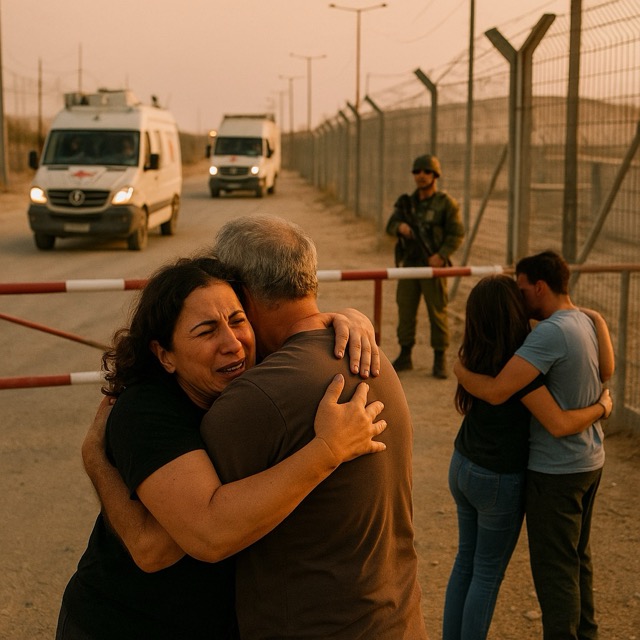
The last 20 living Israeli hostages held in Gaza began returning home on Monday morning under a ceasefire deal that also set in motion the release of large numbers of Palestinian prisoners from Israeli jails—an exchange that families on both sides have awaited for more than two years. The International Committee of the Red Cross (ICRC) escorted the first group across military corridors just after dawn, as television channels in Israel carried live feeds from reunion centers and crowds in Tel Aviv’s Hostages Square erupted in tears and applause.
The releases—what officials described as a phased handover—formed the most tangible step yet in an agreement brokered with heavy U.S., Egyptian and Qatari involvement. Israeli media said transfers were slated to start around 8 a.m. local time along the east–west Netzarim corridor, with additional handoffs later in the morning in southern Gaza. Police closed sections of highways around air bases and hospitals to speed medical evaluations and family reunifications, while military censors urged the public not to broadcast sensitive details about movements.
In Tel Aviv, yellow ribbons and blue-and-white flags fluttered from balconies as thousands filtered into the square that became the nightly vigil for captives’ families. Some held photographs dog-eared from months of rallies; others hugged strangers. “At last, they’re coming home,” said Hadas Levi, whose cousin was among those believed to be alive until confirmation came Monday morning. “But we will not celebrate fully until every body is accounted for and all families can bury their dead.”
Under the terms described by officials and media outlets, Hamas agreed to free the remaining living hostages seized during the Oct. 7, 2023 attacks, and to transfer the remains of dozens more. Israel, in turn, authorized the release of a large cohort of Palestinian prisoners—figures cited by officials and news organizations on Monday ranged from about 1,700 to nearly 1,900—as well as minors. The government framed the exchange as a humanitarian imperative and a necessary step to close the war’s most searing chapter.
Inside the strip, the morning brought a rare quiet. Fuel-starved ambulances idled at hospital gates awaiting instructions; small knots of residents gathered near roundabouts as Egyptian- and Qatari-brokered convoys ferried ICRC teams and aid into designated corridors. A Khan Younis resident described a “breath between storms,” worried that the ceasefire might fray before power and clean water could be restored in a lasting way. Aid agencies said they were ramping up deliveries of food, medicine and shelter materials under a daily cap agreed with Israel.
The choreography behind Monday’s exchanges reflected lessons from earlier partial swaps: staged checkpoints, real-time verification, and pre-cleared air corridors. In the first tranche, seven hostages were handed to the Red Cross for transfer to Israeli custody, followed by additional groups later in the morning. Families were told to expect initial video contact before in-person reunions, and to prepare for prolonged medical screenings, including trauma care.
The political stakes were evident. In Jerusalem, U.S. President Donald Trump addressed the Knesset amid a victory-lap tour that his aides cast as the opening to a broader regional deal. He was due to join a summit in Egypt alongside Arab and European leaders to press a postwar framework: security arrangements in Gaza not run by Hamas, expanded humanitarian access, and a pathway—still hotly contested—toward eventual Palestinian statehood. Israel’s leadership, for its part, hailed the hostages’ return while stressing that broader security goals, including the demilitarization of Gaza, had not been abandoned.
Despite the euphoria, Monday’s scenes were threaded with uncertainty. Israeli officials said a dedicated task force would continue efforts to locate the remains of captives who died in Gaza, a grim mission that could take months. On the Palestinian side, lawyers and families scrambled to confirm lists of those slated for release and their conditions: some prisoners were due to be freed to the West Bank, others to East Jerusalem, and a number faced restrictions on travel or political activity. Rights groups warned that without systemic reforms to detention practices, the cycle of arrests and exchanges could persist.
The broader humanitarian picture remained stark. Gaza’s health system is shattered, with swaths of hospitals out of service, water infrastructure in ruins, and neighborhoods leveled. Aid officials said the daily aid target—hundreds of trucks per day—would, if sustained, begin to stabilize food supplies and reduce the risk of famine, but only sustained access and power would allow full-scale reconstruction. In Israel, trauma clinics braced for a wave of PTSD cases among returnees and families. “Recovery will not end with a reunion hug,” one social worker said.
Among those freed were civilians and soldiers taken from homes, roads and bases in the October 2023 onslaught, including several whose families became public faces of the campaign to keep the issue on the national agenda. In Hostages Square, organizers placed candles for those who never made it home. A violinist played a medley of folk songs that had become a fixture of the nightly vigils, while volunteers handed out dates and water to anyone who needed a seat or a cry.
Across the region, leaders moved quickly to claim credit or stake positions. Egypt and Qatar emphasized their roles as go-betweens. Jordan and the United Arab Emirates called the releases a first step and urged a durable ceasefire that included reconstruction funds and a security blueprint acceptable to Israelis and Palestinians. The European Union welcomed the exchanges and pressed for accountability for wartime abuses on all sides.
Attention now shifts to whether the truce can hold long enough to anchor a broader political settlement. U.S. officials pitched a sequenced plan: extend the ceasefire; expand aid; install an interim administrative mechanism for Gaza with Arab security participation; and launch a track toward renewing Israeli–Palestinian negotiations. Each step has spoilers. Israeli hardliners argue that prisoner releases will embolden militants; Palestinian factions warn that any arrangement that sidelines their political aspirations will fail. For families, however, Monday’s calculus was simpler: measure hope one safe arrival at a time.
If the exchange holds, it will mark the capstone to an exhausting, often agonizing campaign by hostage families who refused to let the issue fade. Their persistence galvanized Israeli society and kept international pressure on negotiators through stalemates and flare-ups. But it also underscored a painful arithmetic: diplomacy advanced most when the human stakes were unavoidable on every screen and in every square. The question now is whether the same urgency will be summoned for the slower work of rebuilding lives.
As dusk approached, the square began to empty. Volunteers collected signs; a child in a yellow ribbon slept on her father’s shoulder. On the big screen, medical teams walked side by side with the newly freed—some smiling, some expressionless, all blinking into a different light. The crowd, for once, seemed content to let silence say what words could not.
Reporting informed by: Reuters, Associated Press, The Guardian, The Washington Post, Al Jazeera, ABC News — all reports published on October 12–13, 2025.




 The Tower Post