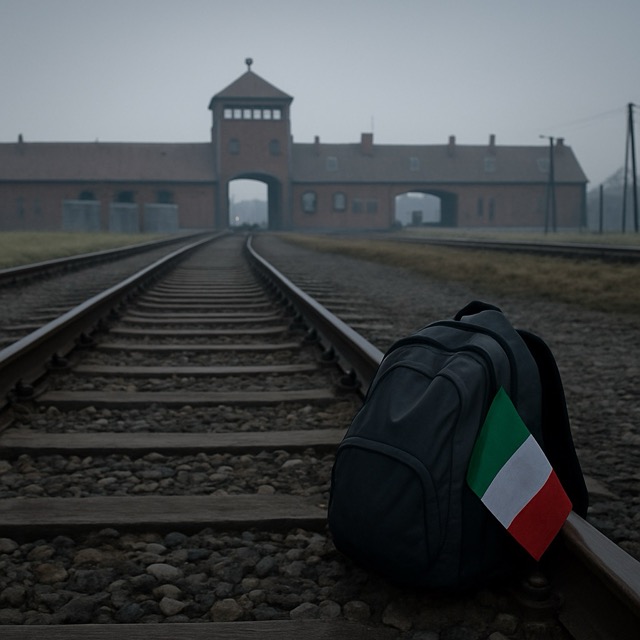
After Giorgia Meloni’s ‘more fundamentalist than Hamas’ jab at the left, Family Minister Eugenia Roccella inflames debate by casting doubt on school visits to sites of the Shoah—prompting a wider clash over historical revisionism and civic education.
Rome—In the span of a weekend, Italy’s simmering culture war over history, identity, and the Israel–Palestine conflict burst back into the headlines. The spark this time: comments by Family Minister Eugenia Roccella suggesting that Italian schools’ study trips to Auschwitz have been “encouraged and promoted” as a way to frame antisemitism strictly as a Fascist-era phenomenon. Her remarks—delivered at a conference organized by the Union of Italian Jewish Communities (UCEI)—landed in an already febrile atmosphere shaped by Prime Minister Giorgia Meloni’s recent claim that the Italian left is “more fundamentalist than Hamas.” Together, the statements drew sharp rebukes from opposition parties, educators, and Holocaust survivor and senator-for-life Liliana Segre, and reopened a painful question: who gets to define the terms of national memory?
Roccella’s words were striking not only for their timing but for their target. For decades, Italy’s schools have treated journeys to Auschwitz-Birkenau and other sites of the Shoah as a cornerstone of civic education, aimed at confronting the machinery of genocide and the consequences of racial laws enacted under Benito Mussolini. The minister argued that these trips have sometimes been used to reinforce a simplified storyline—“antisemitism equals Fascism, and that’s it”—which, in her view, overlooks other, contemporary manifestations of antisemitism. Critics countered that the claim stokes suspicion toward historical study itself and risks minimizing the specific responsibilities of Italy’s Fascist regime for the persecution and deportation of Italian Jews.
Segre’s reaction was swift and personal. “The memory of historical truth only harms those who keep skeletons in their closets,” she said, challenging the notion that students’ ‘gite’—a term Roccella used that many felt trivialized solemn visits—are propaganda rather than pedagogy. Opposition leaders called the minister’s words “gravely irresponsible,” while teacher associations worried about a chilling effect on curricula already strained by political pressure. By Monday, Roccella insisted her reasoning had been misrepresented, saying recordings would confirm her intent was to broaden, not erase, the frame in which antisemitism is taught. But the damage—at least in political terms—was done: what began as a critique of emphasis ricocheted into a national argument about the legitimacy of memory work itself.
That argument is not new. Italy’s memory politics have long oscillated between recognition and reinterpretation. In recent years, as debates over the Middle East have intensified across campuses and city squares, the government has urged a harder line against what it calls imported antisemitism under the banner of pro-Palestinian activism. Ministers have castigated universities as “places of non-reflection,” denouncing encampments and protests as unthinking alignments. Supporters say the stance defends Jewish students and upholds civic order; opponents hear an attempt to equate criticism of Israeli policies with hate speech, shrinking the space for legitimate dissent.
Into this minefield, school trips to Auschwitz carry a unique symbolic weight. They are not just excursions; for many students, they are formative encounters with survivor testimony, archives, and the architecture of extermination. Teachers report that the journeys reinvigorate classroom study, making abstract dates painfully concrete. Local administrators and NGOs partner to ensure the visits include rigorous preparation and follow-up work—reading lists, seminars, and reflective writing—that push beyond the single day at a memorial site. The goal is not to fix history in amber but to clarify how prejudice, bureaucracy, and authoritarianism can align in the present.
Roccella’s contention—that the trips have been “used” to lock antisemitism inside the Fascist past—touches a legitimate pedagogical question: how to connect the Shoah’s specificity to today’s hate without flattening either one. Many educators say the answer lies in more research and more context, not fewer visits. Auschwitz stands at the center of Europe’s moral memory for a reason; pretending otherwise, they argue, courts the very relativism that conspiracy theorists exploit. If students are encountering antisemitic tropes in new guises—online conspiracies, vandalism, or chants that slip from geopolitical protest into ethnic demonization—the remedy is to enrich, not dilute, historical literacy.
The political calculus is trickier. Meloni’s jab that the left is “more fundamentalist than Hamas” was designed to sting, framing her opponents as so doctrinaire they cannot recognize the jihadist movement’s culpability for war and hostage-taking. It is also a move that places the government squarely within a broader European trend: right-wing parties recasting themselves as bulwarks against antisemitism while accusing the left of moral blindness. Yet the broader the lens becomes, the more sensitive the focus on Auschwitz appears. If everything is antisemitism, some historians caution, then the precise mechanisms that enabled genocide—racial laws, collaboration, deportation lists, industrialized murder—risk sliding out of view.
This is why Segre’s intervention matters. Her insistence on “historical truth” is not a plea for nostalgia but for precision. In the Italian case, precision requires squarely addressing the role of the Fascist state and the complicity of parts of society. That is not the whole story of antisemitism today, but it is an indispensable starting point for honest civic education. And for the many teachers who have built years of careful, student-centered work around the trips, the suggestion that their efforts are propaganda feels like a personal affront—and a potential green light for administrators looking to cut budgets or avoid controversy.
The stakes extend beyond Italy. Across Europe, parties on the right and left are renegotiating their relationship to 20th-century memory as the post-war consensus frays. In Germany, debates over cultural programming and boycotts show how quickly historical responsibility can collide with artistic freedom. In France, concerns about antisemitic attacks intersect uneasily with anxieties over laïcité and migration. Italy’s current flashpoint—whether Auschwitz trips ‘politicize’ memory or protect it—belongs to the same family of struggles over how democracies teach history in an age of polarization.
Where does this leave schools? One constructive path would be to expand, rather than replace, the itinerary: pairing Auschwitz with visits to sites documenting other persecutions, adding units on post-war antisemitism, or inviting scholars and Jewish community leaders to co-design modules that tackle contemporary hate head-on. Another involves methodological transparency: disclosing syllabi, source lists, and learning outcomes to parents and students, making clear that the aim is evidence-based study, not party-line instruction. None of this requires abandoning the camps as teaching sites; it requires reaffirming why they matter.
There is also a civic argument about tone. Weaponizing memory—by lumping political opponents with extremist groups, or by insinuating that memorial education is a partisan plot—risks alienating the very students policymakers hope to reach. Healthy democracies need shared reference points, and the Shoah—precisely because it is singular in intent and scale—remains one of them. If politicians insist on fighting their battles over the heads of teachers and teenagers, they may win a few news cycles but lose the long war for civic trust.
At the end of the day, school trips to Auschwitz are neither sufficient nor optional. They cannot, on their own, inoculate a society against hatred, nor can they be dispensed with as relics of a bygone political narrative. They are one instrument in a broader toolkit that includes rigorous history instruction, media literacy, and the moral courage to condemn bigotry whatever mask it wears. Reframing that instrument as a propaganda device not only misreads its purpose; it risks delegitimizing a fragile consensus that the dead deserve witnesses—and that young citizens deserve the chance to become them.
The present controversy will pass, as such storms do. But the lesson it leaves should be written into lesson plans: memory cannot be outsourced to politics. It must be taught—patiently, accurately, and with enough humility to connect the uniqueness of the Shoah with the realities students inhabit today. In that task, the tracks to Auschwitz are not a detour from civic education. They are one of its main lines.



 The Tower Post