
Sanctions, collapsing margins and clogged railways push a once-profitable sector into its deepest downturn in three decades
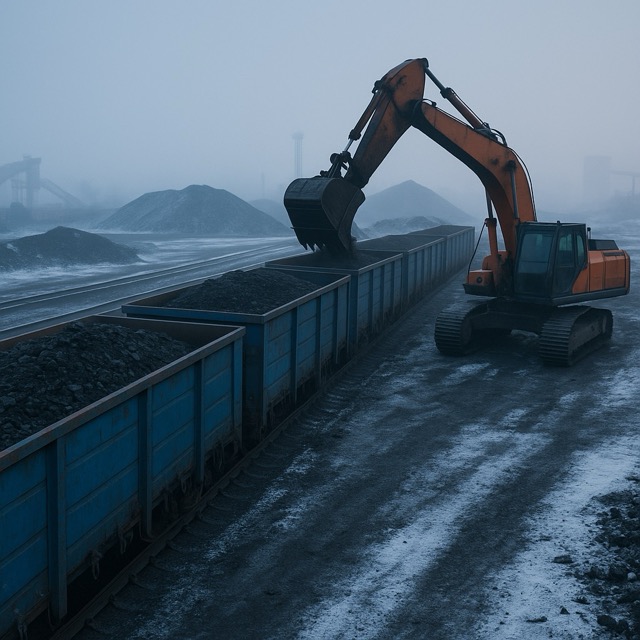
KEMEROVO, KUZBASS —
In the third year of Vladimir Putin’s full-scale invasion of Ukraine, Russia’s coal business — long a workhorse of Siberia’s industrial heartland and a key source of export revenues — has turned into one of the war’s sharpest economic casualties. Producers that posted bumper profits in 2023 are now drowning in red ink, squeezed by sanctions, transport bottlenecks, and a dramatic swing in global prices.
Official data compiled this summer showed sector-wide losses of roughly 225 billion rubles (about $2.8 billion) in January–July 2025 — a whiplash reversal from nearly 375 billion rubles of profit recorded in 2023. Regional officials in Kuzbass say mine closures and furloughs have spread across the basin, with overdue wages rising and local budgets strained.
A swift reversal of fortune
The EU’s embargo on Russian coal in 2022 forced a radical redirection of exports from Europe to Asia. At first, Russia benefited from the global energy turmoil; buyers in China, India and Vietnam absorbed discounted cargoes as gas prices spiked. But as the market normalized through 2024 and into 2025, thermal coal benchmarks slid from crisis-era highs. To hang on to Asian market share, Russian suppliers accepted steep discounts to international prices while swallowing sharply higher logistics costs.
By mid‑2025, many miners were selling below cash cost on some routes, according to traders and rail data. The long, single‑track passage to Far Eastern ports — the critical artery for eastbound shipments — has become a chokepoint, with scheduled maintenance and periodic derailments constraining capacity. Rail tariffs have risen, and priority slots are increasingly contested by military cargo and other strategic shipments.
Margins crushed by distance
The economic geometry is punitive. Russia’s largest coal pits lie thousands of kilometers from the deep‑water terminals needed to reach Asian buyers. Freight now eats much of the final sale price for eastbound cargoes, leaving little cushion as prices soften. Even well-capitalized players with their own port stakes report thinner margins, while mid‑tier producers — reliant on third‑party rail and terminals — are being squeezed out of the export market altogether.
Several mines have halted or curtailed output in 2024–2025, and court filings show a rising tide of restructurings, debt standstills and pre‑bankruptcy procedures. Industry unions describe a patchwork of reduced workweeks, unpaid leave and delayed pay across Siberia and the Far East. Russian Railways has pared back some scheduling, reflecting weaker volumes and capacity constraints.
A shrinking export pie
Global coal demand set new records in 2023–2024, driven by post‑pandemic recovery and high gas prices, but growth slowed markedly this year and is increasingly concentrated in Asia. China’s record‑high imports in 2024 were followed by a more selective buying pattern in 2025 as domestic output rose and hydropower recovered in some provinces. Indian utilities remained opportunistic, but spot tenders tightened on quality, delivery time and payment channels — areas where sanctioned exporters face persistent friction.
Argus freight and rail bulletins show that approved coal volumes for Far Eastern ports fluctuated through 2025, with periods of maintenance and seasonal congestion limiting flows. When rail access opens, producers rush to ship, pushing discounts wider; when it tightens, inventories swell inland and cashflows dry up. The effect is a boom‑bust rhythm that strains balance sheets and erodes confidence among lenders and service providers.
The state steps in — cautiously
Moscow has unveiled a modest support package — tax deferrals, discounted rail tariffs for some grades, and efforts to refinance working capital — but officials have stopped short of a blanket bailout. Policymakers privately warn that propping up high‑cost capacity would only lock in losses if global prices continue to drift. Meanwhile, ambitious plans to expand the Baikal–Amur Mainline and Trans‑Siberian corridors face delays and cost overruns, limiting prospects for a quick fix to the logistics crunch.
Knock‑on effects in company towns
The coal slump cuts deep in regions where mines anchor municipal finances and social services. In Kuzbass, local administrators say reduced severance funds and unpaid wages have compounded household stress. Small contractors — from equipment repair shops to catering firms — report vanishing orders. Some miners have turned to short‑term migration for work in construction or military‑related industries elsewhere in Russia.
Quality and grades matter more
As buyers become choosier, Russia’s producers with higher‑quality coking coal or low‑sulphur thermal grades retain a foothold in Asia, while others struggle. Market participants say pricing for lower‑calorific coal has been hit hardest, especially when coupled with long rail hauls. Port blending and washing capacity can mitigate the discount, but sanctions complicate equipment upgrades and financing.
A strategic dead end?
For the Kremlin, the coal industry’s travails carry political and strategic risk. The sector directly employs well over a hundred thousand workers and underpins the economy of entire districts. While Russia has redirected oil and some refined products to friendly markets with relative success, coal is proving harder to reroute profitably at scale. Even where volumes hold up, net export revenue — what matters for taxes, wages and investment — has been gutted by the cost of getting coal to sea.
A further headache: energy infrastructure strikes inside Russia have periodically disrupted rail operations and refinery output in 2025, forcing authorities to prioritise fuel for domestic needs. The resulting reshuffles in rail scheduling have occasionally sidelined bulk commodities like coal. Belarus, a political ally, has stepped up fuel shipments to fill gaps, but those flows travel on the same congested tracks that coal relies on, worsening the squeeze.
What to watch next
Analysts cite three swing variables for the next 12 months. First, Asian demand: a hot summer or hydropower shortfalls could briefly lift prices, but structural headwinds from renewables and efficiency remain. Second, transport capacity: incremental improvements on the eastern corridors could narrow discounts; persistent bottlenecks would keep margins depressed. Third, sanctions enforcement: tighter financial and maritime scrutiny — including on shipping services and insurance — would raise costs further, while any loosening would likely be marginal given the geopolitical backdrop.
For now, the balance of forces is negative. Even well‑placed Russian miners concede that 2025 will go down as the industry’s toughest year in decades. The war’s collateral damage to a flagship export sector underscores how deeply the conflict has re‑wired Russia’s economy — and how difficult it will be to rebuild profitability in coal without a fundamental easing of both the battlefield and the bottlenecks.
Sources
Financial Times, October 2025; Reuters, October 2025; International Energy Agency, 2024–2025 reports; Argus Media rail and port updates (2025); regional statements and local press reports from Kuzbass (2024–2025).



 The Tower Post