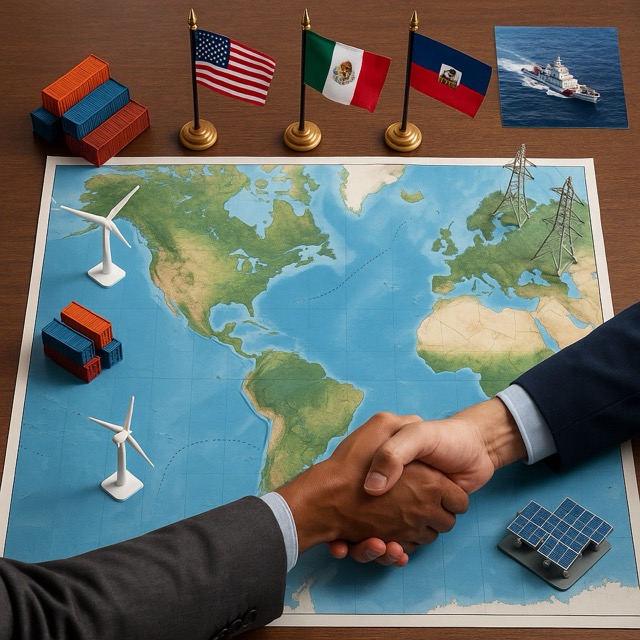
America’s gaze returns to the hemisphere — and rediscovers it still can’t go it alone
Washington is reviving an old instinct under a new label. Call it the ‘Donroe doctrine’ — a twenty-first century remix of the hemispheric focus whose name echoes Monroe but whose methods are far less imperial and far more networked. The core idea is simple: in a world of contested supply chains, illicit flows, climate shocks and geopolitical rivalry, the path to American resilience runs through the Americas. The execution, however, is complicated. As the United States turns its attention back to its own neighborhood, it is discovering that it cannot — and should not — go it alone.
What’s different this time is the balance between muscle and glue. The muscle is familiar: border enforcement, counternarcotics, maritime patrols, and the hum of logistics from Southern Command to Coast Guard cutters. The glue is newer: supply‑chain partnerships, joint climate and energy projects, and rules to keep digital trade open while guarding data and critical infrastructure. Instead of declaring a sphere of influence, the U.S. is trying to build a sphere of interdependence that is both safer and fairer.
Migration is the policy that tests every other policy. In 2023 and 2024 the Darién jungle between Colombia and Panama became a symbol of hemispheric disorder. This year, crossings have plunged after a combination of tougher enforcement in Panama, binational campaigns against smuggling networks, and expanded return and regularization pathways. The drop has eased pressure on the U.S.–Mexico border but revealed an awkward truth: deterrence works only when paired with upstream cooperation, humanitarian channels, and legal labor mobility. Absent those, flows don’t end — they reroute.
Security cooperation is being rewritten in Haiti. A Kenya‑led Multinational Security Support mission, backed financially and logistically by Washington and several Caribbean partners, has begun to transition toward a more tailored, Haitian‑centered force against gang control. The lesson for the Donroe doctrine is twofold. First, burden‑sharing is not optional; regional legitimacy matters more than American horsepower. Second, episodic deployments are not a substitute for political roadmaps and institutions that can outlast any mission.
The geostrategic context is also new. China’s economic presence in Latin America remains formidable — from renewable energy to ports and minerals — yet Beijing’s priorities are shifting as it reassesses risk and returns on capital. Several governments across the region are recalibrating too, tightening the screening of strategic sectors while still welcoming manufacturing, energy, and logistics investment. For the U.S., the choice is not to crowd out China so much as to crowd in competitive options: financing that arrives on time, rules that are predictable, and projects that create local suppliers, not just throughput.
Enter nearshoring, the economic arm of the doctrine. Mexico has already overtaken China as America’s top goods‑trading partner, and Central America is trying to capture light manufacturing that is shifting closer to the U.S. market. But proximity is not destiny. Investors want electricity that is cheap and clean, customs that clear in hours not days, and workforces that can code as well as weld. That is why the administration has leaned on new vehicles — from the Development Finance Corporation to the Americas Partnership for Economic Prosperity — to steer capital into grid upgrades, ports, digital rails and vocational training. The question is whether these initiatives can scale before the next electoral cycle resets the priorities again.
Trade politics loom in the background. The 2026 joint review of the USMCA hangs over boardrooms from Monterrey to Montreal. For the doctrine to work, North America must offer regulatory certainty for the next decade: clear rules on rules‑of‑origin, dispute settlement that actually settles disputes, and a stable framework for new sectors such as semiconductors and EVs. Without that, nearshoring will stall and the hemisphere will remain a slogan rather than a supply chain.
Energy is where cooperation can move fastest. The Gulf of Mexico’s oil and gas interdependence is not going away, but the next wave is transmission lines, storage, and cross‑border hydrogen and critical minerals. The so‑called Lithium Triangle — Chile, Argentina, Bolivia — is trying to convert ore into value chains at home. The U.S. can help with standards, off‑take, and environmental safeguards that bolster community consent. Done right, energy becomes a platform for trust: power bills fall, jobs rise, and the politics of decarbonization get easier.
Security hard‑edges persist. Venezuela’s post‑election turbulence has kept tensions with Guyana simmering over the Essequibo region, pulling the U.S. into deterrence diplomacy and quiet contingency planning. Ecuador’s struggle against organized crime has prompted deeper intelligence and policing ties. Fentanyl precursors and synthetic drugs continue to mutate supply chains, forcing the U.S., Mexico, and Asian partners to widen cooperation from street seizures to chemical registries and e‑commerce platforms. In each case, unilateral moves are blunt instruments; shared data, cross‑border investigations and judicial cooperation are the only levers that bite.
The political map of the hemisphere is itself fragmented. Voters from Mexico to Argentina are demanding security, lower prices and visible competence. That makes grand bargains hard and transactionalism tempting. A doctrine worth its name must therefore survive leadership changes. That argues for fewer one‑off deals and more institutional habits: regular ministerials that outlast administrations; interoperable digital systems for customs and trusted traveler programs; cross‑listed qualifications so a nurse trained in Tegucigalpa can fill shortages in Texas without years of paperwork.
There is also a democratic dividend to be reclaimed. Support for free media, independent courts, and municipal governance is not charity; it is insurance against the next migration surge and the next security crisis. The U.S. cannot bankroll every reform, but it can de‑risk them: tie development finance to integrity pacts, hard‑wire transparency into contracts, and back civil society watchdogs that raise the cost of corruption. When citizens trust their institutions, they are less likely to vote with their feet.
Critics see the Donroe doctrine as old wine in a new bottle — a return to tutelage by another name. That critique lands if Washington confuses consultation with notification. The remedy is procedural humility: co‑designing projects with local counterparts, opening procurement to local firms, and publishing metrics that communities can check. The point is not to make the hemisphere dependent on the U.S., but to make it interdependent in ways that raise everyone’s resilience.
Three practical tests will determine whether this doctrine is more than branding. First, can the hemisphere build lawful mobility at scale? Seasonal work visas, safe recruitment, portable benefits and mutual recognition agreements are the scaffolding of an orderly labor market. If the U.S. and its partners cannot operationalize those, irregular flows will surge back when the next shock hits.
Second, can North America lock in investment confidence beyond 2026? A credible USMCA review that clarifies rules for autos, energy and digital trade — and resists the temptation to reopen everything — would anchor supply chains through 2042. That in turn would justify the ports, rail and grid projects that nearshoring needs.
Third, can security cooperation deliver neighborhoods, not just numbers? Troop counts and seizure stats matter less than whether Port‑au‑Prince residents can get to work safely, whether small businesses in Guayaquil can open without extortion, whether a teenager in Tijuana sees a future in a factory or in a cartel. Those are the everyday metrics a people‑first security approach should track.
The United States is re‑learning a lesson it taught the world in another era: durable power is not the capacity to act alone; it is the capacity to convene others and keep them at the table. In the Americas, that means respecting the agency of neighbors, taking regional institutions seriously, and accepting that leadership often looks like patience. The Donroe doctrine, if it is to stick, will be measured not by what Washington announces, but by what the hemisphere builds together — supply chains that flex under stress, borders that are orderly and humane, markets that reward clean energy and honest work, and cities where the safest route is the shortest one.
America’s attention is turning homeward, yes. But ‘home’ in geopolitics is rarely a single country. It is the thick web of ties that make prosperity and security possible. In the Western Hemisphere, those ties are finally being seen not as dependencies to manage, but as assets to leverage. That is the essence of the Donroe doctrine — less a proclamation than a practice. If Washington sustains it, the hemisphere could become the world’s most reliable workshop and its most competitive green‑energy corridor. If it does not, the old cycle will return: crisis, attention, fatigue, and drift. The choice, this time, belongs to more than one capital.




 The Tower Post