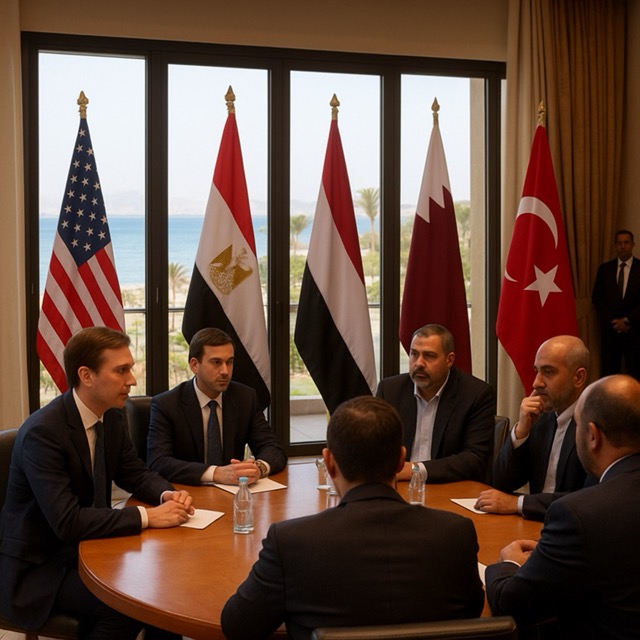
Exclusive reconstruction of a 45‑minute, high‑risk meeting that unblocked the final hurdles to a ceasefire and hostage‑prisoner exchange
Sharm El‑Sheikh/Washington
When the elevator doors slid open at the Four Seasons in Sharm El‑Sheikh last Wednesday night, the two most unconventional American envoys in a generation stepped into a room that negotiators on all sides had tried to avoid. Steve Witkoff, the real‑estate magnate turned presidential special envoy, and Jared Kushner, Donald Trump’s son‑in‑law and veteran of the Abraham Accords, were about to do what Washington has publicly sworn off for years: meet face‑to‑face with senior Hamas leaders.
By multiple accounts from U.S., Egyptian, and Qatari officials familiar with the talks, the encounter lasted roughly 45 minutes. But its consequences rippled far beyond the hotel’s security cordon. Within days, mediators Egypt, Qatar, and Turkey signed a formal document with President Trump that enshrined a ceasefire framework, a phased Israeli withdrawal, and the release of the remaining Israeli hostages in exchange for a large‑scale Palestinian prisoner swap. The signing, staged in Sharm El‑Sheikh on Monday, capped a frenetic week that flipped the logic of two years of deadlock: if every indirect channel had failed, a direct one — however politically toxic — might just work.
The breakthrough came after a logjam hardened around a single fear repeatedly voiced by the Hamas delegation, according to participants in the process: that Israel would resume major operations in Gaza the moment the hostages were freed. Egyptian interlocutors said the Islamists worried they would be trading their last leverage for a promise that could be undone the next morning. U.S. officials had tried paper guarantees before. They had not worked.
Witkoff and Kushner walked in with two levers no memo could match — proximity and personal assurances. “We’re here under the President’s authority,” one of them said, according to a senior mediator briefed on the meeting. The message, distilled: if Hamas kept its side of the bargain, the United States would not allow an immediate return to all‑out war. The envoys also appealed to the politics of exhaustion. The war had crossed a second year. Gaza’s misery, Israel’s losses, the region’s patience — all had reached an unsustainable breaking point. The hostages, one mediator paraphrased Witkoff as saying, had become “a burden rather than leverage,” a phrase that landed with a thud — and then a pause.
It helped that the room itself symbolized a rare convergence of pressure. Egypt’s powerful intelligence chief had quietly encouraged a last‑ditch direct contact. Qatar’s prime minister pushed Washington to take the risk, arguing that Hamas would not budge on a written pledge alone. Turkish facilitators signaled they could help sell a ceasefire to skeptical Islamist figures if they saw the Americans’ commitment up close. Inside Gaza, Hamas commanders had to weigh not only the movement’s survival but the cratering public mood after months of siege and displacement.
The Americans came with a script honed over a week of shuttle talks: a phased sequence, anchored in verification. First, an immediate cessation of hostilities and a pullback of Israeli forces from designated zones to create humanitarian corridors and allow displaced civilians to move homeward. Second, a sequenced exchange: living hostages prioritized, followed by remains, matched against tranches of Palestinian detainees. Third, a monitored redeployment of Israeli units over weeks, not months, with milestones tied to compliance by both sides. Fourth, a reconstruction mechanism — a perennial sticking point — to be overseen by an international board with Egyptian, Qatari, Turkish, European, and U.S. participation to prevent diversion while speeding cement, steel, and cash where they’re needed most.
Two elements were novel. One was political: a written “non‑reversion” clause, in which Washington, Cairo, and Doha would publicly attest that if either side violated the ceasefire, it would face consequences — diplomatic, financial, and, if necessary, military support withheld. The other was personal: Kushner and Witkoff pledged to remain on the ground through the first swap and first pullback, signaling that the White House was tying its credibility to the plan’s early execution.
The cost of such proximity was obvious. Meeting Hamas remains deeply contentious in Israel and in parts of Washington. Critics called it legitimization of a group long designated a terrorist organization by the U.S. and EU. Supporters countered that it was a narrow, tactical contact to end a war and free captives — not a recognition. “We made a hard, clean decision,” a senior U.S. official told this newspaper. “If you want hostages home and the guns silent, you sometimes have to walk into the room you’d rather avoid.”
Even before the Sharm sit‑down, signals were flashing. The White House had dispatched Witkoff to the region with wide latitude, a reflection of Trump’s improvisational style as much as of his envoy’s relationships in the Gulf. Kushner, who retains unique access to regional royals from his Abraham Accords days, arrived to assist as talks teetered. The Egyptians kept the hotel secure and the schedule flexible. A Qatari intermediary quietly floated the idea of a direct contact to break the deadlock on “day zero” guarantees. By Wednesday evening, the orbit had narrowed to a point.
What tipped the scale inside the room, participants say, was less the choreography than the calculus. Hamas, under staggering military and political strain, needed a way to claim a win and survive the morning after. The Americans needed a deliverable big enough to persuade an Israeli government riven by hawks and skeptics. Egypt wanted the border stabilized and the smuggling economy contained. Qatar wanted proof its brokering clout still mattered. Turkey wanted a voice in Gaza’s reconstruction and political future. The deal, as thrashed out, offered each something — and left everyone with grievances to nurse later.
The skeptics’ list is long. Can a “non‑reversion” pledge survive the first serious violation or rogue attack? Will Israel’s phased drawdown stick if hard‑liners cry betrayal? Can Hamas police its own ranks and deter spoilers? What happens if Gaza’s fragile civil service — battered, underpaid, and politically suspect — cannot scale up fast enough to deliver services? The answers will turn on enforcement: a compliance cell staffed by U.S., Egyptian, Qatari, and Turkish officers; satellite and drone monitoring of pullbacks; and a public scoreboard of benchmarks met and missed.
For now, though, the optics have shifted. The Sharm document, signed alongside President Trump at a summit with regional leaders, is the first public, jointly witnessed commitment to a comprehensive cessation since the war’s early weeks. In Israel, families of hostages erupted in tears as the first busses rolled. In Gaza, residents peered from shattered doorways at trickles of aid trucks and, in some neighborhoods, the unfamiliar quiet of a day without bombardment. Markets opened in half‑ruins. Children chased footballs in alleys where tents had stood. It is fragile, reversible — and, for many, miraculous.
Sources in the room say one exchange captured the meeting’s knife‑edge mood. When a Hamas official pressed again on the fear of Israeli backsliding, an American envoy leaned forward. “We’re not asking for trust,” he said. “We’re asking for a test. Let’s make tomorrow morning the first test.” The delegation broke. Outside, the Red Sea wind carried the scrape of hotel chairs and the murmur of phone calls. Within an hour, the Egyptian intelligence chief returned with a simple message: “Based on the meeting we just had, we have a deal.”
The next tests will be harder. The prisoner‑hostage swap will stress every seam of coordination. The second Israeli redeployment — away from densely populated northern districts — will be the most politically explosive. The reconstruction mechanism will face the familiar cross‑pressures of speed versus control. And the question of Gaza’s day‑after governance — whether via a reformed Palestinian Authority, a technocratic caretaker, or an interim multinational arrangement — remains the thorniest of all. Washington has sketched options; none yet has critical mass.
What is clear is that the method, not only the outcome, may shape the region’s next chapter. By personalizing diplomacy and accepting the heat of a prohibited meeting, the Trump team gambled that proximity could compress time. It worked — this time — because others carried the weight as well: Egypt with its security machine, Qatar with its leverage over Hamas’ political wing, Turkey with its credibility among Islamist constituencies, and Israel with a cabinet vote that, however fractious, chose a path out. Whether that coalition can hold when the headlines fade will determine if Sharm El‑Sheikh was an ending or merely an intermission.
For Witkoff, whose own family has known grief, the images of hostages stepping into the light were personal. For Kushner, it was another notch in a career defined by improbable deals and controversies in equal measure. For Hamas, it was a forced acknowledgment that leverage can curdle into liability. And for millions of Israelis and Palestinians, it was a night when politics finally bent, if briefly, to the ordinary human wish for quiet, safety, and home.
If the ceasefire survives its first month, the parties have agreed to convene in Cairo to convert the framework into a longer‑term security and governance schema: border regimes, demilitarization benchmarks, humanitarian corridors turned into trade arteries, and a tightly conditioned reconstruction fund. The Americans say they will invite European contributors and Gulf donors to underwrite the package — with disbursements tied to verified milestones. No one is romantic about the odds. But after Sharm El‑Sheikh, no one can say the door was never tried.


 The Tower Post