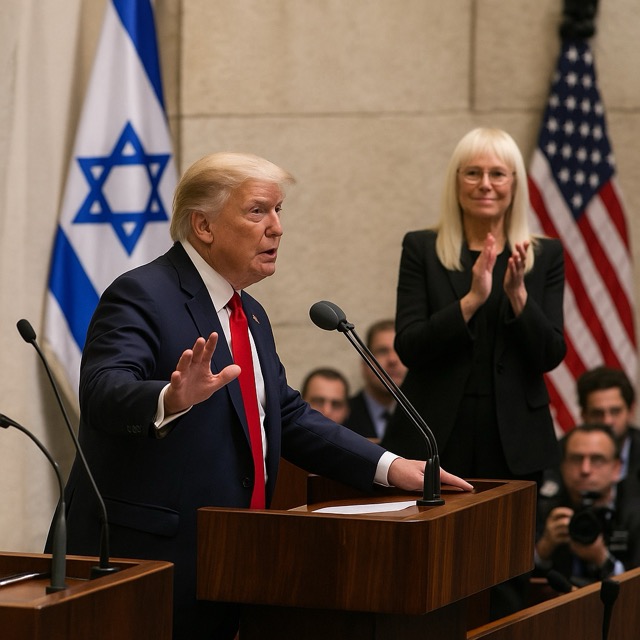
How a casino heiress and mega-donor became a central character in Israel’s climactic October 2025 hostage release — and why Donald Trump singled her out in the Knesset.

JERUSALEM — As lawmakers rose to their feet in Israel’s Knesset on October 13, 2025, Donald Trump paused his victory-lap speech on the Gaza cease-fire and the release of the last living hostages to praise a figure in the gallery: Miriam Adelson. The Israeli-American physician-turned-casino magnate and Republican mega-donor stood to a roar, as Trump joked about her fortune and credited her longstanding influence on his Israel policy.
It was a carefully framed moment at the end of a grueling saga. Earlier that day, after two years of captivity since the October 7, 2023 attacks, the final 20 living Israeli hostages were freed under a U.S.-brokered deal that also saw Israel release hundreds of Palestinian prisoners and detainees. The scenes across Israel — helicopter flyovers, tearful reunions in Tel Aviv’s Hostages Square, and spontaneous applause when names were read on the radio — underscored the breadth of the relief and the emotional stakes.
Adelson’s cameo inside the chamber was more than ceremony. For years, she and her late husband, Sheldon, were among the most consequential private actors in U.S.–Israel policymaking. They championed causes on the Israeli right, funded advocacy networks and research institutes, backed Republican candidates, and pushed for decisions that came to define the Trump administration’s posture in the region, including moving the U.S. Embassy to Jerusalem and recognizing Israeli sovereignty over the Golan Heights.
In 2024, Miriam Adelson made what filings and contemporaneous reports described as a record-shattering nine-figure contribution to pro-Trump efforts — money that fortified the Republican infrastructure heading into the 2024 general elections and the tumultuous year that followed. By 2025, her role had evolved from benefactor to visible confidante: an owner of the NBA’s Dallas Mavericks, a power center in Las Vegas Sands, and, on this decisive October afternoon, a symbol of the donor class that helped set the table for Trump’s regional push.
Multiple reports over the past year describe Adelson as one of the voices urging Trump to keep the hostages at the heart of his Middle East agenda. In January, Israeli and Jewish media noted that she had pressed him to lean harder on the issue — a campaign that dovetailed with relentless lobbying by hostage families. In public, Trump punctuated that pressure with increasingly sharp warnings to Hamas, framing the captives’ release as a moral imperative and a prerequisite to any broader deal. The October breakthrough, sealed alongside Egypt and other regional actors, elevated those private urgings into public vindication.
Inside the Knesset, Trump’s shout-out to Adelson doubled as messaging to multiple audiences: a thank-you to a loyal ally; a signal to Israelis that his inner circle contained familiar, unabashedly pro-Israel figures; and a reminder to Washington that donor-driven networks still animate Republican foreign policy. He also revisited greatest hits — the embassy move, the Abraham Accords — before pivoting to the day’s storyline: that the war had reached an inflection point and that pragmatism, not vengeance, should guide the aftermath.
What makes Adelson distinctive is not only her checkbook but also her media footprint and sustained engagement. In Israel, she has had ties to one of the country’s largest daily newspapers, giving her leverage in a fiercely competitive news market. In the United States, she sits at the nexus of conservative philanthropy and Republican politics, with access that Trump himself underlined in his asides about how often the Adelsons visited the White House during his first term.
Critics see that access as emblematic of a money-driven system that outsources policy to wealthy patrons. Supporters counter that Adelson’s advocacy aligned with a clear, public worldview: that a strong, internationally recognized Jerusalem and a tougher line against Iran and Hamas would make Israel safer, and that any viable settlement must first bring hostages home. The October 13 release, they argue, vindicated that sequencing — even as thorny questions remain about Gaza’s governance, reconciliation, and the fate of unresolved cases of the deceased.
Beyond the optics, the political calculus is straightforward: Trump’s public gratitude toward Adelson came as the administration seeks to convert a diplomatic crescendo into durable policy. The cease-fire’s first phase hinges on enforcement mechanisms, regional buy-in, and humanitarian guarantees. The second and third phases — reconstruction and normalization — will demand money and patience. Donor networks, from Gulf monarchies to American philanthropists, will be instrumental. Adelson’s presence at the center of that conversation is not incidental; it is a preview of how public and private influence will braid together in the months ahead.
For hostage families, however, the metric is intimate and immediate. They credit relentless activism — rallies, vigils, meetings with any envoy who would listen — for keeping the issue in the foreground. Adelson’s reported lobbying was one strand of a broader web that included European and Arab intermediaries, Israeli negotiators, and U.S. officials. Trump’s Knesset speech, with its conspicuous applause line for Adelson, folded those strands into a single narrative about leverage, loyalty, and results.
The moment’s fragility remains. Hamas has been criticized for failing to return all the bodies of those killed in captivity; Israel’s political class remains divided over accountability for the war’s conduct; and regional spoilers have the means to undermine a tenuous cease-fire. Even so, the tableau in Jerusalem — a former U.S. president declaring a ‘new beginning’ and singling out a billionaire patron who, by many accounts, pressed him to keep the hostages central — crystallized the intersection of money, media, and moral suasion in twenty-first-century statecraft.
In that sense, Miriam Adelson’s standing ovation was not a footnote but a field note: a reminder that, in the theater of power, the balcony sometimes shapes the stage.
Sources: The Guardian live/blog coverage and on-the-ground reporting (Oct. 13–14, 2025); PBS/AP report on Trump’s Knesset address (Oct. 13, 2025); Times of Israel live updates from the Knesset; WSJ live coverage noting Adelson’s ~$100m pro-Trump giving (2024 cycle); JPost reporting (Jan. 14, 2025) that Adelson pressed Trump to push on a hostage deal; public campaign finance disclosures and contemporary reporting on Adelson’s mega-donor role.

 The Tower Post