
After losing their grip on a promising start by giving one away, the Commanders face the costs of getting it back.
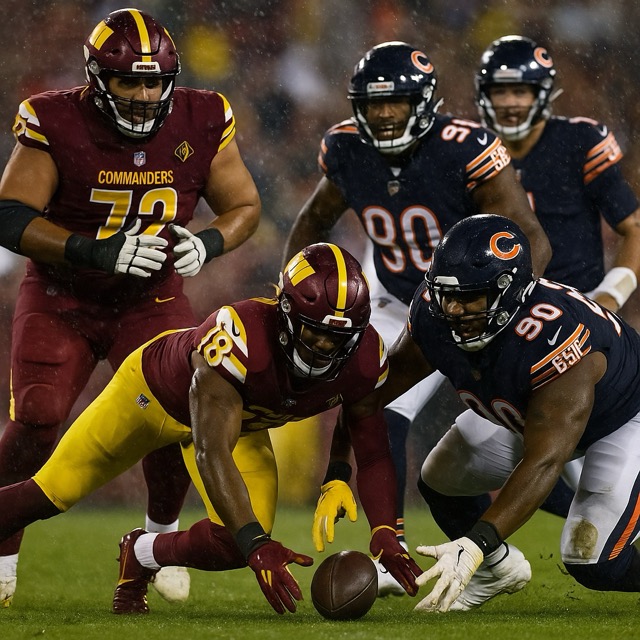
LANDOVER, Md. — The NFL does not hand out mulligans in mid‑October. One moment of sloppiness, a slip in the rain, a ball that hits the ground instead of a chest, and a promising start can feel like a mirage. Washington just learned that lesson the merciless way. After spending September sketching out a workable identity — defense first, explosive but measured on offense, tidy on special teams — the Commanders let a winnable game leak away late. They did not get overpowered so much as out‑lasted by their own mistakes, and that is the kind of loss that makes the next three weeks heavier.
Inside the building, they will call it situational football. Outside, fans will call it a giveaway. Either description fits. With the clock favoring them and the opponent nearly out of timeouts, Washington only needed a clean exchange and two efficient snaps to close the door. Instead came the kind of muddled sequence that haunts a season: the mesh a beat off, the ball on the ground, momentum flipping on contact. It is a single play in a 60‑minute game — yet in a league this compressed, single plays are often the entire story.
What happens next will say more about this team than the loss itself. The locker room sounded properly accountable afterward: no finger‑pointing, no elaborate alibis about weather or whistles. The quarterback took responsibility for ball security. Veterans in the huddle talked about communication and tempo. Coaches talked about detail — the tedious, unglamorous corrections that never make a highlight reel but quietly swing seasons. Those are the right notes, but playing them for four straight quarters is the real test.
The path to recovery starts on offense, where Washington’s blueprint has been sound in concept. When the staff leans into play‑action and designed movement, the picture simplifies for a young passer: half‑field reads, outlets in rhythm, defined shots that respect the risk‑reward line. Tight ends settling into soft zones have been reliable pressure valves, and the receiver room has shown enough run‑after‑catch to punish off coverage. The issue is sequencing — stacking those concepts together before the sticks turn desperate. Too often, the first quarter drifts by in search of identity, leaving the defense to absorb the early burden.
There is also the small matter of the run game. The bones are there: interior double‑teams that move people, backs who finish forward, and perimeter looks that can widen a front. But the efficiency swings from series to series. Washington’s inside zone is sturdy; its answers when the edge squeezes or when safeties fire their gaps must be sharper. This is where motion and tempo are not gimmicks but tools — forcing defenses to declare intentions early, resetting the quarterback’s clock, and creating the clear‑eyed third‑and‑manageable that turns a game into a staircase instead of a cliff.
Protection is the other hinge. Opponents have begun leaning on simulated pressure — showing six, sending four, and muddying the post‑snap picture. That is fixable through cadence variation, formation into the boundary to clean up sightlines, and a trimmed menu on obvious passing downs. The Commanders do not need hero ball to move the chains; they need the ball out on time and out of harm’s way. Punts are not defeats when the defense is built to handle field‑position games.
Speaking of that defense, the film remains encouraging even with the late‑game sting. The line still changes math up front, forcing offenses to earn each yard. A few perimeter angles betrayed them in the fourth quarter, and one missed tackle in the alley became a touchdown that re‑opened a door that should have stayed shut. That is correctable work — fit the gap, keep the outside arm free, rally with leverage. The red‑zone snaps, historically a strength for this coaching staff, must trend back toward stingy. In a tight conference, three red‑zone field goals allowed often equal a win; three red‑zone touchdowns allowed often equal the opposite.
Injuries complicate everything, as they always do. A wideout not quite at full throttle changes the spacing math. A guard playing through something alters how often you want to run behind him. The Commanders have managed by leaning on tight‑end‑heavy personnel and spacing concepts that manufacture completions, but there is a ceiling to dink‑and‑dunk when the game demands a statement. The next step is to find explosives that are safe: layered crossers off max‑protect, shot plays tethered to the run action that the quarterback already trusts, and second‑window throws that punish eager safeties without asking your passer to be a superhero.
Then there is the psychology. A fourth‑quarter giveaway burrows into a team’s collective memory. The only antidote is ritual: a week of wet‑ball drills that turn exchanges into muscle memory, defenders who rake at the ball at the end of every scout‑team rep, and ballcarriers who finish each run with two hands through the traffic. It is boring work, yes, and that is exactly the point. Football is a habits sport masquerading as a spectacle. Teams that fix the boring things faster usually last longer into January.
Context matters, too. Through six weeks, the NFC is a mosh pit of one‑score games and teams orbiting .500. Washington’s record reflects that parity — a couple of bounces from feeling comfortable, a couple from feeling backed into a corner. The schedule ahead offers clarity and risk in equal measure: divisional heat that counts double, a contender or two that will test protection and poise, and a road trip that will stress the travel routine. You do not have to sweep such stretches to recalibrate a season. You have to be the team that refuses to blink on the half‑dozen snaps that decide them.
Here is what that looks like in practical terms. On offense: win first down with a physical run or a sure throw, live in second‑and‑six, and treat third‑and‑three as a run‑pass coin flip that favors you. Use tempo to steal a cheap five yards when the defense changes personnel late. Take the deep shot only when the protection call is clean and the matchup is the one you schemed Tuesday night. On defense: force kicks in the red area, rally to the ball in space, and keep the calls simple late so that speed beats indecision. In the game’s last four minutes: two hands on the ball, eyes on the clock, and a willingness to be boring when boring closes the door.
It is worth repeating: Washington is not broken. The bones of a playoff‑caliber roster are present — a front that can win without help, a quarterback whose composure belies his experience, a special‑teams group that does not flinch. The growth edge is in the margins: communication on third down, precision in exchanges, depth receivers winning isolated matchups, and tackles finishing blocks when everyone is tired. Those are fixable items. They also become identity if you fix them on schedule.
The season is a haul. It punishes detours and rewards teams that keep the car between the lines. Washington spilled a possession, then a game, and now it must pay the toll: cleaner football, tighter situational awareness, and enough emotional maturity to treat one bad night as a lesson rather than a label. Do that, and October’s bruise can harden into November’s backbone. Fail, and the math of the NFC will turn every Sunday into a coin toss with the house edge pointing the other way.
So yes, the road is rougher now. But roads can be re‑paved. The material is ordinary — cadence, leverage, footwork, ball security — and the machines are already in the building. The only question is whether Washington will pour the asphalt this week or keep driving around the pothole hoping it disappears. The league tends to answer that question for you if you wait too long.




 The Tower Post