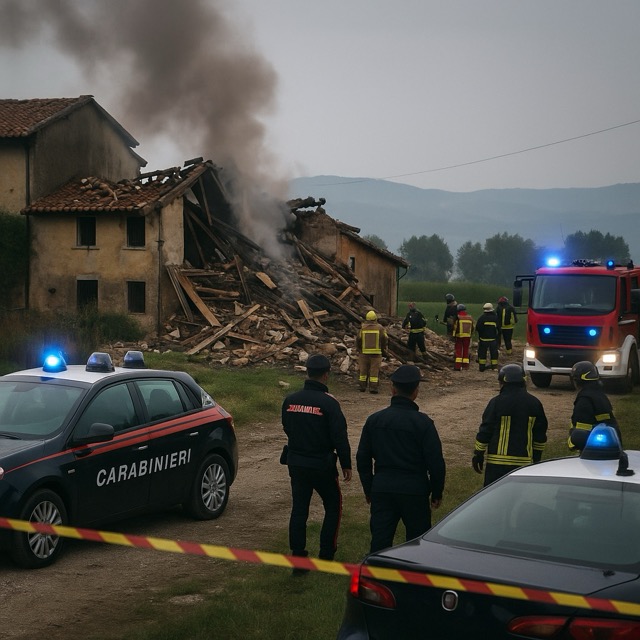
Authorities say the Verona-area cottage was booby‑trapped with gas canisters and incendiaries. Fifteen responders—soldiers, police and a firefighter—were injured. Three siblings are under arrest as prosecutors probe premeditated murder.
Castel d’Azzano (Verona) Italy
The cottage on Via Forette was already cracking at the seams when the rescue crews pulled up, its brick shell peeled open like a matchbox. Minutes earlier, as a Carabinieri entry team forced the front door during a court-ordered search tied to an eviction, a thunderous detonation ripped through the two‑storey farmhouse on the outskirts of Castel d’Azzano, a commuter town six miles southwest of Verona. By the time the dust settled, three Carabinieri officers were dead and at least fifteen other responders—eleven Carabinieri, three state police officers and a firefighter—were wounded, according to officials.
Prosecutors say the blast was no accident. Investigators allege the occupants—three siblings in their 60s from the Rampini farming family—rigged the building as a lethal trap using piped gas, compressed canisters and improvised incendiaries. When the door gave way, an ignition source triggered a fuel‑air flash that flattened walls and sent a shockwave across the fields. Two of the siblings were taken into custody under guard at local hospitals; the third was detained later after initially fleeing, authorities said.
The operation began shortly after daybreak on Tuesday during a renewed attempt to enforce an eviction order and a related search decree. Officials said previous efforts to clear the property had been postponed amid explicit threats by the occupants to blow up the house rather than surrender it. Regional governor Luca Zaia called the event an ‘unthinkable ambush.’ Italy’s President Sergio Mattarella and Prime Minister Giorgia Meloni offered condolences, praising the ‘spirit of service’ of the fallen.
Video from nearby residents shows a plume of dust rising above the flat farmland as sirens converged on the ramshackle structure. Firefighters worked through the morning to suppress spot fires in the rubble as urban‑search teams shored up unstable sections to reach trapped and injured officers. By mid‑day, authorities confirmed the recovery of the three bodies and opened a double‑track investigation: one by local prosecutors into suspected premeditated murder and ‘massacre,’ and another by internal affairs to review the planning of the operation.
Officials familiar with the probe said the building showed signs consistent with a vapor‑cloud explosion: fragmented masonry, a roof blown upward and outward, and windows blasted from their frames. Investigators also collected what they described as Molotov‑style incendiary bottles and a tangle of flexible hoses near what had been the entryway, now a charred void. Forensic teams will seek to pinpoint the ignition—whether from a mechanical switch, a timed source, or an improvised trigger linked to the door’s movement.
The victims’ names had not yet been formally released at press time pending notifications, but Carabinieri commanders in Verona held a brief, somber statement outside the provincial headquarters, flags at half‑mast. General officers described the fallen as ‘experienced operators’ from units trained to serve high‑risk warrants. ‘They entered a building they believed to be safe enough to approach, and they were met by a carefully prepared device intended to kill,’ one senior official said.
Neighbors described the Rampini siblings as reclusive and fiercely attached to the farm, which sits at the end of a narrow lane lined with tool sheds and plastic‑tunnel greenhouses. The legal dispute over the property had dragged on for years, according to residents. Court records cited by officials indicate the family faced liens and an eviction order, and had been warned repeatedly to vacate. In prior visits, officers documented threats and signs of tampering with gas lines. ‘Everyone was afraid something like this could happen,’ said a local shopkeeper, who asked not to be named for fear of reprisals.
Tuesday’s death toll is among the worst single‑incident losses for Italian law enforcement in recent memory. It echoes past episodes in Europe in which evictions or domestic enforcement actions escalated into pre‑planned violence—events that are notoriously hard to anticipate because the suspects control the terrain and the timeline. Experts say the Castel d’Azzano blast will likely prompt a national review of how eviction orders are served when there are credible threats involving gas or explosives.
‘We are confronting a scenario closer to an IED ambush than to a civil procedure,’ said a former bomb squad technician reached by phone. ‘Where there are prior threats and access to combustible gases, you need standoff techniques, remote opening, more ventilation, and perhaps even controlled dismantling before any entry.’ He noted that domestic gas, when intentionally accumulated, can act as a powerful fuel‑air explosive.
Italian fire‑service officials said crews found evidence of multiple gas cylinders on site, some ruptured by the blast and others scorched but intact. The investigation will examine the source of gas accumulation—whether piped methane, LPG cylinders, or both—and the path it took to permeate the interior spaces. ‘The pattern of damage suggests an extensive flammable mixture inside the structure prior to ignition,’ one senior firefighter said.
Authorities emphasized that the warrant team had taken precautions. The eviction and search were supported by multiple units, with medical and fire crews staged nearby. But the speed and intensity of the explosion defeated those layers. Officials said the aim now is to reconstruct the timeline minute by minute—when gas levels might have been detectable, how the door was breached, and whether remote sensors or ventilation could have altered the outcome.
Beyond the criminal liability facing the siblings, prosecutors must determine whether additional charges apply under Italy’s ‘strage’ (mass killing) statute, which is sometimes used when explosives are deployed with the intent to kill multiple public officials. Defense lawyers will likely argue that their clients intended a deterrent, not mass murder; investigators point to prior threats and the presence of incendiaries as evidence of premeditation.
By late afternoon, a cordon remained around the cratered footprint of the cottage, its fields littered with shredded insulation and sheet metal. A mobile command post, humming with generators, hosted a rotating cast of magistrates, forensics specialists and grief counselors for the injured. The town hall announced a day of mourning and a candlelight vigil for the officers. ‘They were here to uphold the law; they paid with their lives,’ said the mayor.
Nationally, the attack has reignited debate over the risks borne by police during civil enforcement and the tools available to mitigate them. Lawmakers from across the political spectrum called for better intelligence sharing about high‑risk evictions, wider deployment of remote‑breach tools and gas detection meters, and specialized training for mixed police‑fire teams. Unions urged psychological support for survivors and the families of the fallen.
As night fell over the Veneto plains, the cottage was a dark silhouette behind floodlights and police tape. The names of the dead would be etched into memorials; the procedures that put them at that door would undergo painful scrutiny. What remains undisputed is the blunt fact of the trap—and the three officers who never came home.
Sources:
— Associated Press, Oct. 14, 2025: 3 Italian carabinieri killed in apparently deliberate farmhouse explosion (Castel d’Azzano, Verona).
— Reuters, Oct. 14, 2025: Explosion in Italy kills three Carabinieri during police raid.
— ANSA, Oct. 14–15, 2025: Three cops killed in blast trap during eviction; 15 injured including 11 Carabinieri, 3 police, 1 firefighter.
— The Guardian, Oct. 14, 2025: Three police officers killed in Italy after explosion at house during eviction.
— Euronews, Oct. 14, 2025: Farmhouse filled with gas; explosion triggered on door opening, per regional governor.




 The Tower Post