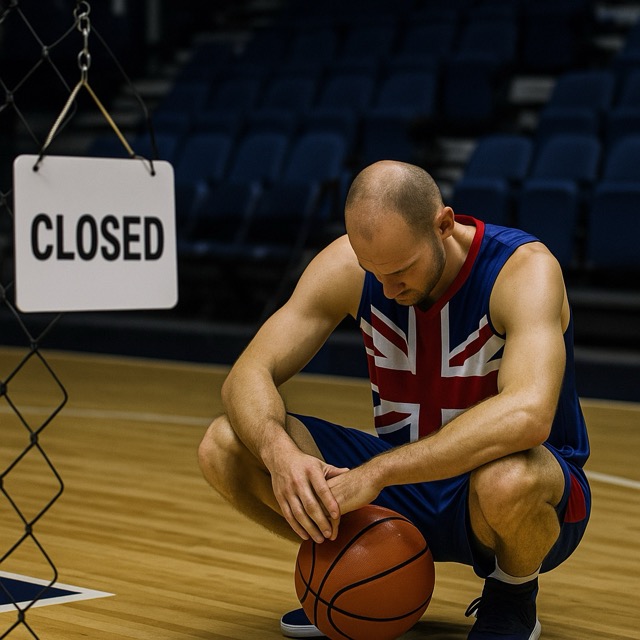
Governance crisis deepens, funding jeopardized, and the sport’s future thrown into doubt across the UK
LONDON — British basketball plunged into fresh crisis on Wednesday after FIBA, the sport’s global governing body, moved to temporarily suspend the British Basketball Federation (BBF) and ban the Great Britain men’s national team from senior international competition pending the resolution of sweeping governance failures. The decision, confirmed by FIBA following a taskforce review, represents the most severe sanction against the British game in decades and caps a tumultuous year marked by legal battles, leadership resignations and an existential row over who controls the professional pyramid.
The shock intervention follows months of infighting between the BBF and a breakaway bloc of leading clubs who have aligned around Super League Basketball (SLB) in opposition to the BBF’s award of a 15‑year license for a new Great Britain Basketball League (GBBL) to a consortium led by U.S. sports executive Marshall Glickman. SLB clubs have challenged the validity of the tender, alleged procedural defects and threatened litigation, while the BBF argues that only a BBF‑sanctioned competition can operate domestically and provide the necessary pathway to FIBA events. The impasse has strangled planning for the professional season and dragged the wider sport into a protracted, public stand‑off.
FIBA’s taskforce—dispatched to the UK in early October for urgent meetings with federation leaders, league executives and government officials—recommended extraordinary measures: to suspend the BBF’s authority to license or recognize national men’s competitions and to field a men’s national team in senior FIBA competitions. In practical terms, that leaves the GB men’s program frozen: no friendlies under FIBA auspices, no World Cup qualifying windows, and no continental play until a credible governance settlement emerges. While the suspension is termed “temporary,” there is no published timeline for reinstatement.
The fallout could be immediate and expensive. UK Sport funding, worth around £4.75 million tied to governance standards and international performance, is now in jeopardy according to multiple stakeholders contacted by this newspaper. Commercial partners—already spooked by the ‘civil war’ narrative—face fresh uncertainty about fixtures, venues and visibility. Several SLB clubs warn they are preparing contingency budgets, citing the risk of lost European spots and stalled sponsor deals, while community programs from Newcastle to Bristol report delaying hires and postponing facility investments until the picture clears.
Leadership flux has compounded the chaos. BBF chair Chris Grant stepped down on Sunday after three years in a voluntary role, leaving an interim team to handle the most serious governance shock the federation has faced since its formation. Insiders describe a vacuum at precisely the moment when consensus and clarity are required. “We need a credible facilitator and a reset on all sides,” said one senior club executive, speaking on condition of anonymity to discuss ongoing legal disputes. “The sport cannot afford factional wins and collective failure.”
At the heart of the dispute lies a question of legitimacy and process. The BBF contends it ran a compliant tender, weighing long‑term stability against short‑term disruption, and concluded the GBBL bid offered a sustainable commercial blueprint and pathways for domestic talent. Opponents insist the consultation was opaque, due diligence incomplete and the resulting license unenforceable without club consent. What began as governance housekeeping spiraled into a power struggle—with players, coaches and fans stranded in the crossfire.
The crisis also arrives at a sensitive sporting moment. After a spirited EuroBasket summer that included a landmark win and packed student arenas, the men’s program had hoped to turn momentum into a consistent calendar of windows, camps and youth integration. Instead, the next steps are a holding pattern. The women’s pathway, while not directly sanctioned, could face knock‑on effects if the funding framework is redrawn or if a new governance settlement reshapes the BBF’s remit across all programs.
What happens now? FIBA signaled it will work with “UK stakeholders” to fashion an interim framework for men’s competitions, an unusual hands‑on role for the international body but one seen as necessary given the paralysis. Such an arrangement could preserve a domestic season in some form while the structural row is mediated—perhaps through a time‑limited bridging license, neutral oversight of scheduling and eligibility, and clear milestones for reunification. Any model will need buy‑in from SLB clubs, who hold the lion’s share of marketable assets and fan bases, and from the BBF, which retains the formal mandate to represent Britain within FIBA when authorized to do so.
Legal jeopardy shadows every path. Multiple parties have lodged or threatened claims—from employment actions by former league staff to competition‑law challenges over access to markets and European play. Each filing ratchets up cost and risk, burns scarce leadership bandwidth and hardens negotiating positions. The unintended consequence, several administrators warn, is that British basketball becomes defined not by the court but by the courtroom.
Despite the rancor, veteran figures insist a solution is realistic and urgent. The outline, they argue, is hiding in plain sight: independent governance with club representation; transparent, externally audited commercial rights; enforced financial controls; and a phased integration that gives today’s SLB operations certainty while stress‑testing the GBBL’s long‑range promises. Players’ voices, often sidelined in boardroom fights, must be central—particularly in safeguarding contracts, medical standards and calendar stability.
A credible roadmap would likely feature three pillars. First, a rapid ‘ceasefire’ compact that freezes litigation while talks proceed under a mutually agreed mediator. Second, a neutral competition committee—answerable to an interim board including FIBA observers—to set rules, eligibility and scheduling through the remainder of the season. Third, a time‑boxed constitutional convention to design the long‑term model, with public minutes, published tenders and binding conflict‑of‑interest rules. The prize would be more than peace: it would be a platform to grow the sport beyond its current niche, converting post‑pandemic interest into sustainable audiences.
The cost of failure is clearer by the day. A prolonged ban risks eroding the national‑team brand just as it began to resonate with a new generation, many introduced to the sport through school programs and a booming 3×3 scene. Without national windows, domestic stars lose shop‑window moments; dual‑nationals may look elsewhere; sponsors chasing international visibility will fade. At club level, European lockouts or administrative grey zones could trigger roster churn and budget cuts, setting back a decade of incremental gains in professionalism and fan culture.
For supporters, the crisis is as much emotional as administrative. British basketball has lived through false dawns: ambitious rebrands, hopeful TV deals, and periodic cycles of boom and retrenchment. The current civil war feels different because, for once, the audience is paying attention—stream numbers are real, student arenas have atmosphere, and junior pathways are producing prospects with genuine upside. “It’s heartbreaking,” said a veteran coach. “We’ve asked the public to believe; now we have to prove we can govern.”
Politically, Westminster has kept a cautious distance, emphasizing arm’s‑length governance while privately urging an end to the impasse. If the funding tap tightens, however, expect sharper questions in Parliament about oversight, value for money and safeguarding of public investment. An intervention—short of taking sides—could include appointing a respected sport mediator, conditioning grants on milestones, and encouraging temporary use of neutral trustees to stabilize operations.
Meanwhile, athletes and fans wait. For the GB men, the ban is a practical reality: training plans in limbo, international windows off the calendar, and the quiet dread of momentum lost. For clubs, the off‑court grind continues: holding sponsor calls, reassuring season‑ticket holders, and preparing multiple fixture scenarios. Referees, table officials and volunteers—too often invisible in these debates—face the same uncertainty about assignments and income. Grassroots programs, already stretched, will carry even more of the sport’s emotional load in the months ahead.
The blunt truth is that British basketball has run out of runway for internecine battles. The FIBA suspension is both a reprimand and an opportunity: a line in the sand that says legitimacy must be earned, not asserted. If stakeholders can use this crisis to build transparent, resilient structures, the sport may finally escape its cycle of promise and disappointment. If not, the game risks retreating back to the margins—its brightest stories drowned out by the din of governance gone wrong.
For now, the scoreboard reads: federation suspended, men’s team banned, fans bewildered. What happens next will determine whether this era is remembered as the moment everything fell apart—or the jolt that forced British basketball to grow up.
Notes:
• FIBA statement and taskforce recommendations confirmed on Oct. 15, 2025.
• Recent coverage from UK outlets chronicled the domestic governance dispute and funding jeopardy.

 The Tower Post