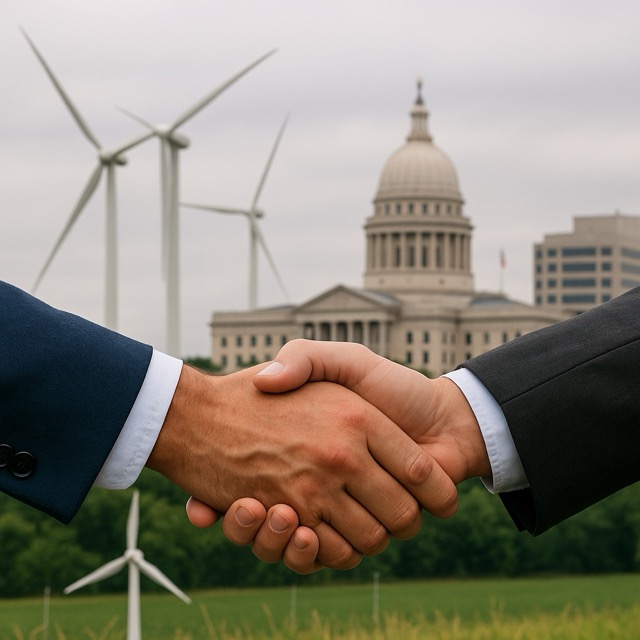
After President Trump says climate change is “the greatest con job ever,” the EU shifts its climate diplomacy to governors, mayors and boardrooms
BRUSSELS—The European Union is quietly redrawing its transatlantic climate playbook. Rather than waiting for policy signals from Washington, EU officials are building a parallel diplomacy aimed at America’s states, cities and corporate leaders—a coalition they believe can keep clean-energy momentum alive even as the federal government rolls back climate rules.
Senior EU diplomats say the shift became unavoidable in late September when President Donald Trump told a United Nations audience that climate change was “the greatest con job ever,” a flourish that underscored a broader reversal of federal climate policy. Since January, the administration has moved to exit the Paris Agreement again, dismantled or weakened multiple emissions safeguards, and prioritized expanded oil, gas and coal production. The EU’s emerging strategy accepts that reality—and works around it.
According to a draft strategy discussed in Brussels this month, the EU will expand formal ties with U.S. governors, mayors and public utility regulators; launch a Clean Transition Business Council to convene European and American companies; and seed joint projects in renewable power, grid modernisation, hydrogen, and carbon markets. The draft envisions a more transactional climate diplomacy: more funding, more projects on the ground, and fewer set-piece speeches.
The approach marks a return to a tactic Europe honed during the first Trump term, when a patchwork of U.S. states—including California, New York, Washington and dozens of cities—set their own emissions targets, expanded clean power procurement and adopted stricter vehicle standards. Then as now, European officials see these subnational actors, plus Fortune 500 sustainability commitments, as a durable counterweight to federal reversals.
“The economic case for clean energy in the United States did not disappear in January,” a senior EU official said, speaking on background to discuss the draft. “Power purchase agreements are still being signed. Heat pumps and EVs are still gaining market share. And many governors want the jobs that come with new grid and manufacturing investments.”
Signals from Washington point the other way. In a series of executive actions, the White House has framed fossil fuel expansion as central to U.S. prosperity and security, with new moves to ease permitting and boost coal, oil and gas production. The State Department’s climate diplomacy footprint has been curtailed, and several agencies have slowed or paused rules touching methane, vehicle emissions and power plant pollution.
European envoys insist the pivot is not a snub to the federal government so much as a necessity. Brussels retains relationships with U.S. counterparts on trade and industrial policy, and the two sides recently agreed to deepen coordination on critical minerals, trade and economic security. But on climate, EU leaders say their best shot at progress runs through the states and the private sector.
Three tracks define the plan. First, a statehouse offensive: Commission officials and EU national embassies will step up travel to state capitals to identify shovel-ready projects—from offshore wind ports on the East Coast to long-duration energy storage pilots in the Southwest. Second, a corporate corridor: the proposed Clean Transition Business Council would match European turbine, grid and heat pump makers with U.S. utilities and developers, with EU development banks and export credit agencies smoothing finance. Third, a rules dialogue: Brussels will offer technical help to state regulators on carbon markets, grid interconnections and transmission planning, areas where Europe has decades of experience.
The EU will also continue to defend the integrity of its own green rulebook. Officials say they will resist U.S. pressure—public and private—to dilute regulations such as the deforestation-free supply chain law or the Corporate Sustainability Due Diligence Directive. And they will press ahead with the carbon border adjustment mechanism (CBAM), arguing that predictable carbon pricing and border measures can coexist with U.S. industrial policy.
To skeptics in Europe’s heavy industry, the pivot looks risky. Some business groups warn that a harder Brussels line on green rules—combined with U.S. rollbacks—could squeeze manufacturers caught between the EU’s compliance costs and America’s deregulatory tilt. EU officials counter that partnering with U.S. states and companies will anchor transatlantic supply chains for solar, wind, batteries and heat pumps, reducing exposure to China and keeping European tech competitive in the U.S. market.
On the U.S. side, governors from both parties have reasons to engage. Clean-energy manufacturing announcements have clustered in states with favorable land, tax and workforce conditions, and utilities face rising reliability challenges from extreme heat and storms. Even red-state public utility commissions are weighing grid reinforcement, interregional transmission and advanced metering—projects where European firms bring capital and kit.
California remains the lodestar. Sacramento’s vehicle emissions standards—which other states can choose to follow—have long shaped automakers’ decisions. California’s cap-and-trade market is being refreshed, and its grid operator is pushing deeper regional coordination. EU officials say they are studying ways to connect European carbon market expertise with U.S. state systems, without stepping on federal toes.
Money will be the test. The EU plans to mobilise its development finance arms, including the European Investment Bank, alongside export credit to make joint projects pencil out. Officials also talk up blended finance with U.S. philanthropic capital—long active in state-level climate efforts—to de-risk first-of-a-kind deployments, such as green hydrogen hubs, grid-forming inverters and industrial heat electrification.
Diplomatically, the realignment has global implications. By pouring energy into subnational partnerships in the United States while sparring with Washington over tariffs and industrial policy, Brussels is betting that climate credibility can be earned by delivery rather than declarations. The EU will also keep pushing multilateral lenders like the World Bank and regional development banks to expand climate lending—another area where it increasingly diverges from U.S. federal preferences.
Critics warn that bypassing Washington carries risks. A later swing in U.S. politics could once more reorder federal priorities, potentially complicating state-federal coordination and leaving cross-border projects exposed. And there is no guarantee that state-level gains add up to the gigaton-scale reductions scientists say are needed this decade.
Still, the economics are shifting in Europe’s favor. Onshore wind and utility-scale solar remain the cheapest new sources of power in much of the United States. Battery storage deployments are accelerating. Heat pump sales have broken records. Even as federal incentives are retooled or repealed, market forces—from aging coal fleets to volatile gas prices—are nudging utilities toward cleaner portfolios. The EU’s wager is that these fundamentals will outlast any one administration, and that governors and CEOs will seize the opportunity.
For now, the optics are unmistakable. On trade, the EU and U.S. continue to haggle over metals tariffs and climate-related frictions at the border. On climate, Brussels is laying track at state level—signing memorandums of understanding with governors, hosting procurement roundtables with utilities, and sending technical teams to advise regulators on transmission, carbon markets and grid reliability. It is climate diplomacy by a thousand workstreams, designed to be resilient to political whiplash in Washington.
Back at the U.N., President Trump’s “con job” remark was the headline—another volley in a rhetorical war that has outlasted multiple summits. In the corridors, however, diplomats quietly noted how much of the real action now happens far from the dais: in state capitols debating interconnection queues, in utility boardrooms approving power purchase agreements, and on construction sites where turbines, panels and transformers meet concrete. That is where the EU is placing its bets—and where, if Brussels has its way, the transatlantic climate project will keep moving, with or without Washington.
Sources: A draft EU strategy to deepen ties with U.S. states and companies on clean energy has been reported by the Financial Times (Oct. 15, 2025). President Trump’s “greatest con job ever” climate remark was made at the United Nations on Sept. 25, 2025 (AP/PBS). Recent executive actions outlining an “unleashing American energy” approach are published on the White House website (January and April 2025). Related EU positioning on multilateral development banks’ climate focus appeared in Reuters (Oct. 7, 2025).
 The Tower Post