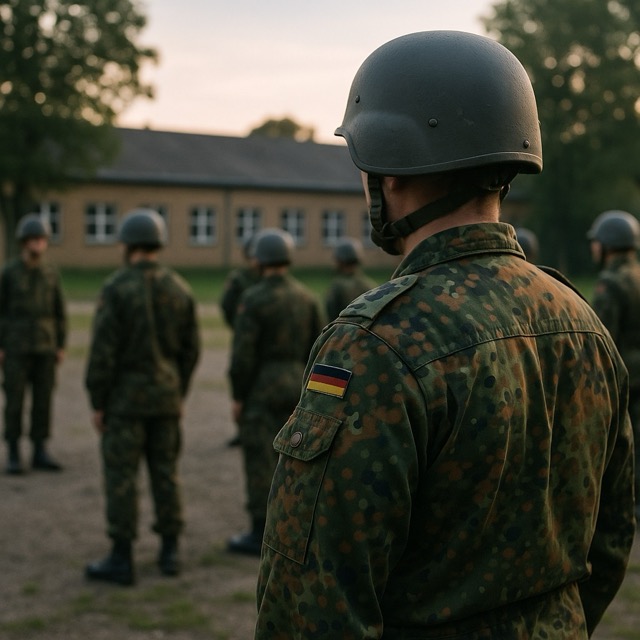
Merz’s partners balk at a lottery‑based draft, throwing defence reform into fresh uncertainty
Germany’s push to rebuild military manpower hit a fresh snag this week after Chancellor Friedrich Merz’s coalition partners rejected a proposed compromise for a new form of military service, cancelling a planned press conference at the eleventh hour and exposing deep fissures at the heart of Berlin’s security agenda.
The plan, championed in recent days by negotiators from the centre‑right Christian Democrats (CDU/CSU) and the centre‑left Social Democrats (SPD), would have preserved a voluntary baseline for service while adding a lottery mechanism to draft a limited number of 18‑ to 25‑year‑olds if recruitment targets were not met. It also envisaged a questionnaire sent to all 18‑year‑old men to assess willingness and fitness to serve, reviving practices shelved when Germany suspended conscription in 2011.
But Defence Minister Boris Pistorius—an SPD heavyweight—publicly balked at the eleventh hour, casting the lottery as a “lazy compromise” that would prove cumbersome to administer and vulnerable to legal challenge. His intervention derailed the rollout and prompted CDU figures to accuse the minister of undermining government unity. A press event expected on Tuesday to present the cross‑party deal was abruptly pulled, and a first reading of the bill in the Bundestag became uncertain even as leaders insisted the timetable could still hold.
At stake is far more than political theatre. Berlin’s attempt to move beyond a purely volunteer model reflects the Bundeswehr’s acute personnel shortfalls at a time of mounting demands: Germany has pledged to meet NATO obligations consistently and to transform its armed forces into the backbone of Europe’s conventional defence. Planners close to the process say the goal is to grow to roughly 260,000 active‑duty soldiers by the mid‑2030s, with a total force—active, reserve and civilian—approaching 460,000 under NATO planning assumptions.
Merz, who campaigned on restoring credibility to the country’s defences, has signalled openness to a compulsory “year of service” in the long run, potentially blending military and civilian options. Yet his coalition agreement envisaged starting with a reinforced voluntary track. The now‑torpedoed compromise sought to square that circle: keep service voluntary by default but add teeth if recruiting fell short amid rising threats from Russia and chronic labour‑market competition at home.
Supporters of the hybrid approach argued that a limited, lottery‑based draft would be fairer than de facto conscription via opaque recruiting quotas, while protecting the economy from a wholesale call‑up. Critics countered that randomness is a poor basis for civic obligation, that a male‑only lottery would invite constitutional scrutiny, and that administrative ramp‑up—in medical screenings, housing, training cadres and legal appeals—would take years Germany does not have.
The blow‑up underscores Germany’s peculiar bind. Since abolishing mandatory service in peacetime in 2011, Berlin has relied on voluntary enlistment and selective incentives. Russia’s full‑scale invasion of Ukraine in 2022, and Moscow’s ongoing pressure on NATO’s eastern flank, have steadily shifted European opinion, including in Germany, toward more demanding models of readiness. Recent polling suggests a slim majority of Germans now favour some form of compulsory service, though younger voters remain notably sceptical—signalling political risks for any government that moves too fast.
The calendar is tight. Coalition leaders insist a revamped military‑service law will still be tabled in the Bundestag this week, allowing months of committee work and constitutional vetting. But the trust deficit exposed by Pistorius’s veto will complicate the path. SPD lawmakers wary of alienating younger and urban voters will push to water down any coercive elements. CDU/CSU deputies, echoing Merz’s call for resolve, will seek binding intake targets and timelines that move beyond what they dismiss as “voluntarism with press releases.”
Meanwhile, the Bundeswehr continues to train, deploy and modernise under a separate €100‑billion special fund and rising base budgets, even as inflation, procurement bottlenecks and industrial‑capacity constraints bite. Personnel, however, is the unsolved variable. Recruiting in tight labour markets is difficult; retention in specialised trades is harder still. Without a predictable intake of motivated conscripts or “selectees,” planners warn, equipment programmes risk outrunning the human beings needed to operate and maintain them.
What would a durable compromise look like? Policy architects sketch three ingredients. First, universal registration at 18 for all genders, using a simple, privacy‑aware questionnaire to map skills, medical constraints and preferences. Second, a tiered intake ladder that prioritises volunteers into both military and civil‑protection tracks (disaster relief, cyber‑security, medical support), with transparent thresholds that, if unmet, trigger selective service by objective criteria rather than pure lottery. Third, a compact with industry and universities to recognise service with hiring credits, admissions preferences and paid training pipelines—making a year in uniform or a civil‑protection role a career accelerant rather than a detour.
None of that sidesteps the constitutional questions—equal treatment, proportionality, the scope of conscientious objection—or the politics of compulsion in a liberal democracy. But it would turn the current argument about a single switch (voluntary versus lottery) into a broader design for national preparedness that fits Germany’s values and the demands of a harder world.
For now, Merz confronts a familiar dilemma for chancellors: he can expend political capital to force an outcome that satisfies neither partner or tolerate drift that undermines his central promise on security. Either path carries costs. What the last forty‑eight hours made plain is that personnel policy, not procurement headlines, will determine whether the pledge to build “Europe’s most powerful conventional army” amounts to more than a speech line.
The window for a clear decision is closing. If the government cannot convert today’s crisis into a workable blueprint by year’s end, momentum risks slipping to the Länder, the courts and, eventually, to voters. Germany’s allies—and adversaries—are watching closely.
 The Tower Post