
Mexican diplomacy under President Claudia Sheinbaum has deftly managed tensions with Washington and at home — but pressure is mounting.
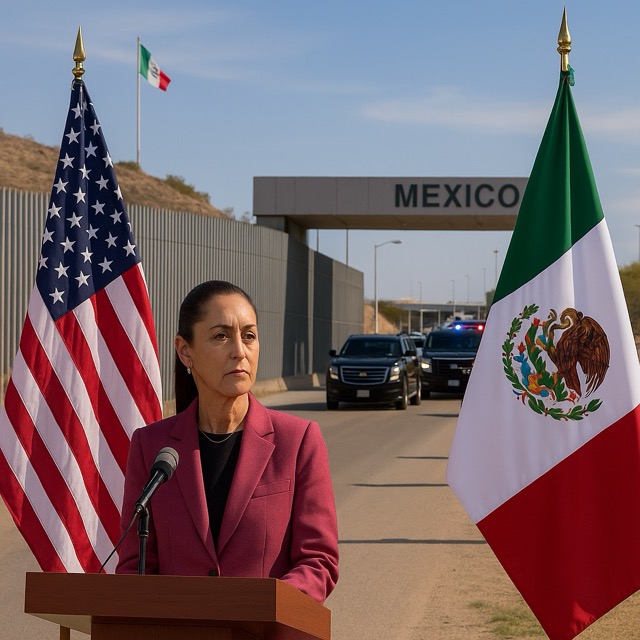
MEXICO CITY — In her first year in office, President Claudia Sheinbaum has practiced a brand of quiet, technocratic diplomacy — one that keeps channels with Washington open while trying to hold together a restive coalition at home. The approach has helped avoid market panic and secured space for Mexico’s nearshoring push. Yet the cushion is thinning. Pressure from the White House on migration and synthetic drugs, the looming 2026 USMCA review, and bruising domestic battles over judicial reform and Pemex’s finances have all converged into the most complex test of Sheinbaum’s presidency so far.
On the northern front, Mexico has expanded cooperation on migration enforcement and extraditions, even as the United States has escalated unilateral tools — from sweeping visa revocations for Mexican politicians to tariff threats against partners seen as enabling Chinese transshipment. Mexican officials privately concede that these tactics complicate bilateral trust, but argue that sustained operational coordination — from interdictions to rail and port screening — has kept the relationship functional and avoided a trade shock.
The economic calculus is equally delicate. Mexico’s bet is that disciplined macro policy and targeted incentives can lock in a once‑in‑a‑generation realignment of supply chains. A January decree earmarked tens of billions of pesos for new fixed investment and training, while a broader industrial plan aims to cut permitting timelines in half and lift investment to 28% of GDP by 2030. The pitch is resonating with automakers, electronics and aerospace firms that want North American proximity without U.S. labor costs. But the same integration that powers growth also imports political risk from Washington: the USMCA’s scheduled 2026 review, and a more confrontational posture on China-facing tariffs that could squeeze Mexican consumers and complicate relations with key Asian suppliers.
Energy policy remains the wild card. Pemex’s debt overhang — among the largest of any oil company — has forced the administration to outline a multi‑year stabilization plan and a glidepath to wean the firm off fiscal support by 2027. Officials tout measures to cut leverage and steady output, while nudging more private participation in gas and renewables build‑out. The strategy reassures markets on paper, but service‑provider arrears and operational mishaps continue to spook investors. The question is whether incrementalism can outpace the math of debt, capex and decline rates — especially with social spending and security needs competing for the same pesos.
At home, Sheinbaum’s most controversial move has been to press ahead with an overhaul of the judiciary, capped by this year’s unprecedented popular elections for judges. Supporters call it a democratic correction to an elite juristocracy; critics say it undermines checks and balances and chills investment by injecting politics into commercial adjudication. Early turnout was low and campaigns were uneven, leaving open the possibility that legitimacy questions dog the courts just as USMCA disputes and big‑ticket infrastructure arbitrations land on their dockets.
Security is the hinge between the domestic and diplomatic. After years of the ‘hugs, not bullets’ paradigm, the federal government has quietly leaned into targeted operations and cross‑border cases against high‑value traffickers, with a pick‑up in extraditions and precursor chemical seizures. The results are mixed: localized homicide declines in some metros offset by stubborn violence elsewhere and cartel fragmentation along the Pacific and border corridors. For Washington, progress is measured in fentanyl interdictions and overdose data; for Mexico, in whether the strategy reduces extortion and impunity without eroding civil liberties. The split scoreboard fuels periodic flare‑ups — and new U.S. leverage — even when day‑to‑day cooperation is solid.
Diplomatically, Sheinbaum has adopted the role of translator between North American hardball and Latin American norms. Her team has leaned into technical working groups on migration, trade facilitation and energy interconnection while publicly defending sovereignty and multilateralism. The tonal shift from the previous administration is real: fewer public brawls, more phone calls. But crisis management is reactive by design. As the United States tightens its visa and tariff toolkit, Mexico will be pressed to show concrete outcomes — fewer crossings, more seizures, faster permits — on timelines it does not control.
The domestic politics are just as unforgiving. Morena’s legislative muscle gives the president room to move, but it also concentrates accountability. Inflation relief has moderated the cost‑of‑living anger that dogged 2023‑24, yet wage gains are uneven and infrastructure bottlenecks — from ports and border bridges to transmission lines — threaten to cap growth just as companies are ready to scale. Governors worry aloud about absorbing migrant flows and funding local security. Business leaders, enthusiastic about nearshoring, warn that legal uncertainty from the judicial overhaul could dull Mexico’s competitive edge.
What could break the balance? Three pressure points loom. First, a disruptive move in Washington — new cross‑border tariffs tied to migration metrics, or secondary sanctions aimed at cartel finance — would force Mexico into choices that carry immediate economic costs. Second, a domestic shock, such as a Pemex accident or a corruption scandal touching senior officials, could drain political capital needed for reform. Third, a mis‑managed USMCA review could reprice Mexico risk overnight if investor‑state dispute pathways narrow or labor enforcement turns overtly punitive.
Still, it is too early to write off the Sheinbaum method. The president’s instinct for incremental fixes — coupled with a preference for technical over theatrical diplomacy — has delivered a year without major crises and with steady inflows of manufacturing commitments. If the administration can lock in energy reliability, professionalize police and prosecutorial capacity, and give investors a clearer litigation roadmap, Mexico could exit 2026 with deeper North American integration and a firmer growth base. If not, today’s careful balance could give way to a more volatile, transactional era.
Either way, the next six to nine months are decisive. The window before the USMCA review narrows, Pemex’s debt clock keeps ticking, and U.S. electoral timetables compress diplomatic room to maneuver. Mexico’s bet is that competence beats confrontation. Markets, and voters on both sides of the border, are about to grade that thesis.
Sources
Reuters coverage on visa revocations and tariff deliberations (Oct. 2025).
CSIS analysis on judicial reform and USMCA implications (Jul. 9, 2025).
Migration Policy Institute and Harvard DRCLAS commentary on U.S.-Mexico migration cooperation (May–Jun. 2025).
Reuters and Mexico Business News on Pemex debt plan (Aug. 2025).
Supply Chain Dive on nearshoring incentives (Jan. 24, 2025).
Oxford Analytica note on Sheinbaum’s diplomacy with Washington (Aug. 29, 2025).




 The Tower Post