
Kane’s brace, Gordon’s opener and a late Eze strike complete a 5–0 rout in Riga as Thomas Tuchel’s side become Europe’s first qualifiers
RIGA
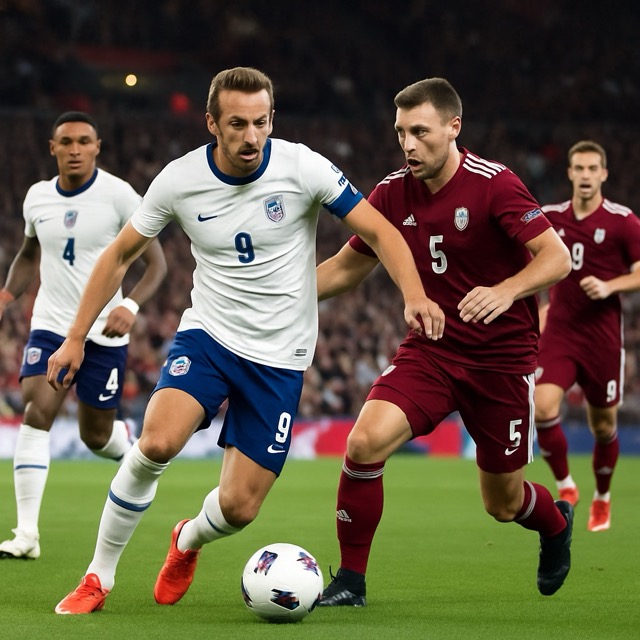
England qualified for the 2026 FIFA World Cup with a commanding 5–0 win away to Latvia, a result that underlined both their clinical edge and their almost metronomic control of this qualifying campaign. On a slick, rain-glossed surface at Daugavas Stadions in Riga, Anthony Gordon’s early strike set the tone before captain Harry Kane added a quickfire brace either side of half-time. A Maksims Toņiševs own goal and a composed late finish from substitute Eberechi Eze completed the scoreline, securing passage to North America with two matches to spare.
The victory carried more weight than the bare numbers. It affirmed Thomas Tuchel’s imprint on a group that has won six out of six in Group K, scoring 18 and conceding none, and—perhaps more tellingly—has spent long stretches of this campaign playing as if on autopilot. This wasn’t vintage theatre so much as a clean, controlled dismantling: England pressed high, recycled possession quickly, and strangled Latvian counterattacks before they could breathe. It was ruthless in the modern sense—dominion through structure.
Gordon’s opener arrived after England pried open the right channel with a sequence of rotations that drew Latvia’s full-back out of shape. The Newcastle winger, preferred again for his vertical running and off-ball aggression, took one touch to settle and a second to arrow low past the goalkeeper. The goal soothed any early jitters and invited England to stretch the pitch, with Jude Bellingham and Declan Rice alternating the tempo—one progressive punch, one calming pause.
Kane’s first spoke to a centre-forward living in the moment. Having peeled into a pocket at the top of the box, he received with his back to goal, rolled the defender, and lashed in with minimal backlift—his 75th for his country. The second, from the penalty spot after Gordon was clipped cutting inside, felt inevitable: a jog, a glance, and a pass into the side-netting to make it 76. There was little his club form hadn’t telegraphed—he is in the rhythm strikers crave and defences dread.
Latvia, game and well-coached in their compact 5–4–1, were left chasing shadows once the third went in. England’s fourth came with a hint of fortune, Djed Spence’s driven cross deflecting off Toņiševs and wrong-footing the goalkeeper. By then Tuchel had turned to his bench, and Eze supplied the night’s coda, gliding onto a squared pass to slot home inside the far post. Jordan Pickford, largely untroubled, preserved yet another clean sheet behind a back line whose spacing and communication have improved by degrees with each camp.
If the performance looked routine, the context did not. With this win England became the first European nation to book their ticket to the 2026 finals, maintaining an extraordinary qualifying run that now stretches to 37 World Cup qualifiers unbeaten since 2009. That stat, more than the margin of victory, speaks to institutional consistency: different managers, evolving squads, same relentless accumulation of points.
Tuchel has, by degrees, shifted the team’s reference points. Out of possession, the line steps higher and the trigger to swarm is sharper; in possession, England are more comfortable resetting through the centre-backs to drag opponents into the press, then punching through the half-spaces. It is not a revolution but a refinement. The tactical choreography also fits the personnel: full-backs who can invert or overlap, midfielders who can break pressure, and forwards—Gordon, Bukayo Saka, Phil Foden when available—whose movements complement Kane’s gravity.
Selection debates will rumble on. There will be calls to restore certain star names as they return to fitness and form, and arguments over whether a double pivot or a single six best releases England’s creative talent. Those are useful problems to have. More pressing is the team’s capacity to translate sterile dominance against modest opposition into incision against the elites. In that sense, it is the habits that matter: regaining shape within three seconds of losing the ball, counter-pressing in layers, committing runners from midfield when the box is crowded. On this evidence, the habits are taking root.
The travel itinerary now points west. World Cup 2026 will be staged across the United States, Canada and Mexico, and England’s qualification with games to spare affords breathing space—to experiment at the margins, to manage minutes, to fine-tune set pieces. Tuchel demurred when asked about celebrations, praising instead his squad’s ‘seriousness’ and ‘hunger.’ Kane, too, sounded a sober note: ‘Qualification is the minimum; our standards must stay high.’
Latvia’s campaign, meanwhile, has been about consolidation and incremental progress. They pressed bravely for periods after the interval and created their best look from a recycled set piece, but the gulf in speed of thought and technical execution was evident. A late flurry did at least stir the home crowd on a wet evening that never truly threatened to turn.
The numbers are authoritative. Six played, six won; 18 scored, zero conceded. England have faced only a handful of shots on target all campaign, and the defensive ledger will please a manager who has spent equal time on distances between the lines as on patterns in the final third. The spine—Pickford, John Stones, Rice, Bellingham, Kane—remains intact, but the supporting cast has grown louder. Gordon’s insistence, Eze’s fluency, and the full-backs’ balance of risk and control add fresh notes to a familiar tune.
None of this guarantees anything when the lights go up next summer, and the sport’s recent history is littered with impeccable qualifiers who fell at the first real gust of tournament jeopardy. But England leave Riga with the one outcome the evening demanded and a performance that, while not perfect, felt sustainably repeatable. The margins at the top are often about how often you can reproduce your good habits. Right now, England are repeating themselves in all the right ways.
By full-time the away end had serenaded Tuchel, who smiled and waved in acknowledgement before gathering his players in a brief, businesslike huddle. There were handshakes with staff, a few swapped shirts, and then the tunnel. Work to do, yes—but passport stamps secured.




 The Tower Post