How 2025’s Nobel Prize-winning chemistry could mop up pollutants and turn toxic substances benign
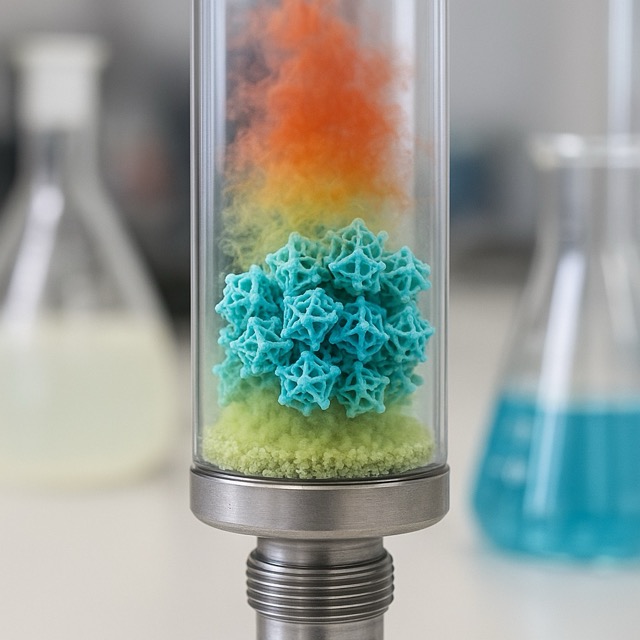
If chemistry has a fairy godmother, she might look a lot like a metal–organic framework. These crystalline scaffolds—built by snapping together metal nodes and carbon-based linkers—are riddled with microscopic rooms that can welcome specific guests and refuse others. This year’s Nobel Prize in Chemistry crowned the field’s architects, Susumu Kitagawa, Richard Robson and Omar M. Yaghi, whose modular ‘molecular Lego’ has turned porosity into a programmable superpower. The win cements MOFs, as these materials are known, as one of the most versatile tools in the fight against pollution and toxic exposures.
The appeal is simple but profound. Traditional adsorbents such as activated carbon or zeolites can be effective, yet their pore sizes and chemical personalities are relatively fixed. MOFs are different: swap one metal for another, or trade a linker for a slightly longer cousin, and the material’s internal landscape changes—new corridors, different doorways, stickier wallpaper. That tunability allows chemists to design a framework that prefers, say, carbon dioxide over nitrogen, or that snares ammonia while ignoring water vapour. In a world awash with complex pollution problems, precision matters.
Consider carbon capture. The blunt instrument is to chill and compress flue gases, an energy-hungry step that has hampered deployment. MOFs offer a subtler route: they can be engineered with binding sites that selectively latch onto CO₂ at the relatively low pressures found in smokestacks, then release it with modest heating or a change in humidity. Start-ups and industrial players are now testing MOF-packed columns that promise lower regeneration penalties and longer lifetimes than amine solvents. The goal is not only to strip CO₂ from exhausts but to capture it directly from the air, where concentrations are a parts-per-million whisper.
Water, too, becomes a solvable puzzle. Some MOFs are hygroscopic superheroes, drawing liquid from arid air and wringing it out again using sunlight or low-grade heat. In field trials, suitcase-sized harvesters have produced drinkable water in desert conditions without an electrical grid—useful for humanitarian crises and remote communities. On the flip side, tailored frameworks can remove pernicious contaminants from water supplies. Researchers have reported MOFs that bind stubborn ‘forever chemicals’ (PFAS), trap arsenic and lead, and sponge up organic solvents after industrial spills. Unlike indiscriminate filters, these sorbents are choosy—good news when trace toxins hide among benign solutes.
The same selectivity can defang gases that terrorise first responders. Frameworks with acid-friendly binding pockets grab chlorine or sulfur dioxide; others soak up ammonia and hydrogen sulfide. A branch of research even targets nerve-agent simulants, with catalytic MOFs that don’t just hold the poison but dismantle it—clipping reactive groups to yield harmless fragments. That blend of adsorption and catalysis—a kind of molecular arrest followed by rehabilitation—could shape the next generation of protective masks and mobile decontamination units.
None of this is alchemy. The breakthroughs come from patient, almost architectural thinking. Robson imagined crystalline networks with repeating metal–linker geometries; Kitagawa pioneered ways to fill those cavities with guests; and Yaghi systematised the design rules into ‘reticular chemistry’, a playbook for stitching matter into preordained shapes. The result is a library of tens of thousands of MOFs, many with record-breaking internal surface areas. Pour a teaspoon of some varieties and you’re, in effect, handling a surface larger than a football pitch.
The Lego analogy is apt but incomplete. Yes, the building blocks are modular, but unlike plastic bricks they can flex, breathe and even respond to stimuli. ‘Gate-opening’ MOFs change shape when a target molecule approaches, while others act like molecular turnstiles—closed to everything until the right guest flashes the equivalent of a chemical ID. These dynamic behaviours, once seen as quirks, are now assets. They allow materials to work under realistic conditions—hot, humid, dirty—without clogging or losing selectivity.
Real-world chemistry is messy, of course, and scaling up has been MOFs’ awkward adolescence. Early syntheses relied on expensive solvents and painstaking crystallisation; powders were fragile and hard to process. Manufacturers have since learned to make tonnes rather than teaspoons, to press powders into pellets and coat them onto fibres and monoliths, and to swap exotic ingredients for industrially friendly ones. Costs are falling, and the first commercial deployments—in gas purification, respirators and niche separations—are quietly normalising a once-lab-bound technology.
There are cautionary notes. A material that guzzles a toxin in the lab may behave differently in a sewage works, where organic gums, biofilms and temperature swings conspire to foul pores. Regenerating spent sorbents must not simply export the problem to landfills or smokestacks. And lifecycle analyses, still patchy, have to prove that MOFs deliver genuine environmental wins when manufacture, transport and eventual disposal are counted. Policy will matter, too: utilities and industrial emitters don’t adopt new materials on a whim. Clear standards, procurement support and carbon pricing will hasten adoption more than any single breakthrough in a beaker.
Then there is the AI angle. The same combinatorial richness that delights chemists overwhelms them: the number of possible node–linker combinations is astronomical. Machine-learning models trained on thermodynamic data and adsorption isotherms are now proposing new frameworks for specific jobs—one for CO₂ in humid air, another for vinyl chloride in a mixed stream, a third that oxidises benzene to less harmful products. The lab becomes a vetting ground rather than a fishing expedition, speeding the route from concept to cartridge.
In parallel, researchers are merging MOFs with other technologies. Embedding enzymes inside frameworks protects the proteins while letting substrates flow, creating robust ‘biocatalytic sponges’ that chew through pollutants. Attaching light-absorbing units turns MOFs into mini-reactors for photocatalysis, where captured CO₂ can be nudged towards carbon monoxide or formate—stepping stones to fuels and chemicals. Composites with polymers and graphene add mechanical strength and electrical conductivity, opening doors to smart filters that sense when they’re saturated and signal for replacement.
The public may never hear the acronym in a headline after a spill or wildfire. They’ll see a filter cartridge, a compact box on a fire engine, a suitcase that exhales cups of water at dusk. But upstream of those quiet miracles is a discipline that marries beauty with utility. It’s fitting, in a way, that a prize for building with emptiness should arrive at a moment when the atmosphere and hydrosphere are too full—of carbon, of microtoxins, of fear. MOFs do not solve climate change or industrial contamination on their own. They do, however, offer something policy can work with: a tunable platform that gets better as we learn more.
What would success look like by the end of this decade? One scenario is unglamorous: millions of little wins. Municipal plants that quietly meet tighter PFAS limits; chemical factories that shave megawatts off separations; cargo ships that scrub their ammonia fuel exhausts; mining operations that capture fugitive gases before they drift into nearby towns. In aggregate, such marginal gains rival landmark projects—precisely because the materials can be tailored, swapped and upgraded without bulldozing infrastructure.
The laureates themselves speak most evocatively about curiosity rather than crusades. Reticular chemistry began as an intellectual adventure into how matter could be stitched together. The applications—capturing greenhouse gases, harvesting water in deserts, disarming toxins—followed because the structures made the improbable possible. That is the quiet power of fundamental science. Give researchers a new alphabet of matter and they will, over time, write better stories for the rest of us.
For regulators and investors deciding where to place bets, three questions can separate hype from help. First, does the MOF work under the wet, hot, mixed conditions outside the lab? Second, can it be regenerated with minimal energy and without creating secondary hazards? Third, can the supply chain deliver at scale and price? Projects that answer all three—some already do—deserve fast tracks and patient capital.
The world tends to celebrate science at its loudest moments: rockets, reactors, billion-dollar pilot plants. But a lot of environmental progress happens in the quiet exchange between a molecule and a well-designed pore. The 2025 chemistry Nobel is a reminder that elegance and impact needn’t be strangers. When the right guests find the right rooms, the party everyone cares about—cleaner air and water—gets a little closer.




 The Tower Post