Inside the whirlwind last episode of Vinted’s TV design series — where creativity, circularity and four-hour time limits decided a career-defining debut
The six-part TV competition RE/style reached its crescendo this week with a brisk, breathless finale that doubled as a manifesto for secondhand fashion. After a season of denim deconstructions, travel-inspired remakes and VIP red-carpet reinventions, two designers—Chiara, from Sicily, and Emily, from York—returned to the workroom for a last, high‑stakes challenge. Their brief: craft a “showstopping” look from pre‑loved garments under the theme “into the wild,” using only secondhand materials and a sharply reduced four‑hour window. The test spoke to the series’ core intent—that ingenuity, not virgin fabric, is what turns clothing into fashion.
RE/style is the brainchild of secondhand marketplace Vinted, produced with Lion Television Scotland and fronted by presenter Emma Willis. Across its run, eight emerging designers from across Europe stitched, draped and problem‑solved in real time, fielding weekly critiques from resident judges Zadrian Smith and Melissa Holdbrook‑Akposoe, with a rotating cast of guest experts. The prize was equally pragmatic and aspirational: a platform to debut at London Fashion Week and a pipeline to sell exclusive pieces through Oxfam and Vinted’s circular channels—an end‑to‑end proof that secondhand can command runway attention and retail appetite alike.
Finals day carried the rhythm of a sprint finish. The workroom reopened with off‑camera hum already in the air—the sort of staticky pressure that only a last episode delivers. Each finalist was paired with returning contestants as studio assistants, a move that injected both camaraderie and tactical advantage. From the first minute, time management looked as decisive as needlework. Four hours leaves no room for muslin tests, and the materials—rescued knits, surplus silks, decommissioned dresses, forgotten trims—resist perfect compliance. Secondhand always talks back.
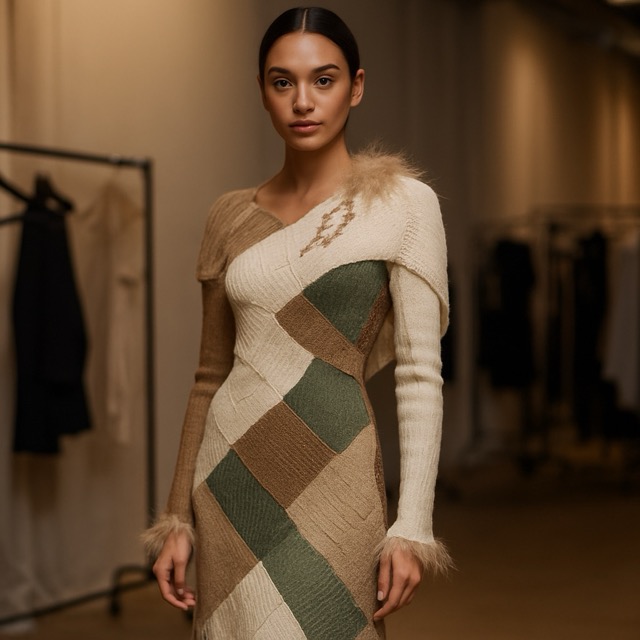
Emily switched lanes from her season‑long menswear instincts and chased drama: a sculptural asymmetrical dress tessellated from bright, pre‑loved knits, blocked with remnant florals that nodded to 1970s optimism. Where earlier episodes showcased her zero‑waste pattern brain, the finale demanded theatre. She answered with bravura cutting and fast finishing, the look reading like a color‑rich topography: peaks and valleys mapped in ribbing, cables and purl. The risk was coherence. Could a knit‑forward statement convince the judges as a red‑carpet proposition rather than an art‑school exercise?
Chiara traveled inward, translating a memory of the Great Smoky Mountains into a two‑piece that married soft drape with plume‑light movement. She worked in hushed creams and forest tones, bias‑cutting from a rescued gown and stabilizing with carefully hidden reinforcing seams. Feathers—salvaged, cleaned and meticulously redistributed—furnished a smoky halo at the hem and collar. The silhouette felt cinematically calm, a counter‑proposal to the season’s louder set pieces. In fittings, the garment breathed; on the turn, it lifted like fog from tree‑tops.
Judging in RE/style leans as much on storytelling as on stitch. Creative direction is the medium through which secondhand escapes bricolage and becomes brand. On the final runway, permanent judges Zadrian Smith and Melissa Holdbrook‑Akposoe were joined by industry voices including model and activist Eunice Olumide and stylist Jessie de la Merced. They probed not just cut and construction but fashion’s broader rhetoric: Why this material? Why this choice now? What does the look say about the life cycle of clothes and the agency of wearers?
Emily’s look scored for nerve. The collage of rescued knits telegraphed joy and technical control, its patchwork harmonized by a deliberately off‑kilter hem and a clean neckline that kept the eye from wandering. Yet the panel flagged the risk of visual noise: in the wrong light, the dress might photograph busy. Chiara’s two‑piece landed the opposite sensation—poise over punch, control over collage—delivering the most elusive of upcycling feats: restraint. The judges praised the evolution of her season arc, from inventive tinkering to fully resolved polish.
When the decision came, it felt inevitable: Chiara took the title. Her win hinged on three strengths that secondhand design often struggles to stage together—narrative, finish and wearability. This was not simply a salvaged triumph; it was the promise of a wardrobe that could walk from workshop to red carpet without translation. In award‑show shorthand, the look read “editorial,” but it also read “owned”: a garment that remains itself even when the camera frame changes.
The victory is more than a moment for one designer. It spotlights a maturing ecosystem around circular fashion. Over the past year, resale platforms, charity retailers and mainstream media have migrated from “thrift haul” novelty to scaffolding genuine design careers. RE/style’s format—sourcing from secondhand stock, compressing timelines, foregrounding repair—functions like a laboratory of constraints. The show’s emphasis on sell‑through (select pieces made available via Oxfam’s Vinted storefront) treats sustainability not as a vibe but as a viable, audience‑facing business model.
There is also a cultural story happening on screen. Television has long been fashion’s amplifier, but rarely has it put such a blunt premium on resourcefulness. If the 2010s taught viewers to fetishize the “it” piece, the 2020s are training eyes to see technique: a godet inserted to save fabric, a dart pivot that eats less cloth, a reline that gives a coat ten more winters. In the finale, you saw hands, not logos. You heard conversations about how to make a salvaged zipper behave, how to nurse a vintage bias back into place without scorching it into submission. That fluency—materials, make, aftercare—feels like the new literacy.
The judging, too, is evolving. Instead of treating sustainability as a grading curve that excuses weak design, RE/style holds its contestants to a fashion‑first standard. Feathers must be secured and ethically sourced; hems must hang right; styling must serve the garment rather than disguise its compromises. When a look wobbles, it’s not “because upcycling”—it’s because the design decision didn’t land. That shift matters. Ethical fashion wins hearts when it wins taste.
What happens next? For Chiara, a confirmed showcase at London Fashion Week will push her ideas from episode‑scale to collection logic: can the language of controlled softness and edited embellishment carry across a dozen looks, sizes and contexts? For Emily, the finale proved a thesis worth expanding—knitwear as architecture, not afterthought. Both outcomes point to a larger market appetite: clothing that keeps moving after its first life, made with the diligence of couture and the humility of repair.
Behind the scenes, the show’s production partners are betting that visibility can accelerate behavior change. If audiences can follow the narrative of a garment’s rebirth—and then buy similar pieces through a transparent chain that includes charity retail—they can begin to read their own wardrobes differently. The finale’s split‑screen of process and payoff crystallized that promise: set a constraint, build within it, and discover that creative limits are often creative catalysts.
None of this romanticizes the hard parts of circular fashion. Secondhand materials add variance to timelines and inventories; sizing becomes an algebra problem; quality control is not a given. But the finale made a pragmatic argument for scaling solutions: design into flexibility; teach repair at the point of sale; create marketplaces where provenance is a feature, not a footnote. Do this on television often enough, and you normalize the workbench as much as the catwalk.
As credits rolled, the season closed with an image that will likely outlast the runtime: a winner hugging her mother backstage, the garment still warm from the lights, feathers lifting in the convection. A career does not begin on a runway; it begins long before, with a decision to keep making. RE/style simply gave that decision a stage—and the finale proved that secondhand, in the right hands, is not an aesthetic compromise. It is a competitive advantage.
For viewers newly curious about the practice, the takeaway is simple: start where you are. Learn a hem. Swap a zip. Buy fewer, better, older. The future of fashion may yet be stitched from what we already own, refined by craft, and carried forward by designers like Chiara and Emily—people who can see not just what a garment was, but what, with patience and skill, it can still become.




 The Tower Post