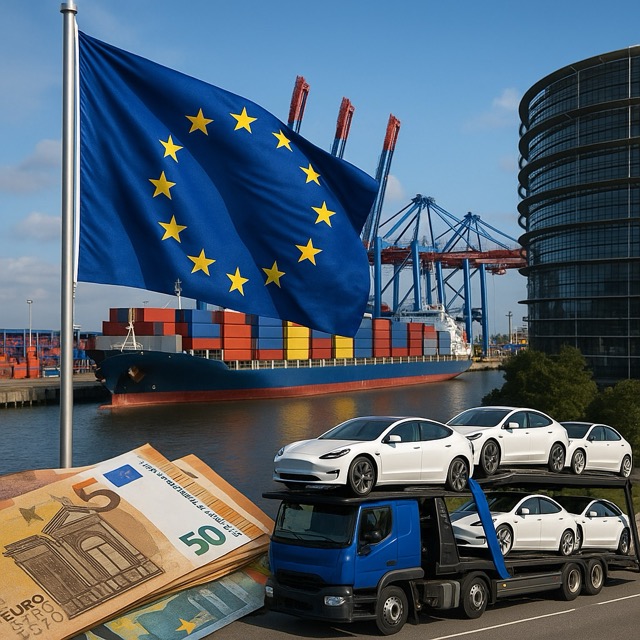
Joachim Nagel urges a more assertive stance as Chinese export pressure intensifies and global trade flows shift

WASHINGTON/FRANKFURT — Europe should approach its trade relationship with China with greater confidence and readiness to defend its economic interests, Bundesbank President Joachim Nagel said this weekend on the sidelines of the IMF and World Bank meetings. In comments that echoed through European capitals, Nagel argued that the European Union’s market of roughly 450 million consumers gives it leverage that it has not consistently used, urging policymakers to “act in a more offensive way” while avoiding an outright trade war.
Nagel’s call comes amid a reconfiguration of global trade flows triggered by escalating tariff measures by the United States and a sustained wave of Chinese exports seeking alternative markets. European manufacturers—from chemicals to machinery and autos—say they are feeling a sharper squeeze from lower‑priced Chinese goods arriving in the single market, even as they contend with high energy costs at home and subdued demand across the bloc.
“Dialogue with Beijing remains essential,” Nagel said, according to remarks reported from Washington. “But Europe must also protect its markets and companies.” His message, delivered as ministers discussed growth, supply chains and industrial competitiveness, adds a central‑banker’s voice to a debate that has increasingly been dominated by trade and industry officials in Brussels and national capitals.
In recent months the European Commission has sharpened its trade‑defense toolkit—expanding anti‑subsidy probes, tightening foreign‑investment screening and signaling tougher conditions on inbound Chinese investment. EU officials are also canvassing options to secure critical raw materials as Beijing asserts greater control over rare earths and battery inputs. The broader objective, officials say, is to ensure that European innovation and jobs are not eroded by systemic overcapacity abroad or by coercive practices that fragment supply chains.
The immediate flashpoints are familiar. Brussels’ tariffs on Chinese electric‑vehicle imports—imposed after a year‑long investigation—were met by a flurry of Chinese counter‑measures, including probes into European agri‑food exports and rumors of further action on aviation and cosmetics. Trade lawyers warn the EU’s EV duties may blunt but not block the economics of exports from Chinese champions whose scale and state support have driven down costs. That keeps pressure on Europe’s auto heartlands in Germany, France, Spain and Central Europe.
Germany, the bloc’s largest economy, has arguably the most at stake. It is deeply integrated with China through machinery, chemicals and premium autos, yet is simultaneously grappling with a multi‑year industrial slowdown. Nagel—who has frequently cautioned against broad‑brush tariffs that could ricochet through supply chains—framed his appeal as a balance: keep channels open, but don’t be naïve about the costs of asymmetric openness.
Trade economists say that ‘asymmetric openness’ has grown more visible as Chinese exporters reroute goods originally aimed at the U.S. into Europe and emerging markets, a byproduct of shifting U.S. tariff schedules. The price effects have been especially acute in intermediate goods, from basic metals to components for solar and electronics, where European producers complain of persistent undercutting and shrinking market share.
EU policymakers are now weighing several next steps. One option gaining traction would attach tougher conditions to large Chinese investments within Europe—including requirements around technology contributions, local R&D or supply‑chain transparency. Another involves accelerating joint procurement and stockpiles for critical minerals and green‑tech inputs to reduce vulnerability to disruptive export controls. A third is to deepen capital markets so Europe can finance its own scale‑ups faster, a project that won fresh political backing this week.
None of these moves, however, obviate the need for coordination with allies. In areas such as rare earths and advanced materials, Brussels has sought closer alignment with Washington and like‑minded partners to mitigate supply risks and discourage beggar‑thy‑neighbor subsidy races. Diplomats caution that if Europe and the U.S. cannot synchronize guardrails, Beijing will exploit gaps between regimes—easing pressure on its own exporters while amplifying costs for Western firms.
For Europe’s central bankers, the trade debate is no longer a distant backdrop. It cuts directly to inflation dynamics, investment incentives and the euro area’s growth potential. Cheaper imports can tamp down headline prices in the short run, but prolonged dumping or sudden retaliatory barriers can whipsaw costs and freeze capex plans. Nagel has argued in recent speeches that euro‑zone inflation is set to hover near the European Central Bank’s 2% goal over the medium term, but he has also warned that poorly designed tariffs could aggravate volatility and sap confidence—especially in export‑heavy economies like Germany.
Industry groups broadly welcomed Nagel’s intervention as a sign that monetary authorities recognize the competitive stress facing European firms. “Our members do not ask for protectionism,” said a senior figure at a German manufacturing association. “They ask for reciprocity, effective trade defense, and faster approvals for investments at home.” Business lobbies are pushing for quicker case timelines in Brussels, tighter enforcement of anti‑circumvention rules, and clearer signals to foreign investors about what constitutes acceptable state support.
Still, the political path is narrow. Several EU member states—particularly those with sizable export exposure to China—remain wary of measures that could provoke commercial retaliation. Others argue that Europe has waited too long to confront structural overcapacity in sectors from steel to batteries and risks losing another decade of industrial leadership if it hesitates now. That divergence complicates the Commission’s ability to act decisively and sustain a unified line in negotiations with Beijing.
What would ‘tougher’ look like without tipping into a trade war? Trade lawyers and former officials sketch a pragmatic checklist: more—and faster—use of anti‑subsidy cases where evidence is strong; coordinated customs enforcement to curb transshipment; investment screening that scrutinizes sensitive technologies and data; and a more muscular push for reciprocity in procurement and market access. They also call for industrial policies that scale European clean‑tech and digital players so they can compete on price and capacity, not just quality.
There are signs of movement. The EU has rolled out transparency requirements across mineral supply chains and is testing new tools aimed at tackling distortive foreign subsidies in public tenders. National governments are channeling funds to strategic sectors while trying to avoid zero‑sum subsidy races inside the single market. And policymakers are dusting off efforts to deepen the capital‑markets union—reviving proposals for a more integrated European stock market that could steer savings into growth companies and strategic infrastructure.
Nagel’s core point was ultimately political: Europe should stop under‑estimating its own heft. With a market the size of the EU’s, and with allies facing similar challenges, the bloc has room to set terms rather than merely react to them. That will require consistency—case by case—rather than a single headline‑grabbing tariff. It will also require managing a delicate relationship with a trading partner that is both indispensable and, at times, disruptive.
For now, the Bundesbank chief’s message adds momentum to a harder‑edged but calibrated approach: keep talking to Beijing, but move faster to defend fair competition at home. As Europe weighs the next set of trade files in the months ahead, the question is less whether to be tougher, and more how to do so in a way that strengthens resilience without closing the door to future cooperation.
 The Tower Post