
Centre-right Liberals’ endorsement lifts government’s overhaul of ties with the EU across electricity, state aid and free movement as referendum battle looms
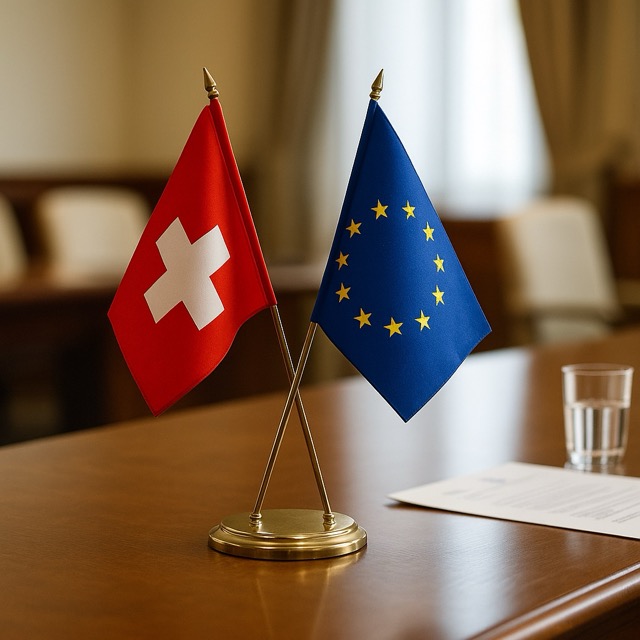
BERN — Switzerland’s push to reset relations with the European Union received a decisive political boost this weekend after the business‑friendly Free Democratic Party (FDP.Die Liberalen) voted to support the government’s broad package of agreements with Brussels.
The endorsement by delegates of the centre‑right party — long a bellwether of pro‑business sentiment — strengthens the governing coalition’s hand as it prepares to shepherd a complex set of accords through parliament and, ultimately, a popular vote. The package, negotiated with the European Commission over the last two years and approved by the Federal Council in June, spans electricity market integration, state‑aid disciplines, transport, and the free movement of people. It also foresees a renewed Swiss financial contribution linked to participation in parts of the EU single market.
While the details differ sector by sector, the common thread is legal clarity: Switzerland would align more predictably with EU rules in the covered areas and accept agreed mechanisms to settle disputes, replacing the patchwork fixes that emerged after the collapse of the Institutional Framework Agreement in 2021. For companies, the prospect is fewer regulatory cliff‑edges; for Brussels, it is a firmer guarantee that outsiders benefiting from the single market play by comparable rules.
Inside the FDP, the case was argued in explicitly economic terms. Industrial exporters still sell more than half their goods to the EU, Switzerland’s largest trading partner, and energy‑intensive firms have faced mounting uncertainty since Switzerland fell out of the EU’s electricity market arrangements. Party speakers said the package would restore predictability for cross‑border supply chains and unlock long‑stalled files — notably electricity — that became collateral damage of the earlier institutional impasse.
The vote is not the end of the argument; it is the beginning of a campaign. The right‑wing Swiss People’s Party (SVP), parliament’s largest bloc, is mobilising against the accord on sovereignty grounds, warning that tighter alignment with EU rules could erode border control and domestic decision‑making. SVP leaders frame the dossier as a choice between independence and integration. FDP figures counter that the agreements are explicitly bilateral, tailored and revocable, and that the price of disengagement is paid in lost market access and investment.
Electricity sits at the heart of the economic stakes. The envisaged electricity agreement would reconnect Switzerland more deeply to continental power markets and grid management, giving operators better access to cross‑border capacity and stabilising flows in dry winters. Energy traders say the lack of a deal in recent years has raised volatility and inflated balancing costs for Swiss consumers; network managers on both sides of the border have warned of inefficiencies when Swiss nodes are treated as outsiders. The new text aims to codify technical cooperation and market coupling, while embedding safeguards for security of supply and hydropower’s special role in Switzerland’s system.
The state‑aid chapter is equally consequential. Bern would mirror EU disciplines that limit subsidies distorting competition inside the single market, with procedures to ensure transparency and a channel to resolve disputes. Economists describe this as the price of privileged access: companies operating across the EU‑Swiss frontier should compete on merit, not on the hidden lift of domestic support schemes. For a small, open economy whose prosperity turns on export credibility, FDP strategists argue, predictability is a comparative advantage — and predictability requires shared refereeing rules.
The most politically sensitive plank remains free movement. The package preserves the core of Swiss‑EU mobility while bolstering flanking measures against abuse and to protect wages — a long‑standing domestic demand. Employers, especially in construction, healthcare and research, rely on European talent; unions insist that wage controls and enforcement must keep pace with inflows. In its messaging, the government stresses that the balance between openness and protection is adjustable in law and backed by joint committees, not ceded wholesale to foreign courts.
Another piece is Switzerland’s renewed “cohesion” contribution to EU programmes, part goodwill, part admission ticket. Critics see this as an annual levy; supporters call it an investment that keeps labs and firms plugged into European networks. The collapse of Horizon Europe participation hit universities and startups; restoring that pipeline is a priority for the science lobby and a potent argument for urban voters who have grown wary of isolation’s costs.
Polls ahead of the FDP conclave showed public opinion edging toward the government’s side following trade tensions and tariff shocks abroad. Business associations have lined up behind the package; cantonal governments, which manage a good share of labour‑market enforcement, are pressing for the legal certainty that would come with institutionalised cooperation. Yet the path to ratification runs through Switzerland’s direct‑democracy machinery. The Federal Council has proposed an optional referendum on the legislative bundles, opening a formal consultation this autumn. Even in a best‑case scenario, a nationwide vote would not take place before 2027 — a long campaign trail over which the arc of European politics and energy prices could still bend attitudes.
Inside parliament, the FDP’s stance could prove pivotal. The party often supplies the decisive votes for economically liberal compromises and, by backing the package, it creates political cover for allied centrists to follow. The Christian‑Democratic Centre (Die Mitte) has signalled openness; the left‑of‑centre Social Democrats support tighter integration but will haggle to reinforce wage protections. If a cross‑party coalition coheres, the SVP will carry the banner of resistance into the referendum arena, betting that concerns about migration and national pride can outweigh pocketbook arguments.
For now, Bern and Brussels are selling the same story: a pragmatic reset that avoids both a full EU membership debate and the steady attrition of market access. The Commission touts level playing‑field gains and institutional stability; the Swiss government emphasises flexibility and control. Where the narratives converge is energy security and industrial competitiveness. With Europe rewiring its grids and subsidy frameworks for a decarbonised economy, being inside the rule‑making tent — even as a non‑member — is worth something tangible.
The open questions are less legal than political. Can the government convince voters that dispute‑settlement mechanisms defend Swiss interests rather than dilute them? Will wage protection reassure sceptical unions outside the traditional left? Can the electricity accord prove its worth quickly enough to puncture the argument that Switzerland is trading autonomy for theoretical efficiencies? And will the SVP’s sovereignty message retain its edge if business confidence and research links revive under a deal?
If the FDP’s delegates are a bellwether, the centre‑right has decided that the costs of drift now exceed the risks of discipline. That judgement carries weight in boardrooms from Basel to Zug and resonates in EU capitals eager to normalise a difficult relationship. The coming months will bring line‑by‑line scrutiny in committees and cantonal hearings, followed by the long march toward a referendum. For Switzerland’s export‑led economy and its networked universities, the outcome will shape the country’s European decade.
For the government — and now the FDP — the bet is straightforward: clarity is competitive. The task ahead is to persuade a sceptical but pragmatic electorate that a rules‑based reset with Europe is not a concession, but a renewal.




 The Tower Post