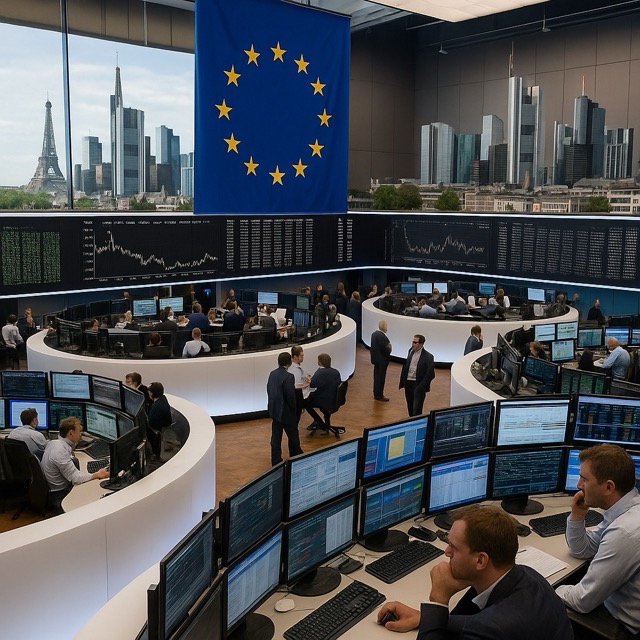
Germany’s new chancellor urges an integrated bourse to deepen liquidity, cut costs and revive Europe’s risk capital — but can Brussels, Paris, Frankfurt and the national watchdogs get on the same page?

Berlin — German Chancellor Friedrich Merz has called for the creation of a single European stock exchange, casting the move as the centrepiece of a broader push to strengthen the EU’s Capital Markets Union and reduce the costly fragmentation that still defines the continent’s financial plumbing. Speaking in the Bundestag this week, Merz argued that Europe will not finance its future — from net-zero technologies to life sciences and AI — without a much larger, deeper pool of equity capital. The proposal, long discussed but rarely championed from Berlin, signals a notable shift in Germany’s position and has quickly reverberated across Europe.
The idea is both simple and radical: consolidate Europe’s disparate equity venues and rulebooks into a seamless marketplace under stronger EU-level supervision. In practice, that would mean far more than a merger of trading screens. It implies unified listing standards, streamlined prospectuses, centralised enforcement of market abuse rules, consolidated market data, and common settlement arrangements that make cross‑border investment as frictionless as trading across state lines in the United States.
What’s different now — and why the signal matters
Capitals from Paris to Amsterdam have pushed for deeper integration for years, but national sensitivities — and concerns in Germany about ceding supervision to Brussels — often stalled the project. Merz’s backing marks a pivot. Berlin is now signalling openness to empowering the European Securities and Markets Authority (ESMA) as a single supervisor for key parts of the equity market infrastructure, aligning Germany more closely with France’s long‑standing position. The shift follows an influential set of recommendations from Mario Draghi on European competitiveness and productivity, which argued that a genuine capital market is as strategic as the single market for goods.
The timing is no accident. European IPOs have lagged U.S. and Asian peers for much of the past decade, and promising companies — especially in biotech and deep tech — frequently look overseas for scale and valuation. Supporters of a single exchange say that duplicative compliance and fragmented liquidity are part of the problem. A consolidated venue, they argue, would narrow the liquidity gap, lower the cost of capital for issuers and, crucially, give European savers a simpler pathway to invest at home.
Who’s on board — market operators and policymakers
Initial reactions from market operators have been cautiously constructive. Euronext, which already knits together exchanges from Paris and Amsterdam to Milan and Dublin, said it stands ready to contribute to “the next level of consolidation” to create a deeper European liquidity pool. Deutsche Börse, operator of Xetra and Clearstream, has not endorsed a single-exchange blueprint but underscores the competitive need to make European capital markets easier for global investors to navigate. In Brussels, the European Commission is drafting measures to press ahead with the Capital Markets Union, from simplifying listing rules to expanding ESMA’s direct oversight.
In the policy sphere, the International Monetary Fund and the European Central Bank have both cited the need to mobilise private investment in Europe as growth cools and public finances tighten. Officials argue that a bolder equity culture — and the institutions to support it — would help finance the energy transition and digitalisation without over‑reliance on bank balance sheets.
The hard part — law, supervision and sovereignty
Turning Merz’s headline into a functioning single exchange will be painful political work. National regulators guard their remits; legal traditions diverge; and the European Parliament will scrutinise any move that shifts power from member states to the centre. The thorniest questions cluster around supervision and enforcement: who approves prospectuses, who polices market abuse, which body arbitrates cross‑border disputes, and how to apportion accountability when something goes wrong.
Proponents say the answer is a pragmatic, staged approach. Phase one could create a “Single European Listing” with a common entry point and harmonised disclosure: one prospectus, passported everywhere. Phase two would bundle post‑trade plumbing — clearing and settlement — into interoperable rails with common standards and fewer back‑office frictions. Phase three would concentrate supervision of core market infrastructures at ESMA, initially for pan‑EU market segments such as large‑cap primary listings and consolidated market data services, before expanding further as trust and experience build.
What it means for companies — especially Europe’s scale‑ups
For issuers, the prize is straightforward: more investors, tighter spreads, and lower compliance duplication. A single exchange would also rationalise index construction — a vital channel for passive capital — so that European champions are more visible in global benchmarks. Founders complain that today’s regime encourages a patchwork of dual listings and “list in New York, list at home” compromises that dilute liquidity. A unified venue could reduce that pressure, raising the odds that the next generation of biotech, climate tech and semiconductor firms scales in Europe, not abroad.
Small and mid‑cap companies could benefit from slimmer documentation, cheaper research coverage via a EU‑wide research payment framework, and an upgrade of Europe’s listing segments for growth firms. But there are trade‑offs: tighter market policing and common enforcement will raise the bar for compliance and governance, especially in jurisdictions where practice has been looser.
What it means for investors — from pension funds to retail savers
For institutional investors, the biggest win is liquidity consolidation and standardised data. A single consolidated tape, with consistent identifiers and high‑quality post‑trade prints, would cut data costs and reduce the need to stitch together multiple feeds. For households, the payoff is clarity. Today, retail participation is patchy and often routed through national wrappers. An integrated market could sit alongside portable, EU‑wide savings products, giving savers a simpler way to own diversified European equities.
None of this obviates domestic capital‑raising. National exchanges would not need to disappear; they could federate under a European umbrella with shared rulebooks, common technology and a centralised supervisory spine — similar to airline alliances operating under a single safety regime. The political sell is that Europe gains scale without erasing local ecosystems.
Risks and objections — the case against
Sceptics warn that an EU super‑exchange could morph into a slow‑moving bureaucracy, blunting competition and innovation among venues. Others fear a power grab by Paris or Frankfurt. There are legitimate legal questions about how far ESMA’s mandate can stretch without treaty changes, and whether a “one‑size‑fits‑all” rulebook would be sensitive to smaller markets. Cyber resilience and operational concentration are further concerns: a single venue raises the stakes of an outage.
Proponents counter that the status quo already concentrates risk — just more opaquely — in a tangle of interlinked trading and clearing systems. They argue that clear lines of accountability at the European level, plus strict interoperability and contingency planning, would make the system safer, not riskier.
The road ahead — what to watch in the coming months
Merz’s gambit injects political momentum into a file that has languished for years. Watch for three signposts. First, whether the Commission tables legislation to boost ESMA’s direct supervision of listing, market abuse enforcement and consolidated data — and whether member states, including Germany, hold that line in Council negotiations. Second, the stance of major market operators: Euronext’s appetite for further consolidation, and Deutsche Börse’s willingness to back a federated model, will shape the art of the possible. Third, the package around the exchange itself: rules for research, venture‑capital scale‑up funds, and pension reform to mobilise long‑term savings. The exchange is the headline, but the ecosystem will determine whether it works.
Europe’s capital market problem is not just pipes and software. It is about risk culture. A single exchange will not magically mint unicorns. But if Merz can convert a headline into a credible legislative plan — and if Paris, Frankfurt and Brussels can swallow some sovereignty in service of scale — the payoff could be a generational upgrade to Europe’s financial architecture. That, in turn, would give European firms a fighting chance to raise growth capital at home rather than defaulting to New York or Hong Kong.
The politics will be bruising; the incentives are finally aligning. Europe has talked about a true capital market for decades. Merz is betting that 2025 is the year it stops talking and starts building.
— Reported from Berlin.

 The Tower Post