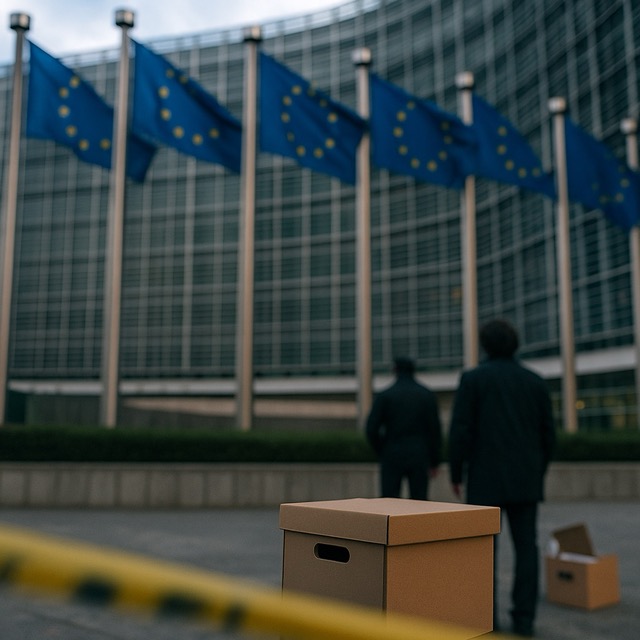
Laure Ferrari — former head of a Eurosceptic think‑tank and long‑time partner of Reform UK leader Nigel Farage — faces scrutiny over untraceable EU funds as EU anti‑fraud officials and Belgian prosecutors review spending at IDDE.
BRUSSELS — The European Union’s anti‑fraud apparatus and Belgian prosecutors are scrutinising how a politically connected foundation spent public money during the turbulent years before and after Britain’s vote to leave the EU. At the centre is Laure Ferrari, the French political operative who once ran the Institute for Direct Democracy in Europe (IDDE) and is the long‑time partner of Nigel Farage, now leader of Reform UK.
Investigators are reviewing a paper trail that dates to 2014–2017, when IDDE received grants as the affiliated foundation of the Alliance for Direct Democracy in Europe (ADDE), a pan‑European political party in which UKIP was the dominant component. Audit reports from that period flagged spending tied to opinion polling, communications and events that could not be fully traced back to eligible, European‑level activities. The findings were referred to the EU’s anti‑fraud office, OLAF, which in turn sent a judicial recommendation to Belgian authorities. Belgian prosecutors have since pursued a criminal investigation focused on suspected misuse of public funds and related accounting offences, people familiar with the process say.
Ferrari, who served as IDDE’s day‑to‑day manager, denies wrongdoing. She has privately told allies the foundation tried to comply with grant rules, that documentation gaps reflect rapid growth rather than intent, and that Eurosceptic groups were singled out in a charged political climate. There is no suggestion of criminal conduct by Farage himself in the current proceedings, and his name does not appear in court schedules for the matter, according to officials familiar with the case file.
A chamber of the Brussels Tribunal de première instance that specialises in financial crime is expected to deliver an initial judgment in early November, according to a spokeswoman for the federal prosecutor’s office. Any ruling could be appealed. Until then most filings remain confidential, and Belgian officials decline to specify which individuals are formally targeted — standard practice at this stage of proceedings. Even so, the revival of a long‑running funding dispute threatens to cast a shadow over the populist right’s most recognisable figurehead in Britain.
How we got here
The funding model at issue was created to foster EU‑wide debate by providing grants to recognised European political families and their think‑tanks. In December 2016, the Bureau of the European Parliament concluded that €500,616 of ADDE spending and €33,864 by IDDE in 2015 had broken grant rules — notably the prohibition on using EU funds to support national‑level campaigning. Parliament administrators later suspended payments, demanded recovery of certain sums, and referred elements of the file to OLAF. External auditors scrutinising 2016 accounts also reported that some IDDE expenditures were either ineligible or insufficiently evidenced, and cited additional sums that could not be verified.
The legal fallout stretched on for years. ADDE partially overturned elements of Parliament’s decision on procedural grounds, persuading judges that comments by a senior Parliament figure created an appearance of bias in part of the process. But IDDE was less successful: key appeals were rejected and the foundation moved into liquidation in 2017. Throughout, OLAF continued to examine the record and ultimately recommended judicial follow‑up in Belgium — the member state with jurisdiction over the entities involved.
What the case turns on
At the core of the Belgian probe are three perennial questions in EU grant oversight. First, documentation: can every invoice, contract and deliverable be matched to declared activities, with adequate audit trails? Second, eligibility: did the projects genuinely serve trans‑European political debate, as required, or did they bleed into national politics — in this instance, the UK’s ferocious campaigns of 2015–2016? Third, conflicts and independence: were donors and contractors sufficiently arm’s‑length from beneficiary parties to avoid indirect subsidy of national operations?
People familiar with earlier audit phases say some IDDE‑linked polling and communications efforts appeared to overlap with UK‑centred political objectives. The foundation has maintained that debates about migration, sovereignty and the future of the EU were inherently European in character even when they resonated most strongly in Britain. That unresolved tension sits at the heart of the Brussels court file now inching toward a first ruling.
Why it matters now
For Farage, the timing is awkward. Having re‑entered frontline politics, he led Reform UK into the 2025 general election and then into a noisy Westminster autumn, seeking to shape the agenda on immigration, energy and tax. Though the current Belgian case does not name him as a suspect, any development involving a close partner risks political blowback. Allies dismiss that as guilt by association; opponents see a pattern of questionable judgment in his entourage.
For EU institutions, the case is less about British politics than about defending the credibility of their financing regime. After a spate of controversies in the 2010s, the Parliament tightened ex‑ante checks on party and foundation grants and beefed up ex‑post verification. OLAF has also deepened cooperation with the European Public Prosecutor’s Office, which prosecutes crimes against the EU budget in participating states, while national authorities such as Belgium’s financial‑crime chamber have signalled greater willingness to pursue complex subsidy cases. A clear judgment in the IDDE matter could be read as a test of how far those reforms have moved the needle from administrative slap‑downs to true accountability.
Ferrari’s defence and her critics
Ferrari’s camp says IDDE confronted the same growing pains that have dogged many small political organisations: under‑resourced back offices, staff turnover and imperfect archives. Where claims proved ineligible, they say, the foundation either reimbursed funds or provided clarifications, and it shut down operations in 2017 as legal uncertainty mounted. Her allies add that she had no role in ADDE’s separate decisions and that conflating the entities exaggerates her responsibility.
Critics respond that this minimises the central issue. EU grants are governed by strict rules precisely to avoid blurring lines between European‑level debate and national power‑building. They argue that the IDDE record shows systematic weaknesses in governance and controls, not isolated paperwork lapses — and that when public money is involved, “haste” is no defence. To them, the case is a cautionary tale about the ease with which lightly staffed political outfits can become vehicles for activities only loosely tethered to the purposes taxpayers intended to fund.
The wider picture
A decade on from the Brexit referendum, the EU continues to wrestle with how to fund political pluralism without subsidising domestic campaigns. Parties and foundations that straddle national and European politics now face more prescriptive eligibility criteria, closer conflict‑of‑interest scrutiny and tougher clawback rules. Even so, enforcement remains uneven across member states, and politically sensitive cases can drag on for years — as the IDDE saga illustrates.
In Britain, where Farage remains both a polarising figure and a proven communicator, the story is likely to be filtered through partisan lenses. Supporters will see yet another attempt by “Brussels” to discredit Eurosceptics by revisiting the past. Opponents will frame it as a belated accounting for a movement that married slick media operations to rickety compliance structures. The reality may fall somewhere in between, in the technicalities of grant law and the fog of a half‑decade‑old paper trail.
What to watch
The first milestone is the Brussels court’s expected ruling in early November. Outcomes could range from dismissals to fines to orders for further investigative measures. Any party could appeal, pushing final resolution into late 2026. Parallel to the courtroom calendar, watch for whether EU bodies initiate additional recovery actions and whether any new civil claims emerge from contractors or staff linked to IDDE’s projects.
Regardless of the legal landing, the case is already shaping narratives. For Farage, it tests his ability to keep personal and political worlds from colliding as he tries to convert media presence into durable power. For EU institutions, it is a reminder that the battle to safeguard public money is never quite finished — especially when politics moves faster than paperwork.
For now, Ferrari remains under a cloud of scrutiny she insists is undeserved. Her future — and to a degree the reputational fortunes of Europe’s most famous Eurosceptic — may hinge on a few dense pages of judicial reasoning due from a quiet courtroom in Brussels in the coming weeks.



 The Tower Post