Vivienne Westwood opens and Stella McCartney closes a star‑studded week (Oct. 16–21), as Saudi Arabia bids for a permanent place on fashion’s global map
Riyadh — The third edition of Riyadh Fashion Week has arrived with real momentum and a guest list that would make any established capital look twice. Running from October 16 to 21, the schedule packs in more than 30 runway shows and presentations across six days, signalling a scale‑up in ambition and execution. The week is bookended by two British heavyweights: the house of Vivienne Westwood opened on Thursday with its first‑ever runway in the Middle East; Stella McCartney is set to close on Tuesday, October 21, with her debut Saudi show—one of the season’s most closely watched finales.
The symbolism is deliberate. Westwood and McCartney represent two poles of modern British fashion—rebellion and responsibility. Westwood’s couture‑meets‑counterculture vocabulary, refined over decades, offered archival drama cut against a Riyadh backdrop. McCartney, the industry’s most vocal advocate for cruelty‑free materials and transparent supply chains, brings a message of conscious luxury to a new audience. Together they telegraph that Riyadh is not chasing novelty for its own sake; it wants to be judged within the same competitive frame as Paris, Milan and London.
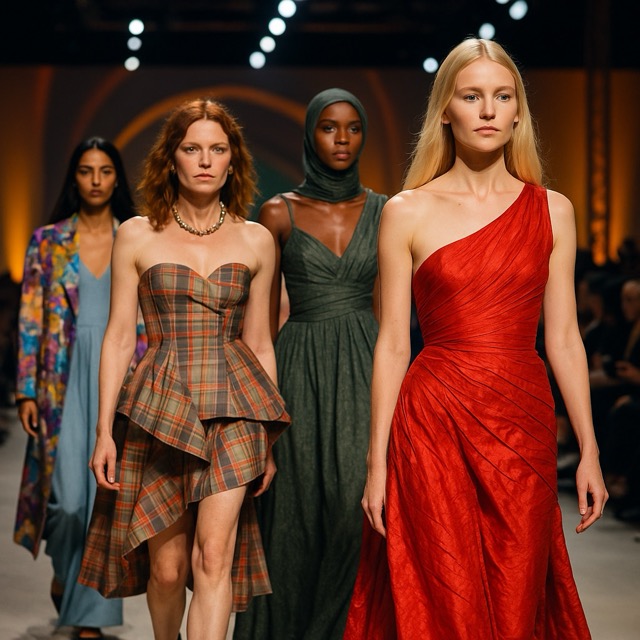
Westwood’s opener, staged in a vaulted venue dressed with warm desert light, recontextualized familiar signatures—corseted bodices, buccaneer boots, draped tailoring—through the lens of place. The brand presented an edit of gowns and evening looks that nodded to house iconography while collaborating with Art of Heritage, the Saudi institution preserving local craft traditions. Embroidery and beadwork read with particular intensity here, the colors echoing the city’s ochres and golds. Seen up close, pannier shapes and slashed tartans felt less like provocation and more like a conversation with regional ornament—proof that Westwood’s archive still has range.
Backstage, the talk moved quickly from iconography to industry. The Saudi Fashion Commission has expanded venues, production teams and buyer outreach, betting that a professionalized platform will translate into wholesale orders and sustained PR. Timetables ran to the minute; livestreams were clean; the press operation worked overtime, seeding looks and moments to social feeds in near real‑time. It sounds basic, but rigour at this level is how a new week begins to feel familiar to editors accustomed to the big four.
The calendar between the bookends is packed with Saudi and regional names intent on brand‑building rather than pure pageantry. Tailoring‑rich daywear dominated early collections, while eveningwear—long a regional strength—arrived with less ornament and more line. Designers leaned on modest silhouettes sharpened by cut: column gowns with architectural capes; fluid abayas in technical crepes; suiting softened by bias‑cut shells. Fabric stories brought local texture into focus—palm‑weave motifs, metal threadwork, and mother‑of‑pearl trims migrated from heritage references into modern detailing. The strongest looks avoided costume and cliché, returning something urbane and portable.
Yet spectacle alone is not the week’s story. Riyadh’s luxury customer base is young and expanding; retail groups have leveraged the event for trunk shows, private appointments and limited‑window pre‑orders tied to runway drops. E‑commerce players piloted pre‑order widgets embedded in livestreams, testing whether impulse can convert before attention drifts down the algorithmic river. For emerging labels, proximity is the prize: international editors and buyers are in the room, and at a fraction of the cost of a European tour.
McCartney’s finale is shaping up as the image that will travel. Industry invitations note a curated edit that splices recent collections with archival signatures—sleek tailoring, body‑skimming knitwear, and liquid evening dresses—constructed without leather, fur or feathers. Expect material notes to be foregrounded: mycelium alternatives, bio‑based coatings, certified viscose, recycled blends. The theatre, as ever with McCartney, is tethered to a case study in process—traceability dashboards and supplier partnerships that convert sustainability from slogan to procurement plan. In the Gulf, where luxury growth outpaces many Western markets, that proposition lands as both an ethical stance and a business pitch.
The optics, however, are complicated. In the days leading up to the opener, Cora Corré—granddaughter of the late Dame Vivienne—publicly criticised the label’s participation, arguing that showing in Riyadh ran counter to Westwood’s activist legacy. Human rights groups added their voices, warning that splashy cultural moments risk laundering state reputations. The brand countered that engagement and cultural exchange are not endorsements. The debate tracked across fashion’s corners of the internet, a reminder that runway choices now live in the same feed as geopolitical headlines.
Within the tents, the work spoke for itself. Westwood’s gowns—some re‑cut from past collections, others embellished in partnership with Saudi artisans—drew long applause, while street‑cast models in tailored looks gave the house’s punk heart a contemporary pulse. The casting of Saudi women across multiple shows read as more than tokenism: the styling was authoritative, the presence assured. When the camera panned to the audience, the picture sharpened—groups of women in black watched and filmed, a now‑typical image of this fashion week that nonetheless still feels quietly new.
Operationally, the third‑year leap is visible. Lighting rigs and modular runways elevated production values; satellite venues shortened travel time; and press‑room logistics resembled those of older, larger weeks. For buyers, the curated showroom reduced friction, enabling order‑writing on site. The next test will be post‑event: can local factories meet Western lead times and QA standards? Organizers insist they can, pointing to vendor audits and capacity investments made over the past 18 months.
The sustainability narrative—anchored by McCartney—threaded through the week with mixed fidelity. Several brands debuted capsules in recycled fibers or certified silks, while others doubled down on hand‑work heavy gowns whose environmental footprint is harder to tally but whose longevity may be their strongest sustainability argument. Stylists leaned into re‑wear for editorial shoots; fabric suppliers from the Gulf pitched bio‑PU and tracers for cellulosics; influencers began citing provenance alongside price and fit. If the conversation sometimes slipped into buzzwords, it also edged toward the operational details that matter.
Big picture, the presence of two British headliners has the effect Riyadh wanted: it collapses distance. Fashion’s geography is redrawing itself along lines of capital, culture and convenience. For global houses, the calculus is blunt—brand heat plus a growth market equals a trip. For Saudi designers, the opportunity is to define an aesthetic that travels without apology. A British archive opened the week; a British sustainability standard‑bearer will close it. The spine of the schedule is local. That triangle—international validation, regional identity, and operational competence—is what turns a one‑off into a circuit stop.
None of this resolves the tensions that accompany cultural soft power. But the runway is also an image‑making machine, and images are how industries update themselves. As the lights drop for McCartney’s finale on October 21, Riyadh will have authored a composite picture: a city leaning into its craft heritage, a new class of designers learning to speak global, an audience ready to shop—and a debate that refuses to stay offstage. That, in fashion, is what relevance looks like.
FACTS & FIGURES (as of Oct. 19): Riyadh Fashion Week runs Oct. 16–21; organizers tout 30‑plus runway shows and presentations; Vivienne Westwood opened with the brand’s first Middle Eastern runway featuring pieces co‑created with Art of Heritage; Stella McCartney is slated to close on Oct. 21 with her first Saudi show, highlighting cruelty‑free design and next‑gen materials.



 The Tower Post