Move underscores White House framing of ‘war’ on cartels as legal and political questions mount
WASHINGTON — The United States will return two survivors of a U.S. military strike on a suspected drug‑carrying semi‑submersible to their home countries of Ecuador and Colombia, President Donald Trump said Saturday, describing the broader campaign as part of a “war” on cartels that he argues warrants the use of military force.
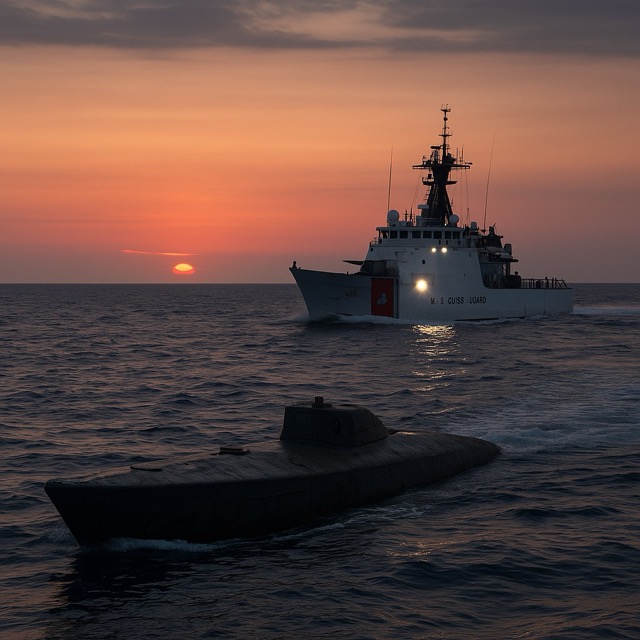
The strike occurred Thursday in the southern Caribbean, according to U.S. officials, when aircraft tracked and then targeted a low‑profile vessel that U.S. intelligence believed was ferrying fentanyl and other illicit narcotics toward the hemisphere’s northbound trafficking routes. Two of the four people on board were killed; the other two were rescued by U.S. forces and moved to a Navy ship before transfer, officials said. The White House decision means the men will be handed to authorities in Quito and Bogotá for detention and prosecution rather than kept by the United States under any law‑of‑war framework.
Trump revealed the plan in a social‑media post and later in brief remarks to reporters, pairing the announcement with a video clip that he said showed the vessel moments before the strike. “Under my watch, the United States will not tolerate narcoterrorists trafficking illegal drugs, by land or by sea,” he said. Officials did not present physical evidence of fentanyl aboard the craft but said the target fit the profile of the “narco‑subs” that have become increasingly common between the Pacific and Caribbean littorals.
The Pentagon has acknowledged at least six lethal strikes on alleged trafficking boats since early September, part of stepped‑up interdiction missions in the Caribbean Sea and adjacent waters. With Thursday’s attack, the confirmed death toll from those operations rose to at least 29, according to public statements by U.S. and regional authorities. The latest strike unfolded in international waters near the coast of Venezuela, a transit corridor that Washington says has seen a surge in maritime smuggling as cartels diversify routes and cargoes.
Authorities in Colombia and Ecuador said they have been in contact with U.S. counterparts about the return of their nationals. Colombia’s President Gustavo Petro confirmed that the Colombian survivor would face prosecution upon arrival, while Ecuadorian officials said their courts would evaluate charges under national anti‑narcotics statutes. Neither government publicly disputed Washington’s account that the boat was engaged in drug trafficking, though both asked the United States to share intelligence used to justify the strike.
The administration’s handling of the survivors is as notable as the strike itself. In previous maritime interdictions that ended with deaths at sea, survivors were often prosecuted in U.S. courts under drug‑smuggling statutes or transferred to partner nations via law‑enforcement channels. This time, senior officials framed the transfers as repatriations in an “armed conflict” against transnational cartels—a formulation that has opened new legal and political fault lines in Washington and regionally.
“This is not primarily a law‑enforcement challenge,” a senior U.S. official said, insisting that cartels’ scale, weaponry and alliances with foreign actors elevate them to the level of “narcoterrorist organizations.” That designation, the official argued, permits U.S. military action in self‑defense and collective defense, including strikes on vessels deemed to pose a persistent threat to Americans. The official declined to provide the intelligence that triggered Thursday’s strike, citing operational security.
Legal scholars counter that the administration is stretching authorities designed for wartime enemies to reach criminal syndicates that—however violent—are not belligerent states or non‑state actors in an armed conflict against the United States. They note that Congress has not authorized hostilities against cartels and warn that recasting counternarcotics as counterterrorism risks bypassing judicial oversight that typically governs searches, seizures and use of force outside declared battlefields.
“There’s a profound difference between interdiction and conduct of hostilities,” said a former Pentagon lawyer who served in multiple administrations. “If the facts are as the administration describes, the United States still bears the burden of showing necessity and proportionality under international law, and of explaining where the armed‑conflict paradigm begins and ends.”
The operational picture is complex. Semi‑submersibles—fiberglass or metal craft that ride just below the surface to avoid radar and visual detection—have proliferated over the past two decades, especially along the Pacific coast of Colombia, Ecuador and Central America. U.S. and regional navies regularly interdict such vessels, often finding multi‑ton loads of cocaine bound for Central American waypoints and, ultimately, the U.S. and European markets. Officials say newer designs are more modular and disposable, with crews trained to scuttle the craft quickly to destroy evidence.
What made Thursday’s target stand out, U.S. officials say, was intelligence suggesting the cargo was primarily fentanyl, the synthetic opioid that has driven a surge in overdose deaths in the United States. Maritime fentanyl shipments are harder to detect than cocaine because the drug’s potency allows smugglers to move smaller quantities that are easier to hide, according to law‑enforcement officials. If confirmed, the shipment would illustrate cartels’ experimentation with maritime corridors traditionally dominated by cocaine flows.
The strike also played into a wider geopolitical standoff. The Trump administration has accused Venezuela’s government of tolerating or collaborating with trafficking networks that use its coastline and exclusive economic zone as staging grounds. Caracas denies the allegation and has condemned what it calls U.S. “acts of aggression” in international waters near its shores. Venezuelan officials said they have asked the United Nations Security Council to examine the legality of U.S. operations, contending that they risk miscalculation and escalation in a region already riven by political tensions.
On Capitol Hill, reaction broke along familiar lines. Republican allies praised the strike and the repatriations as decisive steps against cartels and a demonstration of maritime dominance. Several Democrats sought classified briefings on the legal basis for employing lethal force at sea absent a specific congressional authorization, pressing the administration to clarify how targets are nominated and what safeguards exist to minimize civilian harm and mistaken identities.
Human‑rights organizations, meanwhile, urged transparency. “The government should release the evidence that justified this strike and explain the status and rights of the survivors,” said the director of a Washington‑based watchdog. The groups also questioned whether sending the men to their home countries, rather than to U.S. courts, was designed to avoid legal tests that could constrain future operations.
In Ecuador and Colombia, officials walked a careful line—asserting sovereignty over prosecutions while welcoming intelligence shared by the United States. Both countries have seen domestic turmoil and political pressure stemming from cartel violence and prison uprisings, with leaders pledging tougher measures against organized crime. Analysts said accepting the suspects could bolster cross‑border cooperation even as it exposes Quito and Bogotá to complicated cases reliant on U.S. evidence gathered in military operations at sea.
For now, the administration appears intent on signaling that Thursday’s strike is part of a sustained maritime campaign, not a one‑off interdiction. Officials said U.S. assets—including warships, maritime patrol aircraft and drones—will continue patrolling suspected trafficking routes across the Caribbean and Atlantic approaches, in coordination with regional partners. “We are applying pressure at sea to disrupt networks before their product reaches our communities,” one official said.
Whether the approach is sustainable may hinge on outcomes still to come: proof that fentanyl was aboard the destroyed craft, successful prosecutions in Ecuador and Colombia, and a legal theory that can withstand domestic and international scrutiny. As the survivors head home into the custody of their governments, the United States is betting that repatriation—rather than U.S. detention—will keep the focus on cartels’ alleged criminality and away from the contested boundaries of a new kind of war.


 The Tower Post